Wednesday, May 24, 2006

Kchibo JX-M14 review


Small Radio With Features

This is an attractive little package with good sensitivity as well as good sound, especially for voice reception. Along with AM (MW) and FM, it has 7 shortwave bands. All buttons are raised. Its heavy duty telescopic antenna pivots.

The easy-to-read LCD display is digital, but it has knob tuning. The frequency readout is accurate, according to several known stations I'd checked on several bands. Apparently the display is that of a true frequency counter.

It has a 12-hour a.m./p.m. clock with an alarm. Its three LEDs are for Tune, AM (MW and SW), and FM. On its back is a flip out easel and the serial number.

It has a jack for earphones. (Earbuds are not supplied.) Although the jack's audio output on FM is monaural, it is dual (split) in all modes. To make sure, I compared it with the stereo FM output of my eTraveller VII. I tuned both radios to one of my area's two classical FM stations. While a symphony was being played, I switched my stereo headphones between the two.

The power supply is two AA cells. It has a jack for an external 3 volt source. (AA cells and wall adapter are not supplied.)

There is enough extension past each end of the advertised SW bands to cover the daytime and some nighttime U.S. frequencies, but there is no coverage at all for some of the nighttime ones. Although there are slight differences for a given radio, the actual band stop-to-stop coverage of mine is:

Bands
SW1 5.84 --- 6.47 MHz
SW2 6.86 --- 7.56 MHz
SW3 9.29 - 10.30 MHz
SW4 11.38 - 12.50 MHz
SW5 13.34 - 14.35 MHz
SW6 14.78 - 15.84 MHz
SW7 17.11 - 18.33 MHz
AM 518 - 1723 kHz
FM 87.9 - 107.9 MHz

Shortcomings
There are a couple of little shortcomings. One is when two stations of unequal signal strength are within 15 to 20 kHz of each other, the stronger station wins. The reason is that the stronger station will "pull" the receiver's local oscillator. This is due to the lack of a tunable input where the real selectivity of a receiver begins. I learned of this when I tried to receive a good signal on 12.172 MHz. I'd tune in to it but a louder 12.160 signal would pull it off. (I settled for a good, clear simulcast on 9.330.)

This problem created a phenomenon, too. When I tuned in WWV's 10.00 MHz time signal, during when third world stations were transmitting on or just below that frequency, the display would read 10.01 MHz.

The other shortcoming is that I noticed the clock seemed to have lost about a minute within a week or two. I'll take another look at that. (This, of course, will affect its alarm clock feature, too.) My advice, if that happens in any unit, is to reset the time once a week, and set it ahead enough, so station
sign-ons won't be missed during the week.

One little nuisance is that it defaults to FM at turn on. That's not a problem, though, because it remembers the last FM, AM, or SW frequency selected. Just push the AM button to get back to your chosen SW frequency, for example.

This would make a fine, inexpensive gift for anyone who is really interested in knowing what's going on in the world, or to enlighten those who should -- or think they do. They should, though, also be given some SWL introductory material as well as help in identifying, even finding, major SW stations (guides, schedules, Web links, etc.)

The jWIN is about the size of a paperback book, but a little shorter. My bulky wallet is almost as big. When it's not in use, I keep it and its paperwork in a ZipLoc sandwich bag.

I purchased my jWIN from Johnson Smith Co. Click on Electronics and look for the Mini 9 Band Radio. This place has the best price. And its service is good. I've bought a variety of things from them.

Note: For my grandson and a girl next door, I ordered two jWINs, S/Ns 030404343 and 030404379. Their performance was like mine, i.e., as above.

Friday, May 19, 2006

WELCOME TO THE SECOND NATIONAL INDIAN DX MEETING

WELCOME TO THE SECOND NATIONAL INDIAN DX MEETING

The DX clubs of Tamil Nadu, India are pleased to welcome DXers from all over Tamil Nadu, the India and worldwide to the 2nd National DX
Meeting "All India Radio and International Radio Listeners Meet 2006," which will take place May 21 in the city of Jeyankondam, state of Tamil Nadu, India. Delegates from SLBC, Radio Veritas, Radio Vatican, China Radio International and All India Radio were also going to participate.

CRI History Quiz 2006


China Radio International new Quiz Questions.
Last date 1 September 2006.

For more details visit http://www.chinaradionet.net/cri200605/quiz.aspx
Or
For anwers and details
www.dxersguide.blogspot.com

1. Who was the first radio broadcaster in the history of China's overseas broadcasts?
2. What was the station ID for China's overseas broadcasts in April, 1950?
3. How many foreign bureaus does CRI have around the world?
4. Question Number Two: How many languages does CRI broadcast worldwide?
5. The first question is : In which country did CRI launch its first overseas FM radio station?
6. What is the name of the website run by CRI?
7. Thus far, how many listeners' clubs does CRI have worldwide?
8. How many letters did CRI receive from its listeners in 2005?

++++++++++++++++++++++++++++++++

For the answers read the following articles.

Part 1

Hello everyone, I'm Wang Jing. Today we will launch a listeners’ quiz called “Get to Know CRI”. The quiz consists of four parts about CRI’s history and current events. At the beginning of each part, we will present you with simple questions whose answers can be found in the program. All listeners are invited to join in, and the first-prize winner will win a 7-day trip to China at the end of this year. To take part, send us your answers via email at crieng@crifm.com or yinglian@cri.com.cn or log onto our website at www.crienglish.com. Today is the first part, and our first subject is the launch of China Radio International.

Before we start our program, here are the first two quiz questions. Listen carefully. The first question is: who was the first radio broadcaster in the history of China’s overseas broadcasts. And question number two: what was the station ID for China’s overseas broadcasts in April, 1950.

In the early 1940s, China was fighting against the Japanese invasion. CRI was founded on December 3, 1941 to call on people from home and abroad to join in the fight. At that time its station ID was XNCR, representing New China Radio.

Its first radio broadcaster was Hara Kiyoshi, a Japanese anti-war activist. She broadcast in her mother tongue, telling Japanese people the truth about the war.

When the People’s Republic of China was founded in 1949, the radio station moved to Beijing, the capital of China. On October 1st, 1949, the station broadcast the news of the founding of the People’s Republic of China to the whole world.

And then in April, 1950, China’s overseas broadcasts began to use the station ID - Radio Peking.

This music was a very popular song in China at the time: “The East is Red”.

Later, in order to promote friendship between China and other developing countries, China’s overseas broadcasts opened Farsi, Kiswahili, and Arabic services.

By the mid 1970s, CRI was broadcasting in 38 foreign languages as well as Mandarin and 4 Chinese dialects

Now I’ll repeat today’s questions: who was the first radio broadcaster in the history of China’s overseas broadcasts? and what was the station ID for China’s overseas broadcasts in April, 1950?

++++++++++++++++++++

Part 2

Hello and welcome to today’s “Get to Know CRI” quiz. I’m Wang Jing. In this edition, we will ask you two simple questions about China Radio International, their answers are right here in our program. One lucky winner will get a 7-day trip to China at the end of this year. To take part, send us your answers via email at crieng@crifm.com or log onto our website at www.crienglish.com. Today is the second part of the quiz, and our subject is CRI in Development.

Before we start our program, here are the two quiz questions. Listen carefully. The first question is: How many foreign bureaus does CRI have around the world? And Question Number Two: How many languages does CRI broadcast worldwide?

In 1980, CRI began to set up foreign bureaus to cover news events taking place abroad. The first two were in Tokyo and Belgrade.

So far CRI has 27 foreign bureaus all over the world. When any breaking news happens in the world, CRI correspondents can send back first-hand reports. And with the development of CRI’s broadcast service, it currently uses 43 languages every day to broadcast all over the world.

After China’s reform and opening up, more and more foreigners have come to China for work, study, travel or business. In order to provide them with a better understanding of China, in 1984 CRI began offering domestic service in English in Beijing.

In 1998, CRI began its online broadcasting service by setting up a multi-language website: CRI Online. The website has audio programs in 48 languages, including standard Chinese and four Chinese dialects, and has become quite famous at home and abroad.

Now I’ll repeat today’s questions: The first question is: How many foreign bureaus does CRI have around the world? And Question Number Two: How many languages does CRI broadcast worldwide?

++++++++++++++

Part 3

Hello and welcome to today’s “Get to Know CRI” quiz. I’m Wang Jing. In this edition, we will ask you two simple questions about China Radio International, and the answers are right here in our program! The first-prize winner will get a 7-day free trip to China at the end of this year. To take part in this activity, send us your answers via email at crieng@crifm.com or log onto our website at www.crienglish.com. Today is the third part of the quiz.

Before we start our program, here are the two quiz questions. Listen carefully. The first question is: In which country did CRI launch its first overseas FM radio station? Question number two: What is the name of the website run by CRI?

China Radio International, China's only radio station with international service, launched an FM radio station in Nairobi, Kenya on February 27th this year.

Kenya 91.9 FM radio station is the first overseas FM radio station set up by CRI.

Its programs cover China's economic, social and cultural development, as well as the country's friendly exchanges with African countries. Major international news events also get extensive coverage.

Listeners in Kenya can enjoy music from China, Africa and the rest of the world.

In the next five years, CRI plans to establish abroad 100 FM and MW radio stations so as to reach more audiences.

In addition, CRI has also launched its own website “CRI Online.” By logging onto the website, people can listen to our latest programs any time anywhere. Currently, CRI Online updates about 210 hours of audio programs every day, covering news, sports, life, music and many other interesting stories about China.

Meanwhile, CRI produces about 5 hours of TV programs on world news everyday, transmitting to over 300 local channels in the country by satellite.

Now I’ll repeat today’s questions: The first question is: In which country did CRI launch its first overseas FM radio station? And question number two: What is the name of the website run by CRI?

++++++++++++++++++++

Part 4

Hello and welcome to the final edition of our “Get to Know CRI” quiz. I’m Wang Jing. In this edition, we will ask you two simple questions about China Radio International, and the answers will be right here in our program! There will be prizes for correct answers, with one lucky listener winning a chance to visit China for free at the end of this year. To take part, send your answers to us by emailing crieng@crifm.com or you can log onto our website at www.crienglish.com. Today is the last part of the quiz, and the subject is CRI’s relationship with its listeners.

Before we start our program, here are the two quiz questions. Listen carefully. The first question is: Thus far, how many listeners' clubs does CRI have worldwide? And question number two: How many letters did CRI receive from its listeners in 2005?

Ever since its founding 65 years ago, the number of listeners of China Radio International continues to increase. So far, CRI has 3,600 listeners’ clubs all over the world. Every year, various activities are organized between CRI and its listeners’ clubs. In the year 2005, letters from listeners increased to over 2.17 million.

Many of CRI’s listeners have developed a deep affection for China through many years of listening to its programs. Indrananda Abeysekara from Sri Lanka is one of them.
Recently, he submitted an application to eventually donate his cornea to a Chinese person.

“I am a loyal listener of CRI. By listening to its programs, I got to understand China and develop an affection towards it.”

Due to efforts from this listener, Changsha, the capital city of central China’s Hunan province, and Kaludara, of Sri Lanka, have become friendly cities.

Now I'll repeat today's questions: The first question is: Thus far, how many listeners’ clubs does CRI have worldwide? And question number two: How many letters did CRI receive from its listeners in 2005?

Please send us your answers by emailing crieng@crifm.com or logging onto our website at www.crienglish.com. Thanks for listening!
Saturday, May 06, 2006

BBC Tamilosai special coverage of Tamil Nadu election results


BBC Tamil service has planned extra transmissions on Thursday, May 11 and Friday, May 12 to provide extensive coverage of Tamil Nadu assembly election results.

The plans include a special 15 minute transmission between 06.30 and 06.45 GMT (12 noon to 12.15 Indian Standard Time) on Thursday, May 11. This special programme will be broadcast on shortwave frequencies 13685kHz (Meterband 22), 11825kHz (Meterband 25) and 17810kHz (Meterband 16).

In addition to this special transmission, BBC Tamil is also extending the regular transmission to 45 minutes on May 11 and 12. These extended transmissions will be between 15.45 and 16.30 GMT (21.15 and 22.00 Indian Standard Time) on May 11 and 12 and will be on the regular shortwave frequencies of 31, 41 and 49.

The BBC Tamil service has been covering this election extensively through special reporting from its India-based correspondents, supplementing these with special interviews from its London-based team of producers. These packages are available on its website, bbctamil.com


For more information contact:

Thirumalai Manivannan, Head, BBC Tamil +44 (0) 20 7240 3456; thirumalai.manivannan@bbc.co.uk
Lala Najafova, International Publicist, BBC World Service +44(0)207 557 2944; lala.najafova@bbc.co.uk

Notes to Readers:

BBC Tamil service offers daily a daily programme of news, current affairs and features broadcast at 1545-1615 GMT (2115 - 2145 Indian Standard Time and Sri Lanka time). BBC Tamil provides an essential global insight to over 2.2 million listeners in Sri Lanka, Tamil Nadu in India, and across the world. BBC Tamil is broadcast across Sri Lanka on FM via partner station SLBC and via shortwave. BBC Tamil service’s popular website, bbctamil.com is accessed by Tamil-speakers across the world.

Thursday, May 04, 2006

Wave Guide Feb-Mar 2006

WAVE GUIDE
Compiled by T.R.Rajeesh


Feb-Mar 2006 Vol. 2, No 2
For Private Circulation Only


Hello Dxers,

This is the second edition of Wave guide and am surprised by the inquiries about the availability of this publication from Dxers. Actually this is only a publication meant for private circulation, and compilation depends on the availability of my free time. As for printed copy postage and photocopying charges required in advance in the form of postage stamps.

This edition includes the new frequency schedules for A 06 period as well as feature article on Radio broadcasting in Greenland, Station profile of Radio Nepal and a review on the end of shortwave broadcasting by HCJB Ecuador.

Please let me know your opinion, suggestions and criticisms to improve the quality of this DX guide.

73

Rajeesh, VU3 PIK

DX News

Afghanistan: Radio Afghanistan Kabul reported to be testing with a new 100 KW shortwave transmitter supplied by India from Yakatut transmitter site. On Feb 22nd Dxer Mauno Ritollo in Finland heard they testing on 9345 kHz around 1130 UTC with “Good morning Afghanistan” programme.

Australia: ABC Tennant Creek is finally back on air again heard at 2240 UTC on 4910 kHz.

Denmark: Danish SW Clubs international is celebrating their 50th anniversary. Radio Japan will air first special broadcast with an interview by DSWCI Chairman Anker Petersen on their World Interactive programme broadcast on 6-8 May and a second special show on JSWC DX Segment on 27-29 May. DSWCI will issue special QSL for report on these broadcasts, but return postage is necessary in the form of 1 IRC or 1 US $. Address your reports to: Anker Petersen, Udbyvej 11, DK- 2740 Skovulnde, Denmark.

Ecuador: HCJB Ecuador, Voice of the Andes is approaching end of an era. HCJB started dismantling their shortwave transmitters located at pifo. Future of all their English transmissions including the ever-famous DX Partyline recorded at pifo studio is uncertain at the moment. HCJB announced no plans so far to continue the DX Partyline from Voice of the Great South Land in Australia.

Iceland: According to a press release issued by U.S deputy Secretary of State Mr. Nicholas Burns, U.S Air Force Units that have been on Keflavick Air Base since 1941,may leave Iceland by September this year. AFRTS shortwave Relay station located at Keflavick may also be dismantled by September. So don’t miss your chance to verify AFRTS Iceland before they go off the air.

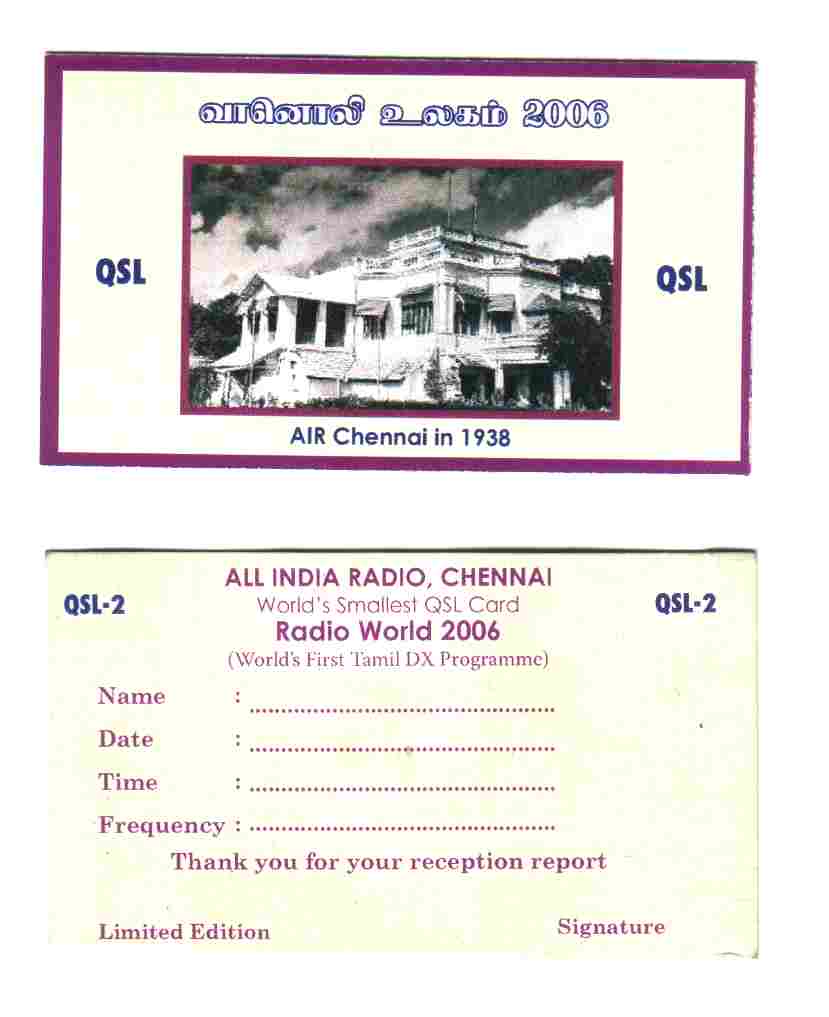
India: All India Radio Chennai now airs the worlds first Tamil DX Program “Vanoli Ulagaam”{Radio World) on Sundays 1135 UTC on 17810,15770,15050,13710,1053 kHz. The program host Mr T. Jaisakthi Vel informs that they will issue the worlds smallest QSL Card for reception reports on their broadcast. Reports shall be mailed with Rs.10 postage stamp/1 IRC to: Vanoli Ulagaam, Thirukadal Kadannu Varum Tamizah Natham,All India Radio Chennai, Kamarajar Salai, Chennai-600004, INDIA.

Kirgizstan: Kirghiz Radio with English news broadcast can be heard from 0110-0120 UTC on 4010,4795 kHz. Full data Verification letters caqn be obtained fromKirghiz Radio, 59 Jash Gvardiya Boulevard, Bishkek 10, Kirghiztan. E-mail reports may be sent to: snbckr@hotmail.com, hofnung.lena@mail.ru .

Yemen: Radio Sana’a is noted on a frequency 6005 kHz from 2000-2200 UTC parallel to 9780 kHz.

QSL Corner

Brazil: Radio Cancoa Nova, 9675 kHz verified with a full data hand written QSL Card and letter in portugese for a printed reception report and 1 IRC in 197 days. I also received interesting Radio cancanova Folder and Car Sticker with nice Brasilian stamps on the large envelope. V/S Alem Frointeiras

Diego Garcia: AFRTS Diego Garcia confirmed my e-mail report with an E-QSL by Bennet G. Marshall, Chief Technician IC (2), stating the listened frequency 4319.

Guam: AWR, 12065 kHz, verified with a full data QSL fro USA office by Adrian Petersen in 30 days.

Japan: Radio Nikkei, 3925 kHz, verified with a full data drawing card in 24 days for a printed repot.

Tanzania: Radio Tanzania Dar es Salaam, 5050 kHz, full data verification card in 32 days for 1 IRC and 10 Rs as return postage. My earlier 4 reports to Radio Tanzania had gone unanswered. V/S Ndaro Nyamwocha

Radio Nepal

Introduction

The Kingdom of Nepal is a land-locked Asian country in the Himalayan Mountain range. It is bounded on the north by Tibet, on the east and west by India. Nepal is one of the poorest countries with very low per capita income and GDP.The capital of Nepal is Kathmandu and their official currency is Nepalese Rupee. Nepal is also the world’s only county with Hinduism as its official religion. The democracy in this little Himalayan country has always been in threat due to internal violence.

Radio Broadcasting

Radio broadcasting is the cheapest and quickest means of mass communications in Nepal. In a mountainous country like Nepal, radio broadcasting has proved to be a very effective medium in disseminating information, educating people and entertaining the masses. It has been providing various programmes aimed at creating mass awareness. The people in the hilly areas and many of the remote villages have no access to motorable roads or to any communication and entertainment facilities. Illiteracy being a common feature among the people, little use is made of the newspapers, which have very limited and delayed circulation. Therefore, Radio has been the most suitable means of disseminating information and providing entertainment to masses in Nepal.

Radio Nepal was established on 1 April 1951. Initially the transmission covered duration of 4.5 hours through a 250-watt transmitter. Over the years, Radio Nepal has strengthened its institutional capacity and diversified itself in terms of programme format, technical efficiency and nationwide coverage.

Studio Facilities

Radio Nepal has its own studios for programme production, music recording, talk shows and news broadcasts. A music library at its premises in Singh Durbar has a collection of about 15,000 songs. Foreign broadcasting Stations also make use of their Studio facilities and transmitters for live and other broadcasts on a rental basis.

The Broadcasting Headquarters at Singha Durbar in Kathmandu has two broad casting houses consisting of one drama studio, two music studios, one reporting studio, three continuity studios, the news studio, seven programme production studios. One of the music studios is equipped with sophisticated 24 track recording facility. This studio is open for hiring purposes for anyone desirous of recording music digitally whether solo track or for albums after payment of studio charges that are very reasonable compared to other private studios. The complex also has one open air live concert facility for functions and musical performances. Like other transmitting stations, the Head quarters also has a 100kva stand by diesel generator.

Programmes
Radio Nepal transmits 15 hours everyday, which includes 2 hours of regional broadcasts 0415 hrs to 0545 hrs UTC in the morning and 1250 hrs to 1315 hrs UTC in the evening. However on public holidays, there is an additional 2 hours, extending the total duration to 17 hours.

Radio Nepal broadcasts news bulletins in Nepali at regular intervals (hourly) from 0115 hrs until the close of the transmission. News bulletins in English are broadcast at 0215, 0815 and 1415 hrs UTC everyday. In additional to the news in Nepali and English, there are bulletins in other languages at various timings.

Radio Nepal attempts to provide prompt and accurate coverage of all national and international news including political, economic and social highlights in an unbiased and objective manner. It attempts to safeguard the basic principle of public interest as the prime public broadcaster of the country. The station also has stringer reporters in several districts for coverage of news and information indifferent regions of the country.

Transmission Facilities
Radio Nepal broadcast programs on Short wave, Medium wave and FM. They have a number of 100 KW and 10 KW medium wave transmitters located at various parts of the country. An FM-Channel covering Kathmandu valley and adjoining areas was started in 1995.
Short Wave: Three transmitters of 100 KW each enable transmission on two frequencies simultaneously. The Khumaltar transmitting station has three 100 KW transmitters as well as a 250 kva diesel generator to cope with power cuts. The Katmandu Transmitting Station at Sainbu, Bhaisepati has one 100 KW main transmitter in addition to a 10 KW stand by transmitter. There is also a provision for at 100-kva-diesel generator.

Broadcast Frequencies: 5005 kHz, 7165 kHz-now inactive (Winter) 3230 kHz (Summer)

Verifications
Radio Nepal broadcasts news in English at 0215, 0815 and 1415 UTC and it can be logged easily through out Asia. DX Reception is also possible in distant locations since they use 100 kW SW transmitters.

Radio Nepal doesn’t have an external service however they verifies reception reports on an irregular basis with colourful QSLs. Dxers consider them as very precious and exotic. Most Radio Nepal verification cards depict beautiful Himalayan Peaks or Sceneries. As Radio Nepal is in a very difficult financial situation return postage is necessary for verifications and the listener should be patient for years to receive a reply! Reception Reports could be mailed to: Mr.R.S.Kharki, Chief Engineer, Radio Nepal, P.O.Box-634, Kathmandu, Nepal.


IBB BOTSWANA

History
The station in Botswana began its operation in 1981, with 50kW transmitter in Selebi-Phikwe that was later handed over to R Botswana. Our station presently operates a 500kW transmitter which is fixed at 909kHz AM, and four 100kW short wave transmitters to transmit in English, Amharic, Swahili, Portuguese, Hausa, Shona, Ndebele and French. All VOA programs originate from studios in Washington D.C., and are delivered to the station for broadcast via satellite.

Facilities
Our SW site can be identified by six towers from the main road. The complex consists of the Admin Office, a Transmitter Building and Facilities Offices. Additionally, the station’s satellite terminal equipment is located here. The medium wave site can be identified by four towers from the main road and consists of a Transmitter Plant building and Facilities. Both stations are equipped with emergency generators capable of maintaining operations incase of commercial power failure.

Staffing
The station is managed by two American Foreign Service Officers (Manager – Mr. William Martin and Transmitter Plant Supervisor – Mr. Thomas Powell). There are currently 25 fulltime local employees, who fall under three units: Administration, Transmitter Plant and Facilities. There is also a contract staff of approximately 22 employees, who provide daily support of gardening, janitorial, chauffeur, and facilities maintenance service. Address: International Broadcasting Bureau, Private Bag 0038, Selebi-Phikwe, Botswana. E-mail: manager_Botswana@bot.ibb.gov

Editorial Information-------------------------
Contact:T.R.Rajeesh,Thandiakkal House, Chevoor-P.O, Thrissur-680027, Kerala, INDIA
E-mail: rajeeshdxer@yahoo.co.in

Courtesy to: Alokesh Gupta, Swopan Chakroborty and World DX Club.

Thursday, April 27, 2006

POST CARD WITH AD OF BBC HINDI


Recently India Post released a meghdoot post card with advertisement
of British Broadcasting Corp, Hindi service. Have a look at :
http://www.geocities.com/alokeshgupta/bbc_hindi_pc.jpg

Background : India Post introduced Meghdoot Post Card on September 2,
2002. Meghdoot is priced at 25 paise that is half the cost of the
regular post card. The writing space available on the address side of
the regular post card is made available for advertising in multicolor
in case of Meghdoot. The rate of the advertisement is Rs. 2 per card
and the minimum order for print is 100,000 cards. Meghdoot is printed
by Security Printing Press at Hyderabad in sheets of 8 cards, although
some have been supplied to post offices by the press in sheets of 4
and pairs of 2 cards.

Being a postal stationery article with an advertisement, its area of
distribution is determined by the advertiser, as its design and copy.
In addition to the post offices in the area of its distribution the
Meghdoot is also made available in limited quantity of 2000 cards at
select 8 philatelic bureaus that handle postal stationery, namely
Ahmedabad, Bangalore, Chennai, Delhi, Hyderabad, Kolkata, Lucknow, and
Mumbai (Alokesh Gupta, New Delhi, India, radiostamps yg via DXLD)

Saturday, April 22, 2006

AIR CHENNAI CELEBRATE THE MARCONI’S BIRTH DAY


Dear DXers, World`s First Tamil language DX program `Vaanoli Ulagam`
(Radio World) going to celebrate the Marconi`s Birth Day. For that
purpose, they are going to broadcast a special program on 23-04-2006
(Sunday). On that day program Marconi, voice cuts will be broadcast
in English. So do not miss the program.

Those who are want to get the special limited edition World Smallest
QSL card (6x3.5CM), send your Reception Report with 1 New IRC to the
following address.

N. C. Gnanaprakasam,
Vanoli Ulagam
Thiraikadal Adaivaram Thamiizh Naatham
All India Radio
Kamarajar Salai
Chennai 600004
Tamilnadu, India

The schedule of the Tamil DX Program `Vaanoli Ulagam`
(Radio World) is as follows:

Sundays between 1115-1215 UT (for about 10 minutes)

To Sri Lanka:
1053 kHz Tuticorin
15260 & 17860 Delhi (Kingsway)
15050 Delhi (Khampur)

To SE Asia:
13710 Bangalore
15770 Aligarh
17810 Panaji (Ardic DX Club, Chennai, India,
http://www.dxersguide.blogspot.com DX LISTENING DIGEST)

Monday, April 17, 2006

Amateur radio operators meet

Fifteen months after their heroic exploits in the aftermath of the tsunami that claimed several hundred lives and wreaked unprecedented havoc in the Andaman and Nicobar Islands, a team of amateur radio operators is back in Port Blair.

Recognising the critical role played by the Hams in the emergency communication between Port Blair and the mainland after the earthquake-triggered tidal waves hit the islands, the government has agreed to sponsor the "Hamfest (VU4) India 2006" from April 18 to 20.

The ministries of information technology and tourism are sponsoring the festival along with the Andaman and Nicobar administration. Lieutenant-governor Ram Kapse will inaugurate the event, which is also supported by ministries of defence, home affairs and human resources development.

The chairman of the Hyderabad-based National Institute of Amateur Radio, Mr S. Suri, said the members of the "Dx-pedition" in Port Blair in December 2004 mobilised their resources to provide humanitarian service to support essential rescue and relief operations. "[Since then] several requests were forwarded to NIAR from international amateur radio organisations, ‘Dx’ forums and individual Hams to organise a suitable event in a befitting manner to highlight the benefits of amateur radio for social and scientific development," he said.

"The services of these amateur radio operators were appreciated by several agencies at home and abroad," Mr Suri added. "The conference will serve as a forum for presentation and discussion on emergency communication and latest technological developments in amateur radio."

A participant, Bharathi Prasad, told this newspaper from Port Blair that about 38 Hams from Italy, Germany, Japan, the United States, Poland and France are participating besides 60 Hams from India. She says one of the several objectives of the festival will be to promote tourism. Ms Prasad and four others, including her husband and son, were in Port Blair when the tsunami struck.

Author: Ramesh Ramachandran
Source: The Asian Age.

FM radio broadcasters have opposed the satellite radio company WorldSpace’s proposal to offer terrestrial radio broadcast. They have written to the mi

FM radio broadcasters have opposed the satellite radio company WorldSpace’s proposal to offer terrestrial radio broadcast. They have written to the ministry of information and broadcasting against issuing ‘terrestrial repeater’ licence to WorldSpace.

A terrestrial repeater will enable WorldSpace to provide its broadcast in cars, directly impacting the business model of FM radio operators. Satellite radio, on the other hand, beams signals directly to home via satellites.
Currently, there are no guidelines for regulating satellite radio in India, while FM radio is highly regulated and has gradually opened up after suffering heavy losses under the licence fee regime.

The Association of Radio Operators of India (AROI) in its letter said, “We fail to understand why government of India is working on WorldSpace application, even when proper guidelines on satellite radio are still not available.”

According to sources, WorldSpace moved its application for terrestrial repeater in one month. “It is trying to get licence for L-Band terrestrial repeater (1452; 1492 MHz) ) from I&B ministry,” sources said.

Once the licence is provided, WorldSpace will beam its radio stations including news, sports and music stations directly to listeners in cars, thereby making FM radio non-viable. Registering protest, Rajiv Mishra, coordinator, AROI and CEO of Radio Masti said FM Radio in India is in its nascent stage and the broadcasters had paid exorbitant one-time-entry fee. “Government will have to protect FM radio industry for at least next 10 years. The ministry is already making plans to welcome new players into the terrestrial radio arena, directly threatening the existence of the FM radio licencees. This is not acceptable,” he said.

Expressing concern, the Telecom Regulatory Authority of India in its consultation paper said, “Absence of a licensing policy causes several problems, including absence of a ‘level playing field’ with respect to FM operators, regulatory uncertainty on the part of the existing and potential satellite radio operators and haphazard development of this important industry.”

http://www.financialexpress.com/fe_full_story.php?content_id=123662

Tuesday, April 11, 2006

The latest cause celebre: Community Radio

The latest cause celebre
BY SEVANTI NINAN
'Media Matters', Apr 09, 2006

FOR more than a decade some of us have been pleading the cause of
community radio, lobbying for a policy that gives licences to local groups
to run their own radio stations. All these years neither the media at
large nor bloggers nor civil society have shown the slightest interest in
the subject. It simply never caught on as an idea. Without any public
demand, the government has dragged its feet, coming up with a policy
only designed to hamstring the whole effort.

But six weeks ago somebody discovered that a little guy in Bihar has
been running a radio station out of a village in Vaishali district and
poof! You had an instant cause celebre. It was illegal but so what? The
poor fellow did not even know it was illegal. Such enterprise in rural
Bihar! The blogosphere was ecstatic. "Raghav FM Mansoorpur 1 rocks."
Everybody copied the story off the BBC site, photographs and all. CNN-IBN
picked it up. The Times of India wrote about it. A blogger in Canada
celebrated the idea. Google sprouted many pages on the subject as all
kinds of bloggers got into the act. Widespread ignorance on the policy in
this matter only served to whip up a huge romanticisation of Radio
Raghav FM Mansoorpur 1. The story acquired a life of its own.

SENSATIONAL STORY

Admittedly it was a wonderful story. The creator of this FM station,
Raghav Mahato, was a mechanic in a village repair shop which didn't even
have a pucca roof. In 2003 he created a radio transmitter out of
locally made battery-powered tape recorders, some wires and a cordless
microphone. He hooked the transmitter to an antenna atop a bamboo pole on the
third floor of a hospital. His buddy Sambhu was the radio jockey.
"Namaskaar, main apka dost Sambhu. Aap sun rahe hain, FM Mansoorpur 1"
(Namaskar I am your friend Sambhu. You are listening to FM Mansoorpur 1).
They played Bhojpuri, Bollywood and devotional songs over this FM
transmission and delivered messages on AIDS. That made Mahato an instant good
guy for the media.

The first story said he earned Rs. 2,000 a month from his venture.
Since the BBC reporter had been there and taken pictures, his story was
possibly the most accurate. He said Mahato earned Rs. 2,000 as a
electronic repair mechanic and ran the radio for free. There was no mention
initially about his schooling but as the story got romanticised he became
"an illiterate mechanic". Then he became "an electronic whiz". The most
saleable detail was the station's cost: Rs. 50. It instantly became
known as the one-dollar radio station. And thereafter, as "the world's
cheapest radio".

The very first story, on bhojpuria.com, had drawn, amidst a lot of
gush, a single dry comment from a Prasar Bharati executive pointing out
that the station was illegal and punishable with imprisonment. It did not
dampen anyone's ardour. As the story flew around cyberspace, more
journalists discovered Radio Raghav, and the story grew bigger. What was the
range of his transmitter? The first story said 15 km. The BBC website
said 20 km. Then it was "hundreds of villages" and "thousands of
people". Hundreds of villages in a 15 km radius? Raghav's fame, you were told,
had spread to neighbouring districts. Strange then that the District
Magistrate of Vaishali only heard of this three-year-old radio station
when the Information and Broadcasting Ministry in Delhi informed him that
there was an illegal radio station running in his district.

THE AFTERMATH

Five weeks after the story broke, nemesis dawned. Government officials
swooped down upon FM Mansoorpur 1, seized its equipment and lodged an
FIR against its owner for violating the Telegraph Act. Talk of
unintended media power! That triggered another torrent of headlines. In Delhi
Sagarika Ghose railed against the closure on CNN-IBN. The channel's
reporter said, "CNN-IBN was the first to report when the station was set up
with an investment of just Rs. 50 rupees." That's a bit rich
considering that the radio station is three years old, and CNN-IBN just over
three months old.

Media audiences have discovered activism, and they are not going to let
go so easily. So what if India does not allow unlicensed private radio?
The Hindustan reported that NRIs from England now want to fork out the
money needed to pay for a license for Mahato. Who says he is eligible
for a licence? Who cares if he isn't? Don't let the facts get in the way
of a cause. We are told that Reporters Without Borders has said that FM
Mansoorpur1 should be granted a temporary licence to allow it to
broadcast. Really? On what grounds?

The community radio movement has been lobbying for at least three years
to change current government policy which only allows educational
institutions to run community radio. It has had no success, but who knows
Raghav Mahato may do the trick.

http://www.hindu.com/mag/2006/04/09/stories/2006040900160300.htm

Shortwave and DX meetings 2006

Hello everyone,

here is a list of bigger sw and dx meetings and gatherings of 2006 and
early 2007 (version 4). Updates and additions are most welcome, send
them
either to risto.vahakainu at helsinki.fi or directly to this list.

April 29-30
XXIV AIR DX Meeting 2006 (the annual meeting of Associazione Italiana
Radioascolto), Sacile near Pordenone, Italy. www.arpnet.it/air

May 5-7
The 50th anniversary and annual general meeting of Danish Short Wave
Club
International in Jutland, Denmark. www.dswci.org.

Jun 9-11
The AGM for the Swedish DX Federation "DX-Parlamentet" on the island of
Aland, Finland. www.sdxf.org.

Jul 28-30
The National Mexican DX Meeting in Ascension, Chihuahua, Mexico.
www.wrmi.net.

Jul 28-30
The summer meeting of the Finnish DX Association at Korpilahti in
Central
Finland near Jyv?skyl?. www.sdxl.org.

Aug 19
The Madison-Milwaukee Get-Together for DXers and Radio Enthusiasts will
take place on Saturday, August 19, in the Milwaukee (Wisconsin) area.
Additional details are pending, and we hope to make a full announcement
in
March. E-mail: DXing2 at aol.com.

Sep 22-24
The annual IRCA Convention (International Radio Club of America) in
Seaside, Oregon, USA at the Comfort Inn. mwdxer at webtv.net

Sep 30
The 50th anniversary of the Swedish DX Federation in Stockholm, Sweden.
www.sdxf.org.

Oct 19-22
The European DX Conference by European DX Council in St. Petersburg,
Russia. www.edxc.org.

best 73's

Risto Vahakainu
The Finnish DX Association
--
Risto V?h?kainu
koordinaattori
Helsingin yliopisto
Tietotekniikkaosasto/sovelluspalvelut
p. 09-191 23133
mp. 050-529 2909

Win a trip to Germany for two people: DW Radio

What do you associate with Germany? Win a trip to Germany for two people!

Germany is hosting the soccer World Cup this summer. For this reason Deutsche Welle is offering its listeners a chance to win a trip to this country for two people!

All you have to do is tell us what you associate with Germany.

Write to us at Deutsche Welle, English Service, Postcode 53110 Bonn, Germany. Or email us at english@dw-world.de. You can also send a fax to 49-228-429-4583. Good luck!

Previous Winners of the monthly Newslink current affairs quiz:

January:
Bennaboy Mustafa - Morocco
Hossen Abed Ali - Bangladesh
Suzy Taylor - Canada
Angelina Kissiva - Tanzania
Juandi Siahaan - Indonesia

Radio Winner:
George Subramaniam - Australia

Congratulations!

"Pocket Beijing 2005 - 2006", is available for free:CRI

Chinastic has just released the "Pocket Beijing 2005 - 2006", a guide to make your stay in Beijing much easier and happier.
With "Pocket Beijing" in your pocket, you won't be lost in the giant capital city of the Middle Kingdom. Your trip will be much smoother than those who don't have one in their pocket. You will find yourself unlike a first-time visitor, though you may indeed be one.

"Pocket Beijing" can be your best guide even after you have just landed at the Beijing airport. It helps you catch the right shuttle bus or taxi, rent a car, and find shops to buy Beijing-style souvenirs. It leads you to restaurants where you taste all kinds of cuisines, and pubs where you can check out the real nightlife of Beijing.

Also, it provides plenty of useful information on exchanging cash and traveler's checks, as well as tips on using ATMs and making phone calls in China. You can also pick up some Mandarin basics from the guide.

"Pocket Beijing" wraps all that you need in your pocket!

"Pocket Beijing 2005 - 2006" is available for free. It can be shipped internationally, though you will have to pay for postage.
Email Chinastic@crifm.com
to order!

The first prize is a week free tour in Prague

For this year's competition you need to listen carefully. RP are asking you to identify three sounds from their archive.

If you have visited the Czech capital, you are almost certain to recognize the first sound, and even if you have never been here, you might well be able to guess:

Listen in RealAudio: Streaming - Download
Listen in MP3: Download http://www.radio.cz/en/html/soutezrp06.html

The second sound collage captures one of the most dramatic moments in Prague's 20th century history, a moment when the building from which Radio Prague broadcasts played a major role:

Listen in RealAudio: Streaming - Download
Listen in MP3: Download http://www.radio.cz/en/html/soutezrp06.html

And the third sound comes from one of the symbols of Prague's Old Town:

Listen in RealAudio: Streaming - Download
Listen in MP3: Download http://www.radio.cz/en/html/soutezrp06.html

If you recognize all three sounds, please send us a few sentences inspired by each of them, and even if you recognize just one or two, do get in touch: you still have a good chance of winning a prize. Send your answer by 18th June 2006 to:
Radio Prague
120 99 Prague
Czech Republic
or to our email address: cr@radio.cz.

The first prize is a week for two here in Prague - enjoying the comfort of the Hotel Falkensteiner Maria Prag in the heart of the old city.

Radio Prague's monthly competition

This month RP are asking you to list all Czech Nobel Prize winners. I won't tell you how many there are but we want the complete list. Please send your answers to Radio Prague, 12099, Prague, Czech Republic or English@radio.cz by the end of April.

World's Tallest Building Contest

Do you where the world’s tallest building is located? According to the Council on Tall Buildings and Urban Habitat, the building boasts several world superlatives: it is tallest to the structural top, tallest to the roof, and has the highest occupied floor. It also holds the Guinness World Record for world’s fastest elevator, and at 508 meters tall, it is the first and only building in the world to surpass the half-kilometer mark!
Now, just by telling us the name of this building, you will have an opportunity to win one of several great prizes!
Send us the name of the world’s tallest building (described above) to one of the following addresses:


Mail Address: PO Box 24-38, Taipei, Taiwan, 10699

Email Address: rti@rti.org.tw


.Which building, in which country, has been verified as the world's tallest building?
1.Taipei 101, in Taipei, Taiwan
2.The Sears Tower, in Chicago, USA
3.The Petronas Towers in Kuala Lumpur, Malaysia

Grand Prize 3 First Prize 13 Second Prize 40 Third Prize 40 Fourth Prize 70
Digital Camera Digital All-Band Radio Taipei 101 T-Shirt Taipei 101 Athletic Cap (Adult Size) RTI Bookmark

Monday, March 20, 2006

RTI Listeners' Club Meeting in Calcutta

What's going on?

It is the first time that Radio Taiwan International English Service has held Listeners' Club meetings since it was restructured in 1998. RTI has received an increasing number of letters from South Asian region over the last six years, showing that more and more listeners in South Asia tune in to RTI.

When RTI made a decision to hold listeners' meetings in South Asia, the English Service had a debate over where the meetings would be held since RTI listeners are scattered all over India, Pakistan, Bangladesh, Sri Lanka and Nepal. After much consideration, RTI decided to go to Delhi and Calcutta (Kolkata).

48 listeners attended the RTI Listeners' Club meeting in Kolkata on Feb. 19, 2006. Two participants came all the way from Chennai which is some 1,600 kilometers away from Kolkata. Believe it or not, it took them two days to get to Kolkata to take part in the meeting and of course, another two days to get back. Some from Pakistan, Nepal and Bangladesh stated their willingness to take part as well. The meeting was held at the conference room of the Peerless Inn which is centrally located and is within a walking distance from the bus station.

The meeting was a tremendous success

The meeting began with a brief introduction of the three RTI personnel, Chairman Lin Feng-jenq, Vice Manager of Programming Department Wayne Wang and Carlson Wong, followed by the video presentation introducing RTI. During the Question and Answer period, listeners responded with constructive suggestions. The highlight of the event is that RTI announced the establishment of RTI Listeners' Club in Kolkata with the hope of bringing together listeners around the region.

The President of RTI Listeners' Club in Kolkata is Swopan Chakroborty.

We were overwhelmed with joy by the enthusiasm of RTI listeners in India and hope that it is a good start. After all, well begun is half done and we do hope to see our listeners soon.

We would like to remind our South Asian listeners that RTI has opened a post office box in Delhi (RTI, P.O.Box 4914, Safdarjung Enclave, New Delhi, 110029, India) for years to help you save postage So write to us!

Background Info

RTI Chairman Lin Feng-jeng officially announced the founding of RTI Listeners' Club in Kolkata on Feb.19, 2006. The President of the Club has the following responsibilities:
· Help promote RTI
· Help arrange Listeners' Meeting
· Monitor RTI Frequencies
· Keep RTI informed of DX activities around Kolkata

The President of the Club is Mr.Swopan Chakroborty. Mr.Chakraborty is also one of the two RTI official monitors in India.

Snapshots

RTI KOLKATA MEET PHOTO'S - CLICK ON THIS LINK (RTI)http://english.rti.org.tw/english/special/club/calcutta_photo.htm

Thursday, March 02, 2006

Radio Taiwan Listeners Club Meet Photos 2006


Ardic DX Club president T.Jaisakthivel and Tanjore DX Club president Baskar Nepolion attended the Radio Taiwan International listeners Club Meet in Kolkatta [19-02-2006]. In this photo they stand with the delegates from Radio Taiwan International.

Wednesday, March 01, 2006

DSWCI Jubilee Contest

The 18th International DX Contest "The Grand Tour with Cancer and Capricorn" contest runs from Friday 24th March, 1800 UTC, to Sunday 9th April, 2400 UTC. It is open to all shortwave listeners regardless to their membership in any DX club.

Primary contest frequencies are from 2300 to 26100 kHz. Logs outside this range will be valued by half points.

The contest fee EUR 3.00 / USD 3.00 shall be sent together with the contest form to:

Jaroslav Bohac, Jizerska 2900/11, 400 11 Usti n.L., CZECH REPUBLIC. E-mail: trams@volny.cz

Deadline: 14th April, 2006 (date of post stamp), 23th April 2006 (by e-mail).

Each participant will receive a contest diploma with his/her classification and a list of paricipants with their results. The first three participants will be awarded non-cash prizes; three additional prizes will be drawn into all participants regardless to their scoring.

In Part 1 listen please to any BC station of the contest country, for 15 minutes at least. For one country one log only. Unofficial, pirate and clandestine stations are not allowed.

Scoring: 1000 points of each logged country will be divided by a number of logs and rounded to two decimal places. Maximum point value 200 points for one country.

In Part 2 you can raise your score by listening to any DX programme. The number of DX programmes is limited to 6! No particular country limit. Scoring in the same way as in Part 1, maximum point value 100 points for one DX programme.

Full value of the Quiz questions is 1/10 of the points reached in Part 1 + Part 2.
Example: If your point value of Part 1 + Part 2 is 1000 points, and you reach 65 quiz points, then you can raise your total score to 1000 *1.065 = 1065 points.

We wish you good listening!

You can download all the 7 pages from our special website:
www.dswci.org/contest . (Bohac and Wernli)

Saturday, February 25, 2006

Radio Romania Internaþional new prize-winning contest devoted to Romanian sculpture.

RRI invites you to participate in a new prize-winning contest devoted to Romanian sculpture. On February 19th 2006 it’s 130 years since one of the most outstanding sculptors of the 20th century, Constantin Brancusi was born in Hobita, Gorj county, in south western Romania. Regarded as the father of modern sculpture, Brancusi is just one of the outstanding sculptors Romania has “given” the world. One of them, Ion Irimescu died in late October 2005 aged 102.

The series of outstanding Romanian artists includes: Dimitrie Paciurea, George Apostu, Oscar Han, Ion Jalea, Cornel Medrea, Gheorghe Dimitrie Anghel, Constantin Baraschi, Gheorghe Iliescu-Cãlineºti, Constantin Lucaci, Frederik Storck, Paul Vasilescu, Vida Geza, Vlad Ciobanu, Mihai Buculei or Marcel Guguianu. The last one, 80 year old sculptor Marcel Guguianu is one of the main promoters and supporters, through the foundation he runs, of our contest.

So tune in to RRI’s programmes and access our site www.rri.ro, and provide correct and complete anwers, in writing, to the questions and you may be a winner of the contest. You should post your answers, at the latest, by March 31st, 2006.

The contest offers two Grand Prizes -two 10-day trips, for one person, with full board, at the end of June and the beginning of July 2006 in Bucharest (to visit the museums and workshops of some Romanian sculptors), in Targu Jiu (to get to know the birthplace and works of Brancusi) in Craiova (to get acquainted with one of the projects of the Guguianu Foundation) and in Bârlad (to see the Marcel Guguianu Exhibition Pavilion). As usual, you have to cover travel expenses outside Romania and get a visa for Romania, if necessary.

If you do not win the Grand Prize, don’t worry because there are many other prizes in objects related to the life and work of some important Romanian sculptors; they will be offered by the local authorities of Targu Jiu, the “Marcel Guguianu” Foundation, by renowned fine artists and by the two media partners of the contest: Radio Oltenia of Craiova and the newspaper “Gorjeanul”, of Târgu Jiu.

And now the questions:

- When did Constantin Brâncuºi live?
- In what Romanian city is the Marcel Guguianu Exhibition Pavilion located?
- Name at least 3 famous Romanian sculptors.
- Name several museums displaying works by Brancusi and Guguianu respectively.

Please write to us what made you particpate in the contest. You can send your answers to: Radio Romania Internaþional, 60-64 G-ral Berthelot street, sector 1, Bucharest, PO Box 111, code 010165, fax 00.40.21.319.05.62, e-mail: engl@rri.ro or eng@rri.ro. Post your answers by March 31st 2006 at the latest. The winners of the contest will be announced in mid April 2006. Good luck.

++++++++++++++++++
Jaisakthivel.T,
President of Ardic Dx Club
ardicdxclub@yahoo.co.in