Wednesday, September 12, 2007

Life on Air: A History of Radio Four

David Hendy
Price: £25.00 (hardback)
ISBN-13: 978-0-19-924881-0
Publication date: 27 September 2007
500 pages, 16pp plate section,
234x156 mm


Description

First major behind-the-scenes history of a British cultural icon
The inside stories behind some of radio's best-loved programmes, from Today to The Archers
Draws on vast BBC archives and new interviews with key personnel
Full analysis of bitter disputes between the BBC and the station's fiercely protective listeners
Coincides with Radio Four's 40th anniversary in September 2007
A compelling insight into the very nature of British life and culture
Radio Four has been described as 'the greatest broadcasting channel in the world', the 'heartbeat of the BBC', a cultural icon of Britishness, and the voice of Middle England. Defined by its rich mix, encompassing everything from journalism and drama to comedy, quizzes, and short-stories, its programmes - such as Today ,The Archers, Woman's Hour, The Hitchhiker's Guide To the Galaxy, Gardeners' Question Time, and The Shipping Forecast - have been part of British life for decades. Others, less successful, have caused offence and prompted derision. Born as it was in the Swinging Sixties, Radio Four's central challenge has been to change with the times, while trying not to lose faith with those who see it as a standard-bearer for quality, authoritativeness, or simply 'old-fashioned' BBC values.In this first major behind-the-scenes account of the station's history, David Hendy - a former producer for Radio Four - draws on privileged access to the BBC's own archives and new interviews with key personnel to illuminate the arguments and controversies behind the creation of some of its most popular programmes. He reveals the station's struggle to justify itself in a television age, favouring clear branding and tightly-targeted audiences, with bitter disputes between the BBC and its fiercely loyal listeners. The story of these struggles is about more than the survival of one radio network: Radio Four has been a lightning rod for all sorts of wider social anxieties over the past forty years. A kaleidoscopic view of the changing nature of the BBC, the book provides a gripping insight into the very nature of British life and culture in the last decades of the twentieth century. Readership: Radio Four listeners; all readers with an interest in British cultural history; scholars and students of history and media studies.

Authors, editors, and contributors
David Hendy, Reader in Media and Communication, University of Westminster
(Via BDXC - UK)

Monday, September 10, 2007

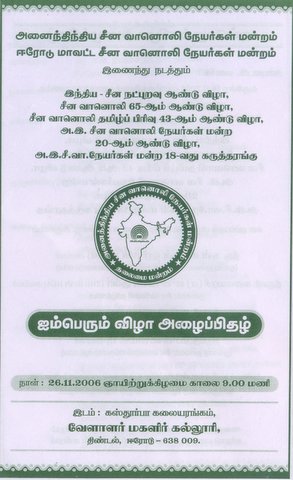
Listening to Tamil radio the China way

ERODE: Avid radio listener from Perundurai, K. Paramasivan ran out of a cinema hall in the middle of the show and came back after an hour. The reason he did that was to listen to his favourite radio programme. "The one hour programme has been my favourite for over two decades and there has been not a day when I have missed the programme," he says. "It is so wonderfully packed with world news and cultural programmes that it has become a part of parcel of my life.” There are more than 30,000 loyal listeners like Mr. Paramasivan, who religiously tune into short wave (SW) 31.04 m to listen to these voices coming from the across the Himalayas. The programme is from China Radio International’s (CRI) Tamil Division, where the Tamil Service has been on since August 1, 1963.It starts every evening at 7.30 IST with news, news snippets and includes programmes on Chinese culture, stories, music, etc."
Listeners like Mr. Paramasivan did not just stop with listening to the Service; they also mailed the broadcasters, participated in the competition and won prizes, which included a trip to China. So much has been the overwhelming response from Tamil listeners that among all the international service in CRI, Tamil Service tops the list for maximum number of listeners’ letters.
"Last year CRI received 5.2 lakh letters, of which 3.5 lakh alone where from Tamil listeners for the Tamil Service," says S. Selvam, a listener from Villupuram. These listeners got together and have formed Anaithu Inthiya Cheena Vanoli Neyar Mandram (All-India CRI listeners’ forum).
"Every district barring Nilgris has got a listeners’ club," says Mr. Selvam, who is the club’s president. The listeners’ club conducts an annual meet in the State, which is well attended. "We are like a family and use that day to meet other family members," says Mr. Paramasivan. Not only that, the CRI encourages readers to participate in competitions.
Every year it selects a winner and sponsors a trip to China. For other listeners who regularly interact with the Service, it sends gifts. Given the popularity of the programme in the State, it appears that through air waves the people of the two countries have established a link much before the Governments agreed to open the Nathu La pass in Sikkim for trade.
///////////////


stories/2007091052840500.htm

Monday, September 03, 2007

BES Review Apr-June 2007

BES Review is a quarterly publication of "Broadcasting Engineering Society(India)" containing articles on latest development in the field of broadcasting and related science.APRIL - JUNE 2007 issue (4.46 MB) is now availbale for download using this link :http://www.besindia.com/april-june07.pdf
Via Alokesh GuptaNew Delhi, India.

Digital Radio Guide


The World Broadcasting Union's Digital Radio Guide is for use by engineersand managers in the radio broadcast community worldwide. It covers a widebase of digital radio technology and services, written by the technicalexperts who work with them. Along with gaining an understanding of digitalradio, readers will also acquire insights into international digitalterrestrial and satellite transmission systems including:- Digital Radio Mondiale (DRM)- Digital Audio Broadcasting (DAB - Eureka 147)- Japan's Digital Radio Broadcasting (ISDB-TSB)- iBiquity's HD Radio System (IBOC)- WorldSpace- Sirius and XM Satellite Radio- Mobile Broadcasting Corp. and TU Media Corp.- Internet RadioThe guide includes references to relevant sources and websites withtechnical descriptions of the aforementioned systems.The Digital Radio Guide has been compiled by the World Broadcasting UnionsTechnical Committee and can be downloaded by clicking on this link :http://www.nabanet.com/wbuarea/

library/Docs/Public/DRG-2007.pdfThe Guide should be cited as a reference if any of its content is used in other publications.

(Source : World Broadcasting Unions Via Alokesh GuptaNew Delhi, India)

Thursday, August 23, 2007

The 1000KW transmitters at Chinsurah in West Bengal

The radio transmission system in the border areas isbeing augmented to strengthen the coverage there, theRajya Sabha was informed on Wednesday. In a written reply, Minister of Information andBroadcasting PR Dasmunsi said several projects andinstallations of transmitters in Jammu and Kashmir andthe North-Eastern states are underway. The Minister said Phase-1 of Jammu and Kashmir SpecialPlan has been completed under which nine projects havebeen commissioned and three are technically ready. In North-East, two FM transmitters at Itanagar andKohima are ready. Under the special plan, 1KWtransmitter at 19 new spots, 5KW transmitter atSilchar, 10KW transmitter at Gangtok and 100transmitters of 100KW have been approved for uncoveredareas. The 1000KW transmitters at Chinsurah in West Bengaland Rajkot have also been replaced by new ones, theMinister said. //////////////
Source:http://economictimes.indiatimes.com/News/
News_By_Industry/Media__Entertainment_/
Radio_transmission_in_border_areas_being_
augmented_Dasmunsi/articleshow/2301069.cms

Monday, July 30, 2007

KCHIBO KK-S500 Digital Receiver


KCHIBO KK-S500 DIGITAL DUAL CONVERSION / SYNCHRONOUSDETECTION SHORTWAVE / FM STEREO / MW RADIO


Ebay seller "Liypn" has listed a new Kchibo KK-S500 Digital Receiver,details as following :FM : 76 -108 MHzMW : 520 - 1620 KHz. (9 or 10 KHz. steps)SW : 1620 - 29999 KHz. This radio is New In Box, 100% Brand New from the manufacturerin China,NOT Used, NOT Refurbished. Super large LCD display with digital display of frequency andthe pointing dial simultaneously 1000 Stations Memory Presets (200 each for MW & SW, 600 for FM) (Will not lose memory even without battery inside radio) Direct input of frequency, knob tuning, pre-set memory and scanning tuning methods are supported. Dual conversion and synchronous detection on SW bands, very sensitive and good selectivity! Excellent sound quality, loud and clear! FM Stereo Listening by earphone. Automatic turn on of radio by setting the timers. With headphone socket, for private stereo FM listening!Dimensions: 5.9 x 3.5 x 1.4 inches / 150 x 90 x 35 mm. Battery: Uses 3 AA size 1.5V. battery. The package that you are bidding comes with the radio, a velvetcloth radio bag, stereo earphone, 3 x rechargeable Ni-MH batteries, AC adapter (220V)and wire antenna.Manual in ENGLISH in pdf format will be provided FOR FREESIX MONTHS MANUFACTURER WARRANTY FROM DATE OFSHIPMENTLabels on this radio are in ChineseWill ship to anywhere in the word by Air Mail Parcel Post with insurance(7 to 10 days delivery). Copy & paste this link on your browser to view the listing :http://tinyurl.com/2htcvf

"KCHIBO KK-S500 Digital Receiver"


New KCHIBO KK-S7600 receiver with remote

Someone left following comment on my blog with details of the new Kchibo KK-S7600 receiver with remote.Anonymous has left a new comment on your post "KCHIBO KK-S500 Digital Receiver": I'm interested in another Kchibo radio the s7600 which I have seen details for, but nobody is selling it, as yet. I can't paste the url here. But the portable is slightly larger than the s500 and includes a remote.The s500 is more expensive than the better know Kaito/Degen 1102,03 radios. Whether the performance is superior to those two portables is questionable and won't be know untill it is reviewed. http://bbs.leowood.net/web/leowood


/forum/photobook.asp?page=1&name=radiolove&ClassID=0


Pictures courtesy the link mentioned above. Via Alokesh Gupta.

Wednesday, July 18, 2007

ABC's 75 Birth Day Compettition


You can win a $100 gift voucher to spend in any of the ABC Shops or Centres, and qualify for the Birthday Prize Draw to win:


A visit from Fifi & Bumble to your school or daycare centre Plus, a mega pack of Fifi goodies including: Fifi mini jumping castle; Fifi's DVD collection; book library collection; plush toy collection; cottage play set; Fifi back pack, hat, sunglasses and Fifi learning blocks!


A family entertainment pack of DVDs and CDs from the ABC Shop including some all time classic DVDs such as:


Da Kath & Kim Code (plus bonus Live in London Uncut)Curtain Not All Tea and SconesGrassroots (Series 2)My Family and Other Animals Opera Australia's "The Pirates of Penzance"BBC's "The Queen at Eighty"Australian Opera's "Manon"Sydney Symphony Orchestra's "Discovery" triplej's "Hottest 100" (Volume 14 JVD and CD )plus an additional 25 CDs from ABC's extensive catalogue


To enter, simply tell us in 50 words or less about your favourite ABC moment from the last 75 years. Then attend an ABC 75th Birthday Event to enter your competition form at the ABC Exhibition Trailer for your chance to win!


Fpr more details visit: http://www.abc.net.au/corp/

history/75years/competition.htm

DRM / DAB Capable Receiver Himalaya 2009 is Officially Launched

DRM / DAB Capable Receiver Himalaya 2009 is Officially Launched

Long time DRM supporter Himalaya (Power) Electronics is proud to present theDRM 2009 to the European market. Based on the experience of manufacturingthe first two DRM receivers, namely the Mayah DRM2010 and the CodingTechnologies Digital World Traveller, Himalaya (Power) Electronics ispleased to deliver a new generation of high quality DRM receivers which ismore affordable than ever.The Himalaya DRM2009 is a standalone radio which supports DAB/DRM/AM/FMservices. It is a real portable receiver that could be run either by AC orbatteries. With the SDcard slot, it can also be used as a MP3 player. Inaddition to MP3 playback features, the SDcard can be used for scheduledrecordings of DAB/DRM programmes. Furthermore, features of Play/Pause forDAB and DRM services are supported through the internal memory. EPG(Electronic Programme Guide) is also supported for DAB service. Thespecialized user interface allows for easy navigation of these advancedradio features.DRM2009 uses an advanced Radioscape multiband module, allowing reception ofa wide range of digital and analog services. DRM2009 is a truly portable andflexible system.Further information about the receiver can be found underhttp://www.himalaya.com.hk/You can order the receiver in Germany and in Austria from the T-Online Shopon http://www.t-online-shop.de/ and from the Charly Hardt´s web sitehttp://www.charly-hardt.de/ .
About Himalaya (Power) ElectronicsHimalaya (Power) Electronics was founded in 1974. For three decades,Himalaya has established a good reputation of producing high qualityconsumer electronics products. Having developed and produced a large varietyof audio electronics products, Himalaya is one of the most experiencedmanufacturers based in Hong Kong. Our specialization has been successfullyshifted to digital products such as digital flash-based audio recorders,radio-controlled atomic clocks, multi-band & RDS portable radios, carstereos, weather alert clock radios and direct key-in world band PLL radios.For the last few years, we have become a key supporter for the new digitalradio standard of Digital Radio Mondiale (DRM). In 2004, we have helped tobring the two most advanced DRM receivers, DRM 2010 and Digital WorldTraveller (USB radio), to the market. Our most recent DRM receivers are theDRM2008 and DRM2009.
About Mayah® CommunicationsMAYAH® Communications' main objective is the development and distribution ofinnovative hiqh quality solutions for audio and audio/video communicationsin broadcast and corporate networks. Focus is given to standardized audioand video formats, such as MPEG-1, -2 and 4 as well as proprietary butaccepted formats such as E/apt-X, ADPCM4SB and others. The company islocated in a nice modern office park just a few minutes away from MunichAirport. Touching base with radio and TV customers in the media metropoleMunich, MAYAH has an optimum location for international business.About Coding TechnologiesCoding Technologies provides the best audio compression for mobile,broadcasting, and Internet. SBR (Spectral Band Replication) from CodingTechnologies is a backward and forward compatible method to enhance theefficiency of any audio codec; putting the "PRO" in mp3PRO and the "Plus" inaacPlus. Parametric Stereo from Coding Technologies and Philips againsignificantly increases the efficiency of audio codecs for stereo signals atlow bit rates. Products from Coding Technologies are fundamental enablers ofopen standards such as 3GPP, 3GPP2, MPEG, DVB, Digital Radio Mondiale, HDRadio, and the DVD Forum.About DRMDRM (TM) is the only universal, openly standardised, digital radio system forshort-wave, medium-wave and long-wave - digital radio for frequencies below30MHz. It has been endorsed by the ITU, and is standardised as ETSI ES 201980. While DRM currently covers the broadcasting bands below 30 MHz, the DRMconsortium is extending the system to the broadcasting bands up to 120 MHz.DRM has near-FM sound quality plus the ease-of-use that comes from digitaltransmissions, combined with long range and low power consumption. Acontinuously growing number of commercial, public, international, nationaland local broadcasters are already broadcasting DRM transmissions intoEurope and North America, Mexico, Russia, China, India and other regions.Multi-standard, DRM-capable consumer radios were introduced, and areavailable in different on-line shops (e.g. www.igear.com ). Furtherinformation on DRMTM can be found under: www.drm.org.
DRM Members
Commercial Radio Australia (Australia); TDP, TDP Radio, RTBF (Belgium);Nautel Ltd., Radio Canada International/ CBC (Canada); Academy ofBroadcasting Science of China, Communications University of China, SoutheastUniversity Nanjing (China); RIZ Transmitters (Croatia); HFCC (CzechRepublic); Aalborg University (Denmark); ESPOL, HCJB Global (Ecuador);Digita Oy, Kymenlaakso Polytechnik (Finland); CCETT, DIGIDIA, DRF Committee,Radio France, TDF, Thomson Broadcast & Multimedia (France); ADDX, APR, AtmelGermany GmbH, Coding Technologies GmbH, Deutsche Welle, DeutschlandRadio,DLM, Sender Europa 1, Fraunhofer IIS, Georg-Simon- Ohm - University ofApplied Sciences Nuremberg, Harman/Becker Automotive Systems GmbH, IRT, LMKRheinland-Pfalz, Medienanstalt Sachsen-Anhalt, Micronas GmbH, Nero AG,Panasonic Automotive Systems Europe; Robert Bosch GmbH, Sony DeutschlandGmbH, SWR Südwestrundfunk, TRANSRADIO SenderSysteme Berlin AG, T-SystemsIntl. GmbH, University of Applied Sciences Kaiserslautern, University ofApplied Sciences Merseburg, University of Kassel, University of Hanover,University of Ulm, VPRT (Germany); Antenna Hungaria, National CommunicationsAuthority Hungary (Hungary); Basamad College, Tehran (Iran); RAI Way, STMicroelectronics (Italy); Hitachi Kokusai Electric Inc., NEC Corporation,NHK (Japan); Telecommunications Technology Association (Korea); LibyanJamahiriya Broadcasting (Libya); Broadcasting Center Europe (Luxembourg) ;Asia Pacific Broadcasting Union (Malaysia); La Red de Radiodifusoras yTelevisoras Educativas y Culturales de México (Mexico); Agentschap Telecom,CATENA Radio Design, NXP Semiconductors, OLON, Radio Netherlands, TechnicalUniversity Delft (Netherlands) ; Radio New Zealand International (NewZealand); Voice of Nigeria (Nigeria); Telenor/Norkring (Norway);Radiodifusao Portuguesa (Portugal); RTRN/Voice of Russia (Russia);Government of Catalonia, Cadena SER - Sociedad Española de Radiodifusión,Universidad del Pais Vasco (Spain); SR International/ Radio Sweden (Sweden);EBU, International Committee of the Red Cross, ITU, VSP - Verband SchweizerPrivatradios (Switzerland) ; Arab States Broadcasting Union (Tunisia); BBC,Christian Vision, Digital One Ltd., RadioScape Plc., VT Communications, WRN(U.K.); Analog Devices, Broadcast Electronics, Inc., Dolby Laboratories,Inc., Dolby Laboratories Licensing Corp., Continental Electronics Corp.,Harris Corp., Broadcast Communications Division - IBB/VOA, NationalAssociation of Short-wave Broadcasters, TCI International, Inc., TexasInstruments, Inc., Via Licensing Corp. (U.S.A.); and Vatican Radio (VaticanCity).


Press ReleaseFor Immediate Release: July, 18, 2007Contact: Fanny Podworny, DRM, http://in.f85.mail.yahoo.com/ym/Compose?To=pressoffice%40drm.orgTelephone number: +49 228 429 3105

(source : drm.org Via Alokesh GuptaNew Delhi, India).

Tuesday, July 17, 2007

The handbook: “Working with the Radio”

It works at the turn of a button and a twist of a knob, it needs no electricity, and it is a portable box of information and entertainment. It is little wonder that the radio is the most ubiquitous piece of technology in the country. But are the opportunities it provides being fully utilised by NGOs in their development activities?
Not quite, according to the Bangalore-based Communication for Development and Learning (CDL), a non-profit organisation that works to “facilitate the use of communication as an integral part of the development process.” To help NGOs tap the scope of the medium, CDL has now produced a handbook, “Working with the Radio”. The handbook aims to “demystify” the medium of radio for first-time users and also suggests options for developing their own programmes.
The figures speak for themselves, says CDL: only 60 per cent of the country’s population is literate and can read the newspaper; only 10 per cent of households have television sets; only 1.2 per cent of the population have access to the internet. Radio, on the other hand, which reaches 91.42 per cent of the country’s geographical area and 99.13 per cent of the population, ought therefore to be “the preferred medium, for not only advertisers and media planners, but also for NGOs.”
Why this is not so can be explained by our notions of the radio as being a “mysterious and highly technical medium” that is “cloistered behind high walls and inside dark buildings”, according to CDL executive director, Shangon Das Gupta. Besides, history has shown that radio stations emerge as the first point of contact between locations of disaster and the rest of the world, the handbook points out.
When the Titanic sank in 1912, it was a radio station that picked up information from a wireless transmission device getting the rescue mission to swing into action, thus saving hundreds of lives; radio similarly proved vital after the Bhuj earthquake of 2001.
More recently, during the 2004 tsunami, the radio became the most important means of communication between the Andaman islands and the mainland .
The handbook is priced at Rs. 100. Visit http://www.cdlblr.org/ or call 25503481 for more information. [Source: The Hindu]

Sunday, June 24, 2007

New Competition from CRI

[ Photos & Essays Wanted ]
What does Hong Kong mean to you? Is it the enchanting Victoria Harbor? The view from the Peak? Or movie stars such as Bruce Lee, Jackie Chan or Maggie Cheung? Give us your idea in a photograph or essay, as China marks 10 years since resuming the exercise of sovereignty over Hong Kong.
Participants are welcome to submit their articles or photographs through the online forum of CRIENGLISH.com. Readers can decide on the titles of their submitted works, but the content should be relevant to the stated theme.
The best photos will be included in an online photo album of CRIENGLISH.com and may have a chance to be shown on Channel 9 of China Central Television. The best essays will be included in an online collection of stories about Hong Kong by CRIENGLISH.com and may be broadcast on the radio channels of China Radio International.
Deadline: July 30, 2007

[ Photo ]1. Images should be no smaller than 600x600 pixels and formatted in JPEG no larger than 1024kbs. 2. Please retain your original files in case you are asked to provide them. 3. Please include a description in English of your photo, including when and in what situation it was taken.

[ Essay ]1. The essays must be written in English. 2. Each essay should contain no less than 250 words.
///////////////
Source: http://english.cri.cn/events/
hongkong30/index.html

Monday, June 11, 2007

93.5 Suryan FM ties up with public buses in Jaipur to air station

Sun Network's radio venture, 93.5 Suryan FM (SFM), has tied up with the public transport luxury style star buses in Jaipur to air their station.
The station has been authorised to use 25 such buses and incorporate their branding on the vehicle. The aim is to increase listenership figures for the station.
"We have recieved permission to air 93.5 SFM in 25 buses across Jaipur. We have also branded the buses both outside and inside," says 93.5 SFM manager business development V.Sridhar.

Estimated to reach an audience of 14,00,000 within a month, the service will be operational from 7 am to 11 pm.
An official announcement issued by the station states, "Bus payouts in Jaipur gives us exposure to a minimum of 14,00,000 audience in a month and will help us during ILT or Ram if it happens in that city."
The city to be targeted next is Hyderabad, where a similar activity will be run.

SFM is positioned as a youthful hit station catering to SEC A, B and C audience.
It is currently operational in Hyderabad, Bangalore and Jaipur and will roll out 45 more stations, with Bhubaneswar next on the cards.

Wednesday, June 06, 2007

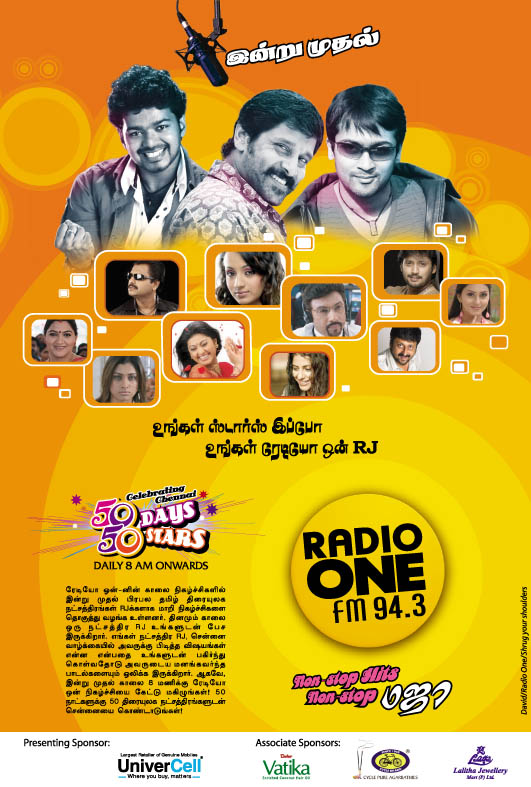
BBC's infotainment updates on Radio One Chennai


FM channel Radio One will ginger up its content with non-news infotainment updates in Tamil by global major BBC. Announcing a tie-up with BBC for providing content, Mr L.V. Navaneeth, Station Head, Radio One-Chennai, said the new 20-minute infotainment updates will be aired once in 20 minutes during the `breakfast show' from 7 a.m. to 11 a.m. from June 6. In other words, the infotainment capsules and `breakfast show' features such as film songs, will alternate every 20 minutes.
"In a couple of months from now, this will be aired throughout the day as we have been doing in Delhi and Mumbai," he said.
Changes in programming
That apart, the channel has also made changes in its programming mix to ensure its core promise — pure entertainment — with slice of life or humorous titbits once in every 20 minutes.
According to Mr Navaneeth, the 20-minute plan was conceived after a study that says no one listens to one channel for more than that period of time.
The channel has roped in popular RJ Suchitra to host the breakfast show.
Talking about the programming partnership with Radio One, the BBC's Business Development Head, Asia-Pacific, Mr Neil Curry, said the non-news infotainment updates would focus on business, sports and entertainment.
According to him, outside the UK, 183 million listeners tune into BBC at least once in a week.
`Open to partnership'
Asked whether BBC would form similar partnership with other FM channels, he said BBC is open to the idea, "but only in towns that are not covered by Radio One".
BBC has 20 per cent stake in Mid-Day Multimedia, the promoter of Radio One.
The company has licenses to operate FM stations in four metros and big cities such as Bangalore, Ahmedabad and Pune.


06/06/stories/2007060602820500.htm

Tuesday, April 17, 2007

Friends FM from Kolkata


Chennai Big FM on social responsibility


R a d i o s t a t i o n s h a v e b e e n j ump i n g o n t h e c o r p o r a t e s o c i a l r e s p o n s i b i l i t y ( C S R ) bandwagon as part of their marketing exercise. The benefi ts derived from such activities, although not measurable in commercial terms, are highly rewarding. One station that has gone big on CSR is Big 92.7FM. Since its launch in September 2006, t h e s t a t i o n h a s ma d e t h e effort to support numerous causes as part of their CSR campaigns. A case in point; the day the station went on air in Chennai, it organised a walk near the city’s Marina beach in its support to create awareness on traffi c safety. The station has also used t h e i r ma r k e t i n g mu s c l e t o w e a v e i n f i l m s t a r s a n d sportsmen to promote their activities. Causes to support t h e p l i g h t o f u n f o r t u n a t e children have been big in many of its campaigns’ focus. Tamil actress, Asin, celebrated her birthday with 40 children from an orphanage and RJ Dheena was involved in a campaign supporting children with HIV/AIDS. And leveraging on their sponsorship status as official radio partner of the premier hockey league (PHL), it organised for the Chennai h o c k e y t e a m ( C h e n n a i Veerans) and RJ Gopi to visit cancer-stricken children at the government cancer hospital. A c t i v i t i e s i n t h e f i r s t s i x months have also included the following: • A free eye check up camp a l o n g w i t h a R o t a r y e y e hospital, resulting in free eye check-ups for around 1000 people. • An event to honour local heroes, such as Dr. Kanaga, who is Asia’s fi rst female neuro surgeon. • A b i k e r a l l y t o s p r e a d awareness on the importance of using helmets. • A morning walk to spread awareness of keeping healthy and to make exercise a regular routine. W h a t m a k e s t h e t r e n d interesting is that the station has never asked for sponsors to fund these activities, as the entire cost has been borne by the station’s marketing budget. So this begs the question, why does the station adopt this strategy? Zarine Jalil Menon, station manager, BIG 92.7 Chennai, thinks the money is well spent and the effort well worth the trouble. "As a radio station, we want to be well connected with our listeners. To do that, we need to address their issues a n d c o n c e r n s , w h a t e v e r t h e y m i g h t b e . " Menon also believes that if the station is able to create public awareness of certain issues, "all of us [can only] gain from it." The station doesn’t isolate a n y o n e c a u s e a s m o r e important than the other, as Menon says, "We will highlight any cause which deserves attention. We have had our l i s t e n e r s c o n t r i b u t e t o t h e medical expenses of children who could not afford it. If such instances come to our notice, we will defi nitely highlight them and involve our listeners in the alleviation of the problem." A l t h o u g h , a c c o r d i n g t o Menon, the benefits from the spend are visible, they are not c omme rc i a l l y me a s u r a b l e . "Through such activities, our listeners and advertisers see us as a responsible station. As we have stuck to CSR from the time we launched, the city sees our conviction in our own policy, and that is very important for our reputation- building."

The Radio Jockey’s Handbook


Do you have what it takes to become an RJ?
Being a radio jockey is not only about relying on your voice, but it involves a whole lot of knowledge as well, says jock, trainer and writer, Simran Kohli in her new book
What does it take to become a radio jockey? And who better to answer this question than someone who’s been there – and is still doing that?
Simran Kohli is now a radio jockey with Big FM in New Delhi, and is also the producer of the late night show, 9 Baje Ki Setting. Having worked with Radio Mirchi, the BBC, Red FM and Hum FM (in Dubai), Simran felt it was time that she shared her experiences – and penned them down in a book, the first of ten books on radio that she proposes.
The Radio Jockey Handbook, which is available in both English and Hindi, targets both the would-be jockey and those already involved in the profession. The book’s structure is properly thought through and carefully laid out.
Adopting a question and answer format, the handbook first deals with the crucial question: do you have what it takes to become a jockey? Most aspirants think that all one needs is a voice, and Kohli quickly disabuses the reader of the notion. She makes it clear that the successful jockey needs more than God-given talent, and that there’s a lot of hard work – and knowledge involved. The book takes you through the process involved in the creation of a program, the elements that go into making a show, the preparation required to make the most efficient use of the resources available at hand.
For the would be radio jockey, Kohli’s book serves two purposes: one, the aspirant, after reading the handbook, is clear that he or she does not have the requisite skills to succeed in this demanding industry. The second is that the aspirant is certain that radio is an industry that he or she could make a mark in.
The book is laced with experiential illustrations that make one’s understanding of the craft better, and the aspirant makes a more informed decision on whether or not to pursue a career in the burgeoning industry.
For those in the industry, the book aims to make them better professionals, teaching them how the maximize the talent and resources at hand.
Published by Fusion Books, The Radio Jockey’s Handbook is handy to have around for professionals, and an investment well made for the hopefuls.

Monday, February 19, 2007

தமிழ்க்கொடி 2006 - இது ஆழி பதிப்பகம் வெளியிட்டிருக்கும் ஆண்டுத்தொகுப்பு!

இந்த தொகுப்பு இப்போது சென்னைப் புத்தகக்காட்சியில் காலச்சுவடு, பாரதி புத்தகாலயம், புன்னகை, சிலிக்குயில், ஞானபாநு, வம்சி புக்ஸ், சாஃப்ட்வியூ போன்ற ஸ்டால்களில் கிடைக்கிறது. தமிழ்நாடு மட்டுமல்லாமல் இலங்கை, அமெரிக்கா, கனடா, பிரான்ஸ், சுவிஸ், ஆஸ்திரேலியா, சிங்கப்பூர், மலேசியா, வளைகுடா நாடுகள் ஆகிய இடங்களில் இருந்து 40 எழுத்தாளர்களின் இதில் எழுதியிருக்கிறார்கள். அரசியல், சமூகம், பண்பாடு, புலம்பெயர் வாழ்க்கை, பொருளாதாரம், கலை, இலக்கியம், ஊடகம் என விரிந்த பரப்பில், 2006 ஆம் ஆண்டின் முக்கிய நிகழ்வுகளையும் போக்குகளையும் ஆழமாகவும், விரிவாகவும் அலசும் / பிரதிபலிக்கும் கட்டுரைகளும் நேர்காணல்களும் இதில் இடம் பெற்றுருக்கின்றன.இந்த ஆண்டுத்தொகுப்பில் இடம் பெற்றுள்ளவை: சிறப்புக்கட்டுரைகள்01. அ. மார்க்ஸ்வெற்றிபெற்றவர்களும் தோல்வியடைந்தவர்களும் 02. வ.கீதாதமிழ்ச்சூழலில் அறிவியக்கம் 03. பா.ரா.சுப்பிரமணியன்சொற்களஞ்சியத்திற்குப் பயன்படுத்த வேண்டிய ஆதாரம்நேர்காணல்04. பாமாமனிதநேயம் செத்துக் கொண்டிருக்கிறது 05. சுப.வீரபாண்டியன்திராவிடத்தை எதிர்க்கும் தமிழ் தேசியம் ஆபத்தானது 06. ரவிக்குமார்தலித் அரசியல்: போராட்ட அரசியலிலிருந்து ஆக்கபூர்வ அரசியலுக்கு07. காஞ்சனா தாமோதரன்நம்மை வளர்த்த சமூகங்களுக்குத்திரும்பிச் செய்ய வேண்டும் தமிழ்கூறும் நல்லுலகு08. கி.பி.அரவிந்தன் (பிரான்ஸ்)எட்டுத்திக்கும் மதயானைகள்09. ஜமாலன் (வளைகுடா நாடுகள்)பணம் தேடிச்செல்லும் பாய்மரங்கள்10. லெ. முருகபூபதி (அவுஸ்திரேலியா)தமிழ் அவுஸ்திரேலியர்கள் இன்று11. மணி மு.மணிவண்ணன் (அமெரிக்கா)தமிழ் அமெரிக்கர்கள் வாழ்வில் திருப்புமுனை? 12. றஞ்சி (சுவிஸ்)பெயர்ந்த புலத்திலும் பெண்கள் 13. ஜெயந்தி சங்கர் (சிங்கப்பூர்)சிக்கல் இல்லாமல் தொடரும் வாழ்க்கை14. ரெ.கார்த்திகேசு (மலேசியா)தோட்டம் விட்டு15. வ.ந.கிரிதரன் (கனடா)மெதுவான முன்னேற்றம்16. துரைமடன் (ஈழம்)அரசியல் திசைப்போக்கும் அடையாள எழுச்சியும்அரசியல் - சமூகம்17. புனித பாண்டியன்தமிழர் மலத்தை தமிழர் அள்ளும் அரசியல் 18. ஞாநிதமிழக அரசியல்: யாருக்கு ஏற்றம்? யாருக்கு இறக்கம்? 19. ச.தமிழ்ச்செல்வன்எதிர்மறைச் சமூகம் 20. ப.சு. அஜிதாபெண்கள் குறித்த சட்டங்களும், தீர்ப்புகளும் 21. பாரதிபாலன்தரமான கல்வியைத் தேடி 22. செ.ச.செந்தில்நாதன்உலகமயமாதல் எனக்கு, உலகபயமாதல் உனக்கு… 23. சுசி திருஞானம்தலைமை தாங்கட்டும் தமிழகம் இலக்கியம்24. ஸ்ரீநேசன்கவித்துவத்தின் எல்லை 25. ஜீ.முருகன்வரிகளும் வார்த்தைகளும்… 26. எம்.கோபாலகிருஷ்ணன்நாவல் என்னும் பெருவழிப்பாதை 27. பாவண்ணன்தொடரும் பயணத்தின் இடையில் 28. அரவிந்தன்சலனங்களும் சவால்களும் 29. அழகிய பெரியவன்தலித் உரைநடை 30. அ.சதீஷ்காலம் கண்ணாடி முன் நிர்வாணமாய் நிற்கிறது 31. ஆ.தனஞ்செயன்தனித்துவமான கல்விப்புலச்சிறப்புடன் 32. லதா ராமகிருஷ்ணன்கவிதைசார் போக்குகள்
கலை33. சி.மோகன்சலனங்களும் சஞ்சாரங்களும் 34. சி.அண்ணாமலைசுழல்வெளி35. க்ருஷாங்கினிமுற்றிலுமான புதுமை சாத்தியமா? ஊடகம்36. அ.ராமசாமிசின்னத்திரைகளின் வண்ணக்கோலங்கள் 37. செழியன்நமது தமிழ்ப்படம் 38. தங்க. ஜெய்சக்திவேல்அலைகள் ஓய்வதில்லை 39. மா. சிவக்குமார்வலைத்தமிழின் அடுத்த வீச்சு 40. நிழல் ப.திருநாவுக்கரசுகைப்பிடிக்குள் கனவு


[ மேற்படி தமிழ்க்கொடி 2006 ஆண்டு மலரினை வாங்க விரும்புவோர்கள் செ.ச. செந்தில்நாதனுடன் zsenthil@gmail.com என்னும் மின்னஞ்சல் முகவரியில் அல்லது மலர்த் தொகுப்பாளரான சி.அண்ணாமலையுடன் mailto:yaazhini@hotmail.comஎன்னும் மின்னஞ்சல் முகவரியில் தொடர்பு கொள்ளுங்கள்.- பதிவுகள்]நன்றி: http://tamilkodi2006.wordpress.com/

German solar expert Wolfram Hess, DL1RXA SK

Wolfram Hess

Obituary: Wolfram Hess


German solar expert Wolfram Hess, DL1RXA SK

http://www.southgatearc.org/news/february2007/wolfram_hess.htm DARC --- Many of you - especially those of you who remember the former GDR-station Radio Berlin International (RBI), will connect one name with RBI: The name of Wolfram Hess, DL1RXA (ex Y31NO).He was well known within and beyond the borders of the former German Democratic Republic for the only totally unpolitical program on RBI - the DX-program! Some of you may even know his late DX-Programme in English on the External Service of the re-united Germany Deutsche Welle.It is with great personal sadness that I have today received the message of Wolfram's death.Wolfram was nationally and internationally known for his many studies and results in solar physics and being an outstanding expert in Sun and Ionosphere Weather Reports and forecasts. Often he beat the Boulder, Colorado Institute's solar weather predictions with even greater accuracy.Since the late 50s, one could hear Wolfram's voice on air - on Amateur Radio (ex Y31NO) as well as on broadcasting. Wolfram spoke the English interval signal of the former GDR External Station Radio Berlin International (RBI). On RBI Wolfram produced the only entirely unpolitical programm which continued as 'DX Aktuell' in the re-united German Radio World until Dec 31st, 1993.Thanks to this virtuous and totally fascinating radio program and his tremendous personal motivation, I managed to get my first Amateur Radio Call Sign in June 1993 - the suffix RBI was, without any doubt, an honor and a joy for me to get! Still today, I hold this suffix with pride and respect for Wolfram's deeds. This is also a personal obituary: A very last 55, 73 and 76 as well as a final ?dididit dadidah? to you, Wolfram!Wolfram Heߠdied on February 9th, 2007 at the age of 67 as the result of a stroke. 73s, Dennis DL7RBI DARC International Affairs Committee(via Mike Terry, dxldyg via DXLD) OBIT> Wolfram spoke the English interval signal of the former> GDR External Station Radio Berlin International (RBI).And much more English narration, in the GDR days even leading to jokes about an omnipresence of PR films with his voice on the Leipzig trade fair ("auf der Leipziger Messe h?man ?l nur Hesse"). He had continued this work until now. > On RBI Wolfram produced the only entirely unpolitical> programm which continued as 'DX Aktuell' in the re-united> German Radio World until Dec 31st, 1993.Here I have to disagree. Such programs are not unpolitical, especially in cases were they are supposed to be unpolitical since in those cases many topics will be taboo. I still remember how in 1994 somebody had send in an item about CRI running a competition about Tibet: It made it on air only with a "but beware, this is propaganda" comment.And DX Aktuell continued, as I already mentioned, after the merger of Deutschlandsender Kultur and RIAS to the new Deutschlandradio Berlin until September 1994, with the very last programme being edition #191 on Sep 30. Not even the slot for DX Aktuell did change for these further nine months (Fridays 10-11 PM on 177 kHz, towards the end even expanded by another quarter hour, devoted to satellite broadcasting news that were updated for the repeat on Monday morning).Btw, DX Aktuell was disputed by parts of the German DX / shortwave listeners / whatever-you-may-call-it scene. This dispute is still documented at http://www.asamnet.de/~bienerhj/0177.htmlIn my perception there were lots of unrestricted applause and various statements that the programme is entirely scrap, but almost nothing in between, as far as the shortwave scene is concerned. Towards the end also other people appeared in the followship, and I think it would have been interesting to see the outcome, especially with so much airtime available (75 minutes!). But we will never know, because "such a programme has no place on a cultural station, it is obsolete for all times", as a certain gentleman put it when acting as the station's bloodhound on this matter.If somebody wishes to send condolences: You could mail them to me (or just post them here) for being forwarded to Wolfram's relatives (Kai Ludwig, Germany, Feb 17, dxldyg via DX LISTENING DIGEST) OBIT. Source:http://www.w4uvh.net/dxlatest.txt


+++++++++++++++++++++++++++++++++++++++++


TIME TO SAY GOODBYE --- SILENT KEY - WOLFRAM HESS, DL1RXA and DK0DXWolfram suffered an apoplectic stroke and died on February 9th, 2007; just before the very last broadcast of Ham radio and SWL hobby program "World DX Meeting" on Deutsche Welle's English service mailbox program on February 25/26, 2007.Started his occupational career as hobby program presenter on former GDR external service "Radio Berlin International". After the collapse of the eastern block he was well known as presenter of "DX Aktuell" hobby program on Deutschland Radio Berlin broadcaster [former RIAS Berlin]. And was too, well known as "Sunspot Cycle and HF broadcast condition prediction 'Pope'" in the ham radio scene in Germany and and beyond. Listen to some DWL World DX Meeting programmes in .mp3 or .ra format: http://www.dw-world.de/dw/0,2142,9542,00.htmlclick to: Current Solar and Ionospheric Weather Reportand you will see a photo picture of Wolfram. 73 wb df5sx (Wolfgang B?, dx_india via DXLD)[quoting previous DXLD about playing ``Time to Say Goodbye``] Viz.:Wolfram, DL1RXA, ist am 9. Februar an der Folge eines Schlaganfalls verstorben, das wurde erst jetzt bekannt. OM Wolfram hat sich als Autor von hervorragenden Funkwettervorhersagen und intelligent-amuesanten Veroeffentlichungen ueber die Grundlagen des Funkwetters einen Namen gemacht. Auf besonders einmalige Weise hat er taeglich auch den Sonnen- und Ionosphaerenwetterbericht fuer den DARC e.V. erarbeitet und die Funkamateure in Deutschland aktuell informiert.(via Harald Kuhl, A-DX Feb 14 via Wolfgang B?, dx_india via DXLD)On a phone conversation we had just three weeks ago Wolfram said in regard to the World DX Meeting that "this will be the last DX I ever made in my life". There has to be a connection.His domestic broadcasting activities are presumably not so widely known outside Germany, so here's a summary:The run of the DX Aktuell show started one day in autumn 1990 when Wolfram found Alfred Eichhorn, the editor-in-chief of Radio Aktuell (the former Radio DDR 1) in a tape editing room. They talked about possible new programmes, Wolfram brought up the idea of a DX show, and so the first edition of DX Aktuell went out via the mediumwave frequencies of Radio Aktuell only a few days later. In spring 1991 all these mediumwave transmitters (including the 1000 kW on 783) were shut down and DX Aktuell moved to 177. By the end of 1991 The Facility (i.e. what used to be GDR radio) ceased to exist but the Deutschlandsender Kultur network continued on some kind of temporary status ("on behalf of ARD and ZDF"), and so DX Aktuell continued as well, but only after some dramatic confusion about the 177 transmitter (it was supposed to go dark altogether but finally 177 stayed on air via the K?s Wusterhausen 100 kW aux until finally the Zehlendorf transmitter had been reactivated with reduced power). It was basically the amount of listeners` mail that kept the programme alive for the following years. DX Aktuell also continued beyond yearend 1993, when Deutschlandsender Kultur merged with RIAS Berlin to the new Deutschlandradio Berlin, but finally came to an end in September 1994 together with a number of other former DS and RIAS programmes. This time listeners` mail was no longer of interest for the "decision makers", a meanwhile well-known phenomenon.For some time there was also a separate "DX-Report" on RIAS Berlin (855, 6005, FM Groߥr Waldstein 89.3 only), founded after complaints from listeners about poor reception of 177 in some areas of Germany. It was a separate show only because RIAS refused to simply relay the Deutschlandsender Kultur programme, simply because this was stuff from the former enemy's station.Here are pictures of a DX Aktuell production at Deutschlandradio Berlin, posted on this site because it so happened that the former RIAS 2 live studio had been used for this purpose:http://www.radiotreff.de/rias2/rias2_sehen_funkhaus_innen.htmA recording of the last DX Aktuell program from the Nalepastraߥ radiohouse, on Dec 31 1993 at 10 PM, just two hours before Deutschlandradio Kultur closed down altogether:http://www.radioeins.de/meta/sendungen/apparat/050820_A1.ramA reproduction of a special QSL card, showing the DX Aktuell authors behind the console of studio K1 (where these programmes were produced from 1990 til 1993) can be seen athttp://www.asamnet.de/~bienerhj/0177.htmlAlso spoken by Wolfram Heߺ The opener of what was then a DX show, launched by DT64 when they were forced off FM ...http://www.radioeins.de/meta/sendungen/apparat/070210_A1.ramI have to add that DX Aktuell was especially valuable for bringing people in touch with each other. On the sad occasion of the very last edition I met somebody I would have otherwise never met due to perceived or real barriers, and this turned out to be decisive for me. I have also to add that during the last months, even just the last weeks, there were first signs of a trend that this programme could become much more than a "mere" DX show, a trend that had no chance to develop further here (in fact such a development happened with the above mentioned DT64 programme, the result received an award just yesterday).Here is the DARC obituary, with a recording of Wolfram's last ham radio read-out just 12 days ago:http://www.darc.de/user-cgi/user.pl?Aktion=langtext&Key=878(Kai Ludwig, Feb 14, dxldyg via DX LISTENING DIGEST) OBIT

Thursday, January 18, 2007

ஆஹா எப்.எம் பற்றி விரிவாக அறிந்து கொள்ள


குமுதம் வார இதழ் தொடங்கியுள்ள ஆஹா எப்.எம் பற்றி விரிவாக அறிந்து கொள்ள சொடுக்கவும் http://www.kumudam.com எனும் இணைய பக்கத்தை.

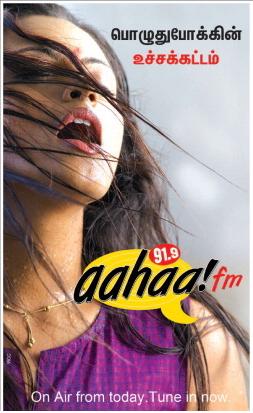
Aahaa FM to hit Chennai airwaves


Chennai is all set to have another FM station hitting its airwaves soon – Aahaa FM, the radio venture of Kumudam Publications Pvt Ltd. Aahaa FM would be an out and out entertainment channel targeting young Chennai audience. The Tamil weekly major has appointed Chennai-based creative shop WOC as its creative partner for the new channel.

The content of the new FM channel would be predominantly in Tamil with minimal English and Hindi mix. 91.9 is the frequency number of the new station.

Commenting on the account win, WOC’s Managing Director, Amudhan, said, “This is the fastest account we have ever won. We were invited and in the presentation we said that we could contribute towards the content as well, which, I think, helped us win this account. It is a fairly big account. The client has given us an absolute free hand and the media campaign would break a week ahead of the launch. It will be a big impact campaign and we are looking at some pretty powerful creative.”

“The client wanted a creative partner who understood the Chennai market and at the same time could deliver cutting edge work, and our presentation fit the bill,” he added.

Commenting on the strategy, Amudhan said, “All the existing channels have the same clichéd format and there is hardly any distinction between the one programme and the other, except for replacement of RJs for every programme. We are taking some risks and gambles to be different from the all the existing players. Unlike other channels, Aahaa FM would not be an RJ dependent station but a content dependent one.”

Chennai currently listens to Suryan, Radio Mirchi, Radio City and the recently launched Hello FM and Big FM, while Muthoot Group and Radio Mid-Day West (India) Ltd, a Radio One-BBC World combine are waiting in the wings.

Kumudam Group publishes several magazines, including Tamil weekly ‘Kumudam’, ‘Kumudam Snegithi’, ‘Kumudam Bakthi Special’, ‘Telugu Bakthi Special’, ‘Kumudam Reporter’, ‘Kumudam Jothidam’, ‘Kumudam Health’, ‘Kumudam Theera Nadhi’ and ‘Kalkandu’.

Become a member of Radio Bulgaria's

Dear listener of Radio Bulgaria,

The good news is that in order to become a member of Radio Bulgaria's
Monitoring Club and receive the 6 QSL cards in the series you have to
fulfill the following requirements:

For the FIRST QSL CARD you will have to submit THREE reception reports
for January and THREE for February.

For the SECOND QSL CARD you will have to submit THREE reception
reports for March and THREE for April.

For the THIRD QSL CARD you will have to submit THREE reception reports
for May and THREE for June.

For the FOURTH QSL CARD you will have to submit THREE reception
reports for July and THREE for August.

For the FIFTH QSL CARD you will have to submit THREE reception reports
for September and THREE for October.

For the SIXTH QSL CARD you will have to submit THREE reception reports
for November and THREE for December.

A valid reception report should cover at least 15 minutes of our
broadcasts on any frequency and at the time you prefer, and should
include details of the contents of the broadcast and SINPO rating.

Upon reception of the full set of 6 QSL cards, you will also get the
Monitoring Club Membership Certificate of Radio Bulgaria.

Letters and reception reports should be sent within the period
specified for each QSL card.

For more information contact us at the following address:

English Service, Radio Bulgaria 4 Dragan Tzankov Blvd.
1040 Sofia, Bulgaria
english@bnr. bg

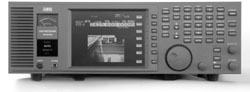
AOR AR-ALPHA MULTI-MODE COMMUNICATIONS RECEIVER


AOR is currently developing its flagship in communications receivers, a new kind of wideband software defined receiver based on ZERO-IF and DDS local generator, added to a 6” TFT screen displaying an amazing 1GHz bandwidth FFT spectrum! This high-end receiver targets communication professionals and authorities (surveillance, law enforcement…) as it also features a 1MHz wide high resolution digital I/Q output to PC.

Main specifications:

- Zero-IF and DDS local generator

- 10kHz-3.3GHz (with or without gaps, depending on country regulation)

- FFT Spectrum Display up to 1GHz bandwidth Wide Band I/Q digital output through continuous isochronous USB 2.0 Interface (1MHz BW, Mantissa 4-bit, Index 13-bit for wide dynamic range, 98.304M-bit/sec. transfer rate)

- Multi mode receive : WFM (in stereo, selectable de-emphasis), NFM, AM (Synchronous AM, diversity synchronous AM), ISB, RZSSB, USB, LSB, CW, P25, TV (FM, AM, NTSC/PAL/ SECAM/ PAL-M)

- Multiple IF filters: 200Hz, 500Hz, 3kHz, 6kHz, 15kHz, 30kHz, 100kHz, 200kHz, 300kHz

- Versatile digital processing: Digital noise filter, auto notch filter, noise blanker, IF shift, AFC, variable CW pitch, voice descrambler, voice squelch, CTCSS, DCS

- 6” color TFT display

- 19” rack mount

(all specifications subject to change without notice)

*Availability and price is still unknown*

AR-ALPHA Brochure Ad PDF 600 kB
AR-ALPHA Specifications PDF 500 kB


Jan 18, 2007
SM5YLO Lennart Deimert

Tuesday, January 09, 2007

BBC BENGALI SERVICE NEW TRANSMISSION

Dear listener
you may have heard from our programmes that we are going to launch a
NEW
dawn transmission from Thursday January 11, 2007. This will be a
half-hour programme, with news and current affairs, live contributions
from Dhaka, Delhi and Kolkata, press reviews, sports, culture etc.

The new dawn will be broadcast at 7am India time, on 31 metreband (9560
kHz) and 25 metreband (11995 kHz) on the shortwave.

Please let the listeners' clubs, your friends, neighbours in your
locality know of the new transmission.

Also, on Jan 8, 9 and 10, we will be testing the two frequencies . The
English news will be broadcast for half an hour on the above two
frequencies at 7am-7.30am, to see how effective they are. Would it be
possible for some listeners in West Bengal, Assam or Tripura to
monitor
these test tranmissions on those three days? Please request them, and
pass on the feedback to me immediately afterwards.

Regards
Amita Pal
BBC WS Marketing, Communications & Audience
New Delhi
+++++++++++++++++++++
Thanks to ,

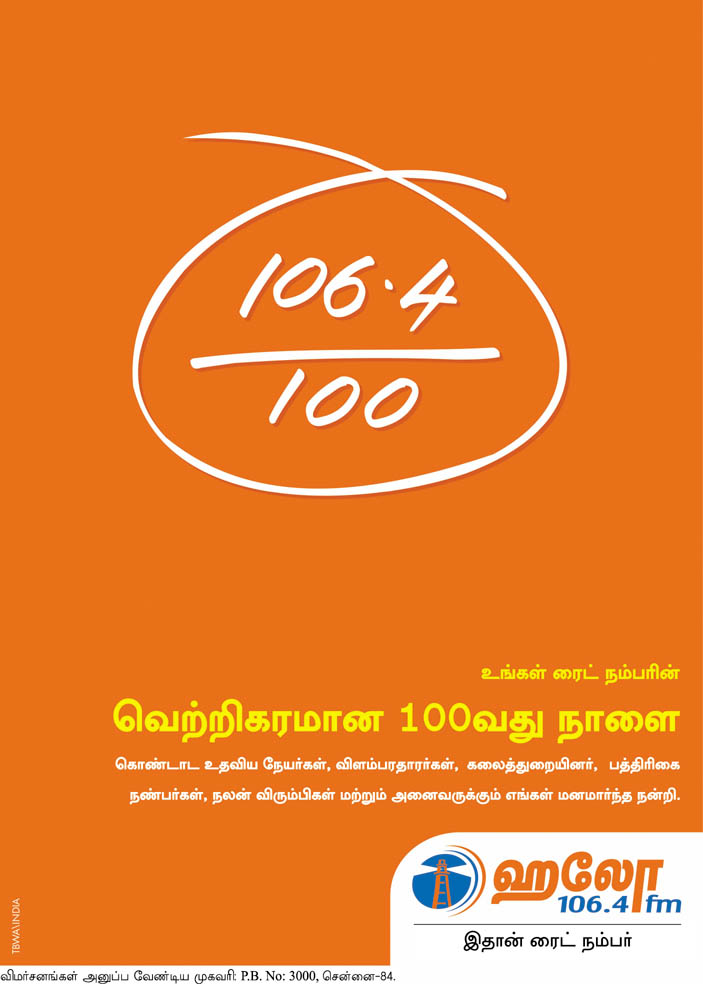
ஹலோ எப்.எம் 100 ஆவது நாள்


தினதந்தியில் 09-01-07 அன்று வெளிவந்த முதல் பக்க விளம்பரம்

Radio One start in Chennai


This advt published on 10-01-2007 Daily Thanthi front page.

HCJB: New book to celebrate 75 years of ministry


vision
to reach the world
100-page, 9" x 11.75", hardcover book packed with scores of full-color photos, facts and history.
Pricing and Donation InformationFor a suggested donation of $50.00 or more (**) to HCJB Global, you will receive a copy of the book.

** The Internal Revenue Code permits you to deduct the amount you give in excess of the $24 fair market value of materials or services provided by HCJB Global. To assist you in determining the tax-deductible portion of your gift, a good faith estimate of the fair market value is shown with the total amount of your gift.

For more details:

http://www.hcjb.org/anniversary/site/75th_anniversary_celebration.html

World's First Missionary Broadcasting Ministry Changes Name; HCJB World Radio Becomes 'HCJB Global'

HCJB World Radio, the world’s first missionary broadcasting ministry, which also has developed an international medical outreach, has changed its name to “HCJB Global,” the organization announced recently.

The ministry also named its media ministries “HCJB Global Voice” and its healthcare ministries “HCJB Global Hands.”

“We feel as we move into the future and expand the incredible dynamic between media and healthcare, the HCJB World Radio name did not accurately portray this vision,” said HCJB Global President David Johnson. “We will work to develop leaders and mobilize missionaries as we serve the world through HCJB Global Voice, our media arm, and HCJB Global Hands, our healthcare ministry.”

At the same time, HCJB World Radio Engineering Center in Elkhart, Ind., has become the HCJB Global Technology Center, focusing on the provision of quality assistance through consulting, service and engineering development wherever technological solutions play a role in the advance of the gospel.

The new names, along with new logos, were launched at Urbana 06 in St. Louis, Mo., in late December. HCJB Global will formalize the name change in a dedication event at the ministry’s newly named Ministry Service Center in Colorado Springs later this month.

“This is a major change for our ministry, because it is far more than skin deep. Our new name reflects major changes in our vision and focus as we work to integrate media and healthcare ministry around the world,” said Communications Director Jon Hirst. “As we moved toward the name change, we found that our friends and supporters wanted us to retain the call letters of our first station radio station—HCJB—that we established 75 years ago in Quito, Ecuador. In maintaining the name, we are honoring our heritage and building upon it.”

For 75 years HCJB Global Voice has used shortwave radio, satellite, FM, AM, television and the Internet to deliver the gospel worldwide. For over 50 years HCJB Global Hands has been providing compassionate healthcare to those in the greatest need.

Since 1990 HCJB Global has enabled local partners to plant more than 300 radio ministries in 100 countries throughout Euro-Asia, North Africa/Middle East, Sub-Saharan Africa, Asia Pacific and the Americas.

HCJB Global’s missionaries, pastors, broadcasters and healthcare providers use media, healthcare and training to work with partners in more than 100 countries around the world to spread the gospel. Lives are transformed, so that people are engaged in the growing church, making an impact on their communities as they are empowered to use media and healthcare tools. The ministry is headquartered in Colorado Springs, Colorado. Its web site is www.hcjbglobal.org.

http://www.christiannewswire.com/news/310361893.html
++++++++++++++
Thanks to
ALOKESH GUPTA, PO BOX – 4914, SAFDARJUNG ENCLAVE, NEW DELHI – 110029, INDIA. TEL : +91-11-26177277, MOB : +91-9818449395, E-MAIL : alokesh@radiointel.com

Sunday, December 10, 2006

Suitcase Radio in Rs 5000

Shubhranshu Choudhary

Suitcase radio is what they call it. Weighing only about 12 kgs andmaking a hole of about only Rs 5000 in your pocket, this radio stationis being prepared by three students Kamal, Vikas and Dayal from Haryana.One can listen to the waves till 15 kms and none of the material used in its manufacturing is imported. All the material was procurred from the local markets of Ambala.This radio station was quite popular among the students in theuniversity hostel where they used to play it. They also used to getrequest from outside the university to play songs of choice.Interestingly the professors also knew about it but they never stoppedthem.In 1995, Indian Supreme Court passed a judgments that public has full and more rights on radio transmission rather than only government but unfortunately it is still illegal for a common man to run a radio station.Although this radio stations is analog but Kamal, Vikas and Dayal claim that they can make a digital FM radio station in about 20,000 rupees which will have a CD player, cassette player, mixer of four channels, two mikes and an antenna cables. It will be a complete radio station on its own which one can take anywhere.They emphasize an important fact that these techniques existed longbefore, only thing they want to prove is that technology can bedeveloped based on existing techniques without putting too much pressure on the financial front.These kinds of experiments and innovations are taking place in otherparts of the country as well. Few days back a volunteer organizationfrom down south organized a seminar for tribal communities from all over the country. The translation of the developments of the seminar in four different tribal languages kept playing on four FM radio stations. Because the people from different tribal were able to understand whatexactly was being said and done at the seminar, their participationinvolved was amazing to look at. This was all possible because of the FM radio station of mere Rs 50.Unfortunately, the women of tribal association near Vishakapattanam were not so very lucky. Police into custody labeling them as illegal took their sets.Vickram Crishna of the Radiophony.com organization who is providingtechnical help to such organizations says, "We are using the same radio technique which the foreign security agencies use in their walky talkies to maintain security systems of multinational companies in urban areas.But it is very much saddening and unfortunate that our government trusts them but its own tribal women."Recently, Government has given green signal to educational institutes to open radio stations. Frederick Noronha who is associated with themovment says that with such low-cost instruments, radio station and run in almost every village of India.Every citizen of this country can take part in information revolution.To democratise the media in a country like India there is no better option available than radio.
story on BBCHindi.com about radio in India (text in Hindi), at:http://www.bbc.co.uk/hindi/regionalnews/story/2005/
08/050823_radio_station.shtml

Thursday, December 07, 2006

Community Radio Manager’s Handbook

A Guide to Sustainable Radioby AMARC Africa This handbook, targeted at station managers and anyone involved in community radio, aims to be a guide on how to manage a community radio station in a sustainable manner. The handbook does not aim to be prescriptive, but aims to offer guidelines on issues that need to be considered when setting up and operating a community radio station and at what stage of the process they need to be considered. It offers information on the relationships that need to be built with stakeholders and gives ideas on how to make these relationship work better for the station. The handbook covers guidelines on the following issues:
How to get the Government to support you
How to identify what you want to do for the community, then doing that in your radio station
What is a volunteer
How to work with volunteer
How to get the community involved and how to keep them involved
How to market the station
What is an audience survey?
How to make money for your station
How to keep your station independent
How to manage conflict
How to manage change
How to help a community radio station to grow
How to make a training plan for the station
How to solve common problems you may face.
http://africa.amarc.org/files/AfricanCRHandbook.pdf for this resource in PDF format.

Publisher: AMARC Africa
Cost: Free downloadDate of publication: 2000
Number of pages: 185
Language(s): English
Contact:AMARC International
705 Bourget Street
Suite 100
Montreal
Quebec
Canada
H4C 2M6
Tel : +1-514-982-0351
Fax : +1-514 849-7129
amarc@amarc.orgAMARC website
Source: The African Community Radio Manager’s Handbook

Tuesday, November 28, 2006

Separate Lakshadweep Islands DXpeditions No Longer to Butt Heads

NEWINGTON, CT, Nov 28, 2006 -- The first of two planned DXpeditions to rare Lakshadweep Islands (VU7) is set to start December 1. A team sponsored by the Amateur Radio Society of India (ARSI) -- the International Amateur Radio Union (IARU) member-society for India -- plans to operate as VU7LD from Kavaratti Island. Meanwhile, a second announced foray to the second most-wanted DXCC entity has returned to its original plans to commence in mid-January instead of December, thus avoiding the potential for on-air chaos. ARSI says it has permission from India's telecommunication and military authorities to operate from December 1 until December 30.

"The plans for this expedition are well under way, and we are assembling together around 25 Indian radio operators who have a proven record of operating in 'pile up' conditions on all modes, so that the poor propagation conditions are utilized to the maximum," the DXpedition's Web site reports. ARSI says VU7LD -- the actual call sign could change -- will operate on all HF bands on CW, SSB and digital modes.

A DXpedition under the auspices of the National Institute for Amateur Radio (NIAR), will kick off with a three-day hamfest January 15, and the DXpedition will continue for approximately 10 days. The NIAR DXpedition plans to operate as VU7RG, in honor of the late Indian Prime Minister Rajiv Gandhi, VU2RG.

"We are pleased to inform that the Ministry of Communications and Information Technology, Department of Telecommunications, WPC wing has released the first list of special permission issued to foreign hams holding Indian Amateur Radio licenses to operate Amateur Radio stations from Bangaram, Kadmat and Agathi in Lakshadweep Islands," Rama Mohan, VU2MYH, said in a November 22 statement on the VU7RG Web site. "Until today a total of 33 DX hams have been officially approved for the VU7RG operation!" The NIAR operation could include as many as 50 radio amateurs from India and elsewhere.

NIAR says the "well-known, experienced operators" staffing all three operating sites will "work closely together to avoid multiple stations on the air using overlapping frequencies."

Concerns arose within the DX community in October after NIAR rescheduled its event from January to December, and it appeared the two DXpeditions would have multiple stations on the air simultaneously on various HF bands and modes at least during the first part of the month. NIAR organized and sponsored a DXpedition and hamfest-conference in the Andaman Islands (VU4) earlier this year.

Part of the Laccadive Islands, Lakshadweep -- the smallest union territory of India -- is located in the Arabian Sea some 200 to 300 km off the southwestern coast of India. The territory marks its 50th anniversary this year.
++++++++++++++
Source: http://www.arrl.org/news/stories/2006/11/28/103/?nc=1

Monday, November 20, 2006

AIR QSL's

Couple of qsl's from AIR :


AIR Gangtok QSL - 3390 kHz
http://www.geocities.com/alokeshgupta/air_gangtok_qsl.pdf

AIR Gangtok Prog Schd ( Times in IST)
http://www.geocities.com/alokeshgupta/air_gangtok_ps.pdf

AIR Bhopal QSL - 3315 kHz
http://www.geocities.com/alokeshgupta/airbhopal_qsl.pdf

These are also available at files section of this group :
http://groups.yahoo.com/group/dx_india/files/

-----------------------
Alokesh Gupta
New Delhi

குமுதம் தொடங்க உள்ள 'ஆஹா எப்.எம்': விளம்பரம்


குமுதம் 8/11/2006 இதழில் பக்கம் 15 இல் வெளிவந்த விளம்பரம்

Monday, November 06, 2006

'Listeners' lifestyles the key to radio sustainability'

Radio broadcasters should get involved in the lifestyles of their
listeners in order to guarantee the sustainability of their stations and
services, the ABU Programme Committee meeting heard in Beijing today.
Addressing delegates to the Programme Committee at the 43rd ABU General
Assembly, Capital Maharaja-Sri Lanka's Nedra Weerasinghe said radio
broadcasters should develop new services that complement the lifestyles
of their listeners.
"In an age of on-demand availability of information and entertainment,
radio needs to respond to keep up with the changes. The answer to this is to
develop new services that listeners want.
"A service that fits a lifestyle is often set for greater success than
a single emphasis on increasingly complex gadgetry," she said.
Ms Weerasinghe also cautioned broadcasters against upgrading to new and
better technology just to keep up with the times.
"We should use technology and not be driven by it. Upgrade only if it
enhances the listening experience and brings you closer to the
listeners, or if you have no choice," she said during the symposium on "Ten great
ways to make people listen longer".

Among the ways highlighted to attract and retain radio listeners were:
- having innovative programming;
- finding disc jockeys that can express themselves powerfully;
- rewarding listeners with competitions and prizes;
- connecting with listeners by inviting them to the studios;
- taking complex issues and presenting them in an easy-to-understand manner;
- maintaining good public relations and social responsibilities;
- motivating staff to interact directly with the public; promoting the station constantly and consistently.

"The key point is that radio needs to better understand what people
want. Radio stations that want to be in business 10 years from now will need
to better understand how consumers choose music to fit their lifestyles.
"It's a question of convenience and enriching people's lives, because
we can provide interaction, information and entertainment the way they want
it," said Ms Weerasinghe.

Friday 03 Nov 2006
http://www.abu.org.my/public/dsp_page.cfm?articleid=2417&urlsectionid=715&specialsection=ART_FULL&pageid=247&PSID=2807
----------------------------
Alokesh Gupta
New Delhi

DXERS UNLIMITED'S WEEKEND EDITION NOV 4 -5 2006

RADIO HAVANA CUBA
DXERS UNLIMITED
DXERS UNLIMITED'S WEEKEND EDITION NOV 4 -5 2006
BY ARNIE CORO
RADIO AMATEUR CO2KK

Hi amigos radio aficionados ! You are now listening to the weekend
edition of Dxers Unlimited, your favorite radio hobby program, covering
each and every aspect of our wonderful way of using our spare time.
YES,
there are more than 80 different ways that you can enjoy this hobby...
from listening to the AM broadcast band with a very inexpensive little
radio trying to pick up distant stations late in the evening, to taking
part in one of the big worldwide amateur radio contests... From
soldering the last electronic component to a printed circuit board that
will let you listen to the aircraft VHF band when connected to your
short wave radio, to installing a home brew antenna that will extend
the
range of your ham radio station... Si amigos, there are many different
and always challenging ways of enjoying the radio hobby... and that's
exactly what I want you all to think about every time that you have a
chance to start a new radio project... For example, listener Anil from
Mumbai , India, writes via e-mail to tell me that he has picked up
Radio
Havana Cuba's short wave broadcasts on 15230 kilo Hertz, something
surprising if you consider that 15230 kilo Hertz at the time that he
heard that transmitter was using our 160 degrees azimuth curtain array
of dipoles antenna... It seems like an odd radiation lobe of the big
curtain was making its way to India, across the Pacific Ocean, or as
one
of our engineers said , one never knows how a big antenna radiation
pattern may generate small lobes, that are the ones that produce such
unusual reception in far away places, even when the main lobe of the
antenna is pointing to a completely different azimuth..

More about reception reports received here , and what to expect during
the frequency management period BO6 that has just started a few days
ago.
Stay tuned for more radio hobby related items, coming to from Havana...
I am Arnie Coro..

.....

This is Radio Havana Cuba, the name of the show is Dxers Unlimited, and
yes, we do QSL , we do verify reception reports, and we do it the way
it
should be done... absolutely free of charge ... since the very first
day
that we tested a one Kilowatt Gates shortwave transmitter connected to
a
half wave dipole that was strung between two wooden poles provided by
the local electricity utility's storage yard near our Bauta
transmitting
station, we asked for signal reports, and as soon as they started to
come in, we began to answer them... and I remember from those days,
that
we went to the post office to buy stamps , and asked the girl at the
counter for the most beautiful Cuban stamps , so that when we sent out
the first Radio Havana Cuba QSL letters, listeners will also receive
Cuban stamps too...
You can send your signal reports and comments about this and other
Radio
Havana Cuba's programs via e-mail to arnie@rhc.cu, again arnie@rhc.cu,
and if you are not yet in cyberspace, send an AIR MAIL postcard to
Arnie
Coro, Radio Havana Cuba, Havana, Cuba...
Now more about B-06, and for those of you not familiar with that term,
now the international broadcast stations that use the so called HF or
more properly decametric bands, divide the year into two periods A and
B, each lasting six months. But the broadcast schedule periods don't
start on the first day of January, and end on the 31st of December...
The start up dates for the so called winter period, also known as the B
period, start at the end of October and lasts until some time in
March... This period that started a few days ago is known to broadcast
station frequency management engineers as B 06... And when B 06 ends in
March of 2007, then the A 07 period will start , covering all of the
summer season and a few weeks more until late October of 2007 when the
B
07 period will begin...
Selecting the best frequencies for broadcasting to the different target
areas of international short wave stations is a very complicated
process, that requires a lot of know how about antenna systems and
radio
wave propagation.
Managing the frequencies of a short wave station is quite a task, and
engineers make use of the most up to date computer programs, solar
activity forecasts and of course, that we do rely a lot on listener's
feedback, because short wave radio propagation is far from been an
exact
science...
In a few days time, our station Radio Havana Cuba will implement the
B-06 schedule, that this year is coming a bit late for us, due to the
need to finish working on several new antennas....
For our English language program listeners in North America, there are
a
few changes that are required due to the much lower solar activity
expected during the next several months... For example, our long time
frequency that has served so well listeners in the Central time zone of
North America, 9820 kilo Hertz , can not be used effectively during the
B-06 period, so we are changing it to a lower frequency band... YES
amigos, we are moving away from 9820 kilo Hertz from 23 hours UTC to 05
hours UTC , and will start using instead 6180 kilo Hertz with our new
low frequency band curtain array that is beaming to 340 degrees
azimuth.
This antenna has a gain of about 17 decibels over a dipole on 6 mega
Hertz, something that is achieved by using our new 105 meters high twin
towers that support the big antenna array, that engineers describe as
an
HR 4, 4, 0.8 Curtain Antenna, that meaning that it is a set of four
columns and four rows of dipoles, connected in phase, and that the
lower
row of dipoles is placed at 0 decimal 8 wavelengths above ground at the
center operating frequency of the antenna... I expect that this new
antenna will be delivering a very nice signal covering a large area of
North America from the Rocky Mountains to the East Coast... on 6180
kilo
Hertz... but of course, you, the listener will be the one that will be
telling us if reception is really good.By the way if you want to
practice Spanish, the 23 hours UTC to 00 Hours UTC segment on 6180 kilo
Hertz to Central North America is broadcast in Spanish, and we switch
to
our North America and the Caribbean English Language program at 00
hours
UTC... keeping 6180 kilo Hertz in operation until 05 UTC , that is
exactly twelve o'clock midnight Eastern Standard Time, and we may be
extending this broadcast until 07 hours UTC too...
Si amigos !!! the B 06 broadcast period is now in effect, and you will
need to take some time to find the new operating frequencies of many
international broadcast stations that have changed their schedules to
best adapt to the much lower solar activity expected...

......

ASK ARNIE, si amigos !!! ASK ARNIE is according to your e-mail,
postcards, letters, and Fax messages , THE most popular section of
Dxers
Unlimited... Today's ASK ARNIE, will be devoted to answering a question
sent by seventeen listeners from the USA, Canada, the UK, Jamaica,
Trinidad and Tobago , Nigeria and South Africa... They all want to know
more about what to expect during the end of the present solar cycle...
Well my friends, as you heard just a while ago, when I was explaining
why we have to drop our 31 meters band 9820 kilo Hertz frequency to
Central North America in favor of a frequency on the SIX megahertz or
49
meters band , the much lower solar activity has a devastating impact on
the higher frequency short wave bands...
When extended periods of very low solar activity happen, with the daily
solar flux staying around 70 units and the number of sunspots is zero
or
near zero for many days, the higher frequency short wave bands from 10
or 12 mega Hertz up simply go dead... The ionosphere is no longer
capable of sending back to Earth radio waves above 10 or 12 mega Hertz
during the local daytime hours... and as soon as the Sun sets, South to
North propagation paths take a nose dive, with the maximum usable
frequency dropping to frequencies as low as even 5.5 mega Hertz.. When
this happens, listeners monitoring the short wave bands will notice
that
there are almost absolutely no signals heard above 6 or 7 mega Hertz, a
very good indication of an extremely low period of solar activity. Of
the seventeen listeners that asked for the explanation that you have
just heard, six wanted also to know when HF propagation conditions
above
12 to 15 mega Hertz are going to improve... and the answer amigos is
that you should not expect any significant improvement until at least
the second half of the year 2008.... YES, you heard it right, until
solar cycle number 24 starts to generate more solar activity ,
something
expected by scientists to happen during the second half of 2008, short
wave propagation conditions on the higher frequencies are going to be
very poor or even non existent at all...
So, this is the right time to start thinking about installing antennas
for the lower frequency bands, and for those of you that don't have
space to install those long wires, there is an excellent option... home
brewing a large magnetic loop antenna , of at least 2 meters or about 6
feet diameter... that will provide the possibility of picking up low
frequency stations within the range between 1.5 and 10 mega Hertz..
In an upcoming edition of Dxers Unlimited, I will be describing such a
magnetic loop antenna, that can be installed in a much smaller space
than the area that you will require to install a long wire for low
frequencies reception...

......

Si amigos, we do QSL, send me your comments about the program,
reception
reports and radio hobby related questions to arnie@rhc.cu, or VIA AIR
MAIL, send a post card or letter to Arnie Coro, Radio Havana Cuba ,
Havana, Cuba...
Before going QRT here,let me tell you that many radio amateurs around
the world are enjoying very much using the PSK31 digital keyboard to
keyboard communications mode, that can be installed very easily using
readily available computer software for both LINUX and WINDOWS
operating
systems... PSK31 is a form of radio teletype that uses a very narrow
bandwidth and for that reason stations using low power and simple
antennas can make lots of DX contacts !!!

Thursday, November 02, 2006

BBC International Playwriting Competition 2007

Introduction

Welcome to our tenth biennial International Playwriting Competition, run in conjunction with the British Council. Write our actors their dream script Once again, we have two first prizes: for the best play by a writer with English as their first language, and for the best play by a writer with English as their second language. These two winners will each receive £2500 sterling and a trip to London to see their play being recorded for broadcast on BBC World Service in the World Drama slot. The playwriting competition is one of the most exciting events here at BBC World Service Drama, as it provides us with an opportunity to connect with our audience, drawing on a vast, untapped resource of writing talent from around the world. Previous winners have gone on to gain further commissions for BBC World Service Drama and other areas of BBC Radio Drama. So, if you are an experienced novelist or writer for theatre, film, television, but are new to Radio Drama; if you are a writer with no experience at all writing your first script; or if you're a writer somewhere in between - we want to hear from you. Your work is our future. Good luck.

Prizes

£2500 sterling for the overall winning playwright of the best play written with English as a first language and a trip to London to see the play being recorded and to attend a prize-giving evening.
£2500 sterling for the overall winning playwright of the best play written with English as a second language and a trip to London to see the play being recorded and to attend a prizegiving evening.
A prize of a digital or short wave radio for the best radio play to be written from each of the following geographical areas: The Americas; Europe; Africa and the Middle East; South Asia; Russia and the Caucasus; Asia and Pacific.
BBC goodie bags for all writers whose plays reach the judges' final shortlist.

Rules

You are asked to write a radio play of about sixty minutes on any subject of your choice. This means that your finished script should be a minimum of 50 pages of A4 paper (or equivalent) and a maximum of 75 pages (note, a rough guide is a minute per page; read and time your play if you can before you send it!). The play should have a maximum of six central characters.
The play must be the original, unpublished work of the person or persons submitting it. It must not have been professionally produced, in any medium.
Open to anyone not normally resident in the UK.
If you are under the age of 16 you must obtain permission from your parent/guardian before you enter this competition. Your parent/guardian must be prepared to travel with you to London to collect your prize. Your parent/guardian must be prepared to pay for their own travel costs.
Your play must be with us in London by April 30, 2007.

Help writing a radio play

Tell a good story. Radio Drama thrives on strong narratives. Whether you?re writing a tragedy, a comedy, a deeply personal piece of autobiography or a play to change the world, a great storyline will keep your audience listening.
However, don?t make the story too complicated, with too many themes, characters and plotlines, or the listener will get confused.
Get under the skin of your characters. Get to know them really well. Each will have their own individual speech mannerisms. Don?t have them all speaking in your tone of voice.
Don?t - in the interests of furthering the plot - have characters telling each other information they already know!
Radio Drama is not only about words. Use the four building blocks of radio drama - speech, sound effects, music and silence. Decide exactly what ?sound picture? - what mixture of these four elements - the listener needs to hear in each scene. Will a scene be enhanced by having music under it? Will a pause between a speech add to the dramatic effect?
But, if in doubt, keep it simple - the play stands or falls by the words you have written, not the amount of music or sound effects.
Vary the pace and length of your scenes, as well as their background acoustics and ?location?. A radio play which has six ten-minute scenes, each set in a dining-room, is likely to be less effective than a play which varies its scenes and settings. Keep the listener interested by thinking about how the play will sound. Using a variety of backgrounds, scene lengths and sound effects will usually serve to make a story more effective for the listener.
Presentation is important. Script readers (and play competition judges) are better disposed towards neatly-typed, professionallypresented manuscripts. Type all directions and sound effects in capital letters (e.g. HAMLET?S GARDEN. HAMLET IS DIGGING FOR POTATOES. IT IS RAINING) and dialogue in lower case. Leave a space each time a character speaks. Enjoy writing your play. If you enjoy it, the chances are that other people will too.
Feel free to ignore some of these tips. All the best playwrights break ?rules? from time to time. But have a good reason for breaking them.
Remember that good drama is not simply about one idea but about what happens when two ideas collide. Sixty minutes gives you a lot of time to develop your plot and your subplot.
Tune in to BBC World Drama on BBC World Service or listen via our website by going to www.bbcworldservice.com and selecting BBC World Drama from the Radio Programmes list.

And remember

Please read the rules and abide by them. If a play is either too short or much too long it may be disqualified.
Please do not send your only copy. Manuscripts are not returned under any circumstances.
Please do not send us amendments or further drafts once your play has been submitted.
Please do not send cassettes, CDs, videos or sheet music with your play - it is not necessary at the entry level and they cannot be returned to you.

Entry form

The entry form should be completed by all competitors and attached to your play.
Click here for the entry form (pdf version)
Click here for the entry form (word version)

Source: http://www.bbc.co.uk/worldservice/specials/1521_int_play_comp/index.shtml