Blake and Monty's Guilty Pleasures, LOTW, DiscoOn this week's program, check out our new contest!! We've got great prizes for great letters, you'll hear some of them on this week's MLMB. Listener Blake Poppelwell shares his guilty pleasure with us on this week's edition of the "Sweetspot." Spotlight host Marc Montgomery joins us with a few guilty pleasures of his own. Vivaldi helps us with your letters and Terry has a special LOTW from Tennessee. Disco here and disco there, plus much more!!
The Maple Leaf Mailbag Radio Canada International P.O.Box 6000 Montreal, CANADA H3C 3A8
For listeners from India: The Maple Leaf Mailbag Canadian High Commission P.O.Box 5207, Chanakyapuri New Delhi 110 021, INDIA
For listeners from Pakistan: The Maple Leaf Mailbag P.O.Box 3390 Islamabad, PAKISTAN
Host and producer: • Ian Jones Production Assistant: • Roman Michael Pitt
Friday, October 21, 2005
RTI will honor it's top letter-writing listeners!
At the beginning of 2006, RTI will pick ten listeners who have sent us the most letters this year. Then, from among those ten listeners, we will choose one as our best listener of the year! This top letter-writing istener will receive a beautifully designed book, featuring the black-faced spoonbill, an endangered bird species that makes Taiwan its home. Published by Taiwan’s Post Office, the book, written both in Chinese and English, also comes with beautiful stamps. So write to us and tell us your suggestions and comments about our shows. The more letters you send to us by the end of this year, the better your chances of being chosen as our best listener!
Our mailing address is P.O. Box, 24-38,Taipei, Taiwan ROC.
Or email us at prog@rti.org.tw.
Our mailing address is P.O. Box, 24-38,Taipei, Taiwan ROC.
Or email us at prog@rti.org.tw.


RTI is looking for new monitors for 2006
RTI's English Service will be selecting nine new monitors for 2006. Eachmonitor will be given an official certificate and gift as an expression ofour appreciation. Monitors for 2005 received a porcelain from the renownedNational Palace Museum.Responsibilities: Monitors will be responsible for writing threecomprehensive and clearly-written reception reports each month for one yearfrom January 1-December 31.Qualificiations: Monitors will be selected based upon quality of receptionreports, dedication, and geographical location. The final qualification isto assure that we have monitors in different locations.Application: All interested applicants should email as soon as possible to:paula@rti.org.twOr send a letter to: English Service, P.O. Box 24-38, Taipei, TAIWAN ROCMonitors will be announced: on the Internet and in "Mailbag Time" in lateDecember, 2005 http://english.rti.com.tw/Content/WhatsNewSingle.aspx?ContentID=1506&BlockID=30
Monday, October 10, 2005
Radio Polonia Quiz
Radio Polonia want to know this month is this: Which of the following has never been the President of Poland. Is it: a) Aleksander Kwasniewski b) Marek Belka or c) Lech Walesa Just answer a, b, or c and send it in to RP without delay via email at english.section@radio.com.pl
OR Radio Polonoa,50M, Shanti path, Chanakyapuri, New Delhi-110021, India. Get you answer in by October 26 and you might just possibly be the proud owner of a Radio Polonia Goodiebag…so good its gets everyone’s vote….
OR Radio Polonoa,50M, Shanti path, Chanakyapuri, New Delhi-110021, India. Get you answer in by October 26 and you might just possibly be the proud owner of a Radio Polonia Goodiebag…so good its gets everyone’s vote….
Radio Prague's competition
"RP are looking for the name of a Czech-born rock musician - guitarist and songwriter. He was born in Prague in 1948 but in the 1960s he left for New York with his parents. At the legendary New York club CBGB's he met the ambitious and talented Patti Smith and the two of them started collaborating. Over the years, he played alongside some other influential rock artists, including Iggy Pop and John Cale. After the fall of the communist regime, he returned to his native Prague. At present, he is a songwriter, film composer and a sought-out producer." Please, send us your answers by the end of October, to Radio Prague, 12099, Prague, Czech Republic or english@radio.cz. OR Radio Prague, 50M, Chanakyapuri, New Delhi – 110021
Electronics Quiz
In November 2005, the eetasia.com Network - Asia's primary online destination for design engineers - rolls out a dedicated website for engineers in India: www.eetindia.com.
Here's how it works:
After registering, just enter the e-mail addresses of your friends and colleagues in the referral form.
Each successful referral earns you one point. If the person you referred registers at eetindia.com, you earn one additional point.
At the end of the promo period, the registered user with the highest number of points will win corresponding prizes:
First prize: 4GB iPod miniSecond prize: 1GB iPod ShuffleThird prize: 512MB iPod Shuffle
The more colleagues you refer, the more points you earn, the greater your chances of winning the iPod.
Here's how it works:
After registering, just enter the e-mail addresses of your friends and colleagues in the referral form.
Each successful referral earns you one point. If the person you referred registers at eetindia.com, you earn one additional point.
At the end of the promo period, the registered user with the highest number of points will win corresponding prizes:
First prize: 4GB iPod miniSecond prize: 1GB iPod ShuffleThird prize: 512MB iPod Shuffle
The more colleagues you refer, the more points you earn, the greater your chances of winning the iPod.
Radio Havana Cuba, Quiz
AMECA (CMA) 2005
The Caribbean Medical Association has created the "120 Years Club"which brings together those persons who wish to live that long with asatisfactory quality life. Radio Havana Cuba, Cubana Airlines, Cuba's HotelNacional and the CMA, invite you to participate in this contest whosequestion is as follows:WHAT WOULD YOU PROPOSE TO MODIFY OR INCORPORATETO THE PRESENT LIFE STYLES IN ORDER TO PRESERVE OR ACHIEVE AN EXCELLENTLONGEVITY?The winner of the first prize will have the opportunity to travel to Cubafree of cost and to participate in the XI CMA Congress slated for Havana inApril 2006. Besides, ten Mentions will be awarded consisting in certificatesand souvenirs.Deadline is March 31st, 2006. Send your correspondence to:Radio Havana CubaP. O. Box 6240Havana, CubaFax (537) 8365810
Radio Havana Cuba Sports Contest

The International Olympic Committee has granted Cuba the venue of the "11th World Congress Sports for All", to be held in Havana from October 31st to November 3rd, 2006. The central theme will be "Physical Activity: Benefits and Challenges." Radio Havana Cuba, the Cuban Olympic Committee and the Cuban Ministry of Tourism invite you to participate in this contest by answering the following questions:
1) HOW IMPORTANT IT IS FOR THE THE PEOPLES THAT THE MASSIVE PRACTICE OF SPORTS BE ACCESSIBLE TO EVERYONE?
2) WHERE AND WHEN WERE THE PREVIOUS "WORLD CONGRESSES SPORTS FOR ALL", ORGANIZED BY THE INTERNATIONAL OLYMPIC COMMITTEE HELD?
The winners of the first two prizes will be awarded all expenses paid trips to Cuba to attend the 11th World Congress Sports for All? Ten mentions will be awarded as well. Contest deadline is August 31st, 2006. Send you answers to: Radio Havana Cuba, Apartado 6240, La Habana, Cuba, E-Mail: rhc@radiohc.cu. Radio Havana Cuba, E-1/9, Vasant Vihar, New Delhi – 110057.
1) HOW IMPORTANT IT IS FOR THE THE PEOPLES THAT THE MASSIVE PRACTICE OF SPORTS BE ACCESSIBLE TO EVERYONE?
2) WHERE AND WHEN WERE THE PREVIOUS "WORLD CONGRESSES SPORTS FOR ALL", ORGANIZED BY THE INTERNATIONAL OLYMPIC COMMITTEE HELD?
The winners of the first two prizes will be awarded all expenses paid trips to Cuba to attend the 11th World Congress Sports for All? Ten mentions will be awarded as well. Contest deadline is August 31st, 2006. Send you answers to: Radio Havana Cuba, Apartado 6240, La Habana, Cuba, E-Mail: rhc@radiohc.cu. Radio Havana Cuba, E-1/9, Vasant Vihar, New Delhi – 110057.
Friday, September 30, 2005
Inside Europe Monthly Quiz

Test your knowledge on international distress signals
Let’s face it: If you were lost at sea, sending out a message in a bottle probably wouldn’t save you. Fortunately, a far more reliable distress signal was introduced internationally this month back in 1906. Still in use today, the SOS signal, or "Save Our Souls", was first transmitted in 1909. But it wasn't until the Titanic sank in 1912 that laws were passed stipulating that large ships should have radio contacts. DW want to know how you send an SOS signal in morse code? You can email your answer to DW. The address is europe@dw-world.de. Or simply write to DW via snail mail at European Desk, Deutsche Welle, Bonn, Germany. Or Voice of Germany, P.O Box:5211, Chanakyapuri, New Delhi – 110021. DW has got 5 Deutsche Welle prizes to give away and DW will ll announce the winners next month.

New Competition online...New Competition online...Listen
It’s competition time once again on Radio Polonia… As you might have noticed, it’s also election time in Poland with General and Presidential Elections taking place within a couple of weeks of each other. What we want to know this month is this: Which of the following has never been the President of Poland.
Is it:
a) Aleksander Kwasniewski
b) Marek Belka or
c) Lech Walesa
Just answer a, b, or c and send it in to us without delay via email at english.section@radio.com.pl Get you answer in by October 26 and you might just possibly be the proud owner of a Radio Polonia Goodiebag…so good its gets everyone’s vote….
Thursday, September 29, 2005
தமிழோசையைப் பிரிகிறார் ரமேஷ்

தமிழோசையில் கடந்த ஐந்தாண்டு காலத்துக்கும் மேலாக பணியாற்றிவரும் நமது ரமேஷ் தமிழோசையிலிருந்து விலகுகிறார்.
ரமேஷ் செய்தி
லண்டனிலிருந்து இயங்கும் அனைத்துலக அபயஸ்தாபனம், அம்னஸ்டி இண்டர்னேஷனல் நிறுவனத்தில் பணிபுரிய அவர் செல்கிறார்.
பிபிசி தமிழோசையில் பணிபுரிந்த கடந்த சில ஆண்டுகளில் அன்றாட நடப்பு செய்தி நிகழ்ச்சிகளில் மட்டுமல்லாமல், அனைவர்க்கும் அறிவியல் நிகழ்ச்சியிலும் தமது முத்திரையைப் பதித்தவர் ரமேஷ்.
அவர் தயாரித்து வழங்கிய விண்ணும் வசப்படும், அணுசக்தி உலகம் அறிவோம் போன்ற அறிவியல் நிகழ்ச்சிகளும், தென்னிந்திய இசையில், மேலைநாட்டு இசைக்கருவிகள் போன்ற கலை கலாச்சார நிகழ்ச்சிகளும் நமது நேயர்களின் வரவேற்பைப் பெற்றிருந்தன.
2005 செப்டம்பர் 29ஆம் தேதியுடன் தமிழோசையில் தனது பணியை முடித்துக்கொள்ளும் ரமேஷ் நேயர்களுக்கான தனது செய்தியில், இலங்கையிலும் இந்தியாவிலும் வேறுபல இடங்களிலும் வாழும் எண்ணற்ற தமிழ் நெஞ்சங்களை தமிழோசை மூலம் எட்டிவந்தது மறக்கமுடியாத அனுபவம் என்று கூறுகிறார்.
தமிழோசை குடும்பத்துடன் இணைந்து பணியாற்றியது மகிழ்ச்சிகரமானது என்கிறார் அவர்.
விரைவில் இலங்கையில் நிலையான சமாதானம் உருவாக வேண்டும் என்று மனதார விரும்புவதாகவும் அவர் தெரிவிக்கிறார்.
தமிழோசைக் குடும்பத்திலிருந்து விடைபெறும் ரமேஷுக்கு நமது வாழ்த்துக்களை நேயர்கள் சார்பாக தெரிவித்துக்கொள்கிறோம்.
Wednesday, September 28, 2005
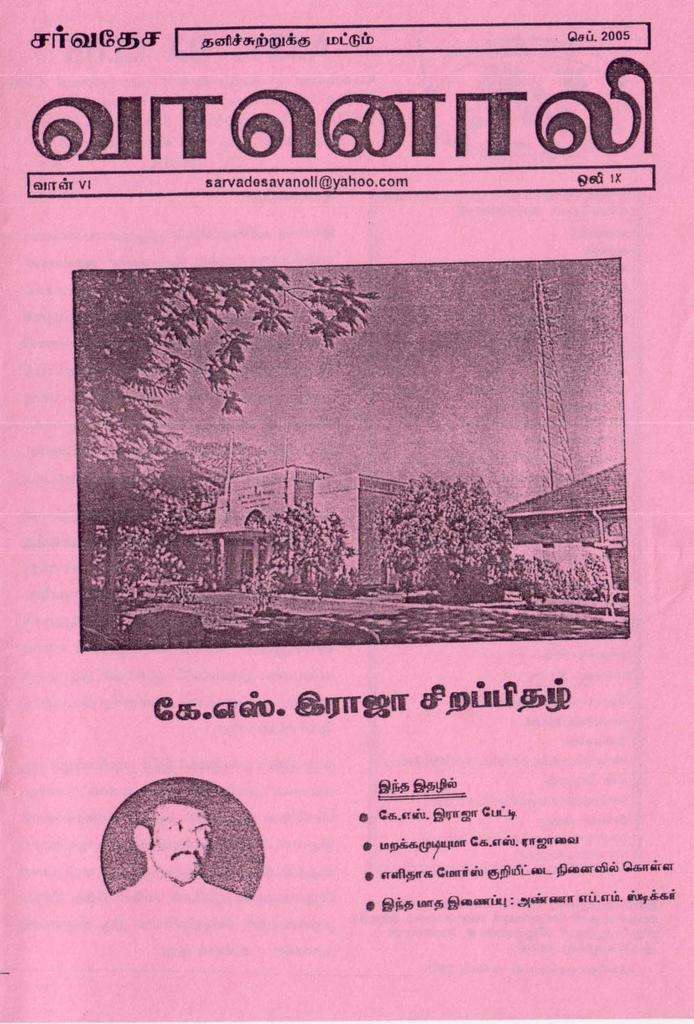
Sarvadesavanoli September 2005
In this September Issue..
K.S RAJAH SPECIAL
* We can’nt forget K.S. Rajah
Viyaram A Kannan www.viyaramonline.com
* K.S.Rajah Interview
- Dinamalar Varamalar
* Radio Vativan Listeners Meet review
Vannai K Raja k_raja123123@yahoo.co.in
* Radio Vatican Sis.Therasa Interview
Vannai K Raja, Baskar Nepolian
* Radio Guide
- Receiving Antenna handbook
* Digital Page:
Philips RL 146 www.philips.co.in
* Short Wave -An Introduction
Easy way to memorize the Morse code
* Radio in Newspaper* Radio Competition details
- Voice of Germany
Inside Europe Quiz europe@dw-world.de
Current affairs quiz newslink@d-world.de
- Radio Singapore International
Jingle Quiz rwww.mediacorpradio.com/jinglecompetition/form.hm
- Radio Veritas Asia tamil@rveritas-asia.org
Monthly Quiz
Annual Quiz
- China Radio International
Tamil Service Quiz Answers tamil@cri.com.cn
English Service Quiz crienf@cri.co.cn
* DX Club News* Dxing Q&A
DRM details
Worldspace details* On the Short Waves* This is 4 U..* Free: Anna 90.2 Sticker
Tuesday, September 27, 2005
Prasar Bharati crosses another milestone
FOCUS: PRASAR BHARATI
Dedicated to the public good
B.S. PADMANABHAN
Prasar Bharati crosses another milestone as its two media units, All India Radio and Doordarshan, enter the digital era.
THE inauguration of a new Broadcasting House and Tower B of Doordarshan in New Delhi recently is an important milestone in the history of public broadcasting in India as it marks its entry into the digital era. The 75-year-old All India Radio (AIR) and its 40-year-old sister organisation, Doordarshan, are now equipped with state-of-the-art technology to compete effectively with private networks in meeting the wide-ranging requirements of the increasing number of listeners and viewers.
The occasion was also significant for another reason: as it seemed to reinforce the fact that public broadcasters continued to be relevant in a developing country like India. As Union Minister for Information and Broadcasting S. Jaipal Reddy said while inaugurating the new buildings, Prasar Bharati, the umbrella organisation under which AIR and Doordarshan function, has not lost its relevance with the advent of satellite television. He rightly pointed out that every developed country with a multi-channel television system had a vibrant public broadcasting service. India was no different, he said.
In fact, a few years ago, a Review Committee headed by N.R. Narayana Murthy underlined the importance of Prasar Bharati in providing high quality media content in order to empower and enlighten citizens. In the opinion of the committee, the programmes should inform, educate and entertain even while ensuring a sizeable audience and reach. In the light of the committee's report, Prasar Bharati sought to reorient its growth strategies and succeeded in making its presence felt as a vibrant and socially relevant public broadcasting organisation. Going digital is the latest manifestation of this trend.
With a network of 215 radio stations, AIR today covers 92 per cent of the country's geographical area and almost the entire population. With a network of over 1,400 terrestrial transmitters, Doordarshan covers 90 per cent of the population and is way ahead of the reach of all the satellite channels put together. Moreover, as the Review Committee envisioned, Doordarshan's channels telecast a healthy mix of entertainment and socially relevant programmes reflecting the varied cultures and languages of the nation.
AIR's studio in New Delhi is the biggest in Asia. It has 26 fully-automated transmission studios and all recording, editing and playback equipment, including mixing consoles and master routers, are in digital mode. Each transmission studio has a digital audio workstation, two compact disc players and a digital mixer. As many as 10 transmission studios have digital phone-in units with the facility to have conference with up to 12 callers on ISDN and PSTN lines. The newsroom has been equipped with state-of-the-art facilities. For the first time in the long history of the radio newsroom the editor will be able to edit news agency copies and compile a bulletin entirely by using the computer network.
The new software system would enable a central server to receive the news from different sources, besides sound bites from television, and make them available to editors on individual workstations. In the studios, instead of reading from paper sheets, newsreaders will now read off computer monitors, where the story will keep getting updated electronically. Sound bites, which used to be manually inserted into bulletins, will now be livening up all the AIR bulletins. The audio quality would also improve since it will be recorded on hard disc, instead of the decades-old tape spools, and transmitted digitally. The digital newsroom will eventually network all the 45 regional news units, making it possible to transfer text and voice across the country at the flick of a button. This will, in turn, improve the response time of AIR to breaking news, and the quality of news bulletins aired from regional bureaus.
Doordarshan has acquired state-of-the-art facilities for production and transmission of programmes. The new Tower B with 11 storeys has four studios besides a large technical area, rehearsal rooms and a film preview theatre. The post-production facility comprises 25 non-linear edit suites, 25 A/B roll edit suites and extensive computer graphics facility. The newsroom has workstations for 75 journalists backed by an integrated automation system.
THE entry of AIR and Doordarshan into the digital era is not a sudden development, but the culmination of a series of technological advancements over the past few years. In line with its mandate as a public broadcaster, AIR has been expanding the radio coverage to reach people who were hitherto outside its network, especially those in the border areas of Jammu and Kashmir, northeastern India and the islands of Lakshadweep and Andaman and Nicobar. In Srinagar, a 300 kW MW transmitter has been installed in place of the existing one with a capacity of 200 kW. Relay stations have been set up at Naushera, Kupwara, Rajouri, Diskit, Khalsi, Nyoma, Drass, Tiesuru and Padum. At Kargil, a 200 kW MW transmitter has been installed to strengthen radio coverage in the border areas. In the northeastern region, FM channels with stereo playback facilities have been set up at Kohima and Itanagar. Port Blair now has an FM channel. AIR has upgraded the captive earth stations at Guwahati, Itanagar and Shillong with digital systems. New digital uplink stations have been added to the AIR network at Jalandhar, Raipur and Ranchi, while nine existing analogue stations at Guwahati, Itanagar, Shillong, Lucknow, Srinagar, Jaipur, Shimla, Patna and Cuttack too have been upgraded with digital systems. The project to expand FM transmission to cover 50 per cent of the country's people is in progress.
A new stereo studio for Leh has been planned. Computer-based recording, editing and playback systems that ensure high quality digital recording and facility for linear as well as non-linear editing have already been installed in 76 stations and more are being brought under the system in a phased manner. Captive earth stations with digital uplink capabilities are being set up in Kolkata, Tiruvananthapuram, Hyderabad, Ahmedabad, Bangalore and Bhopal. The downlink facilities are being digitised in phases. Until March, 53 stations had been provided with digital downlinks. Digitisation of the Akashvani Sound Archives is at an advanced stage and out of the 43,000 compact discs to be prepared 35,000 are ready.
Another significant development is that a dozen AIR channels in different regional languages broadcast from various State capitals are now available all over the country through the Ku-band Direct to Home (DTH) platform of Prasar Bharati. Software has been developed for information exchange and improvement of efficiency in the working of various AIR units. They include online processing software such as AIRNET, archive management information system, document management system, and stand alone software such as library management information system, and proforma accounts system. The AIR news-on-phone service is now operational in five cities - Delhi, Mumbai, Patna, Chennai and Hyderabad. The plan is to introduce it at 11 more stations soon. This facility enables callers to listen to news highlights of the hour by dialling a designated number.
The Tenth Five-Year Plan's proposals for Doordarshan focus on digitisation. Currently, 20 out of Doordarshan's 25 channels are digital. Digital earth stations have already been set up in Mumbai, Hyderabad, Bangalore, Patna, Jallandhar, Chennai, Thiruvananthpuram, Ahmedabad, Kolkata, Bhubaneshwar, Shillong and Aizawl. Engineers of Doordarshan put up, in record time, the Ku-band transmission facility at Todapur, near New Delhi, for broadcasting DD Direct Plus, the Direct-To-Home (DTH) broadcast service. Ku-band transmission, which ensures near total coverage, is a cost-effective alternative to terrestrial transmission. Doordarshan has distributed 10,000 DTH receiver systems and 200 cable head-ends in select States of north, central and northeastern India, where television coverage is below the national average. One of the compelling reasons for introducing DTH is to ensure that programmes of AIR and Doordarshan reach every household in the country. The DTH service would help Doordarshan and AIR expand their reach with investment much lower than that required for increasing the number of transmitters.
Mere expansion of facilities without improvement in the content of the programmes can hardly help public broadcasters survive in a competitive environment. From all accounts, both AIR and Doordarshan are conscious of this and have taken fruitful initiatives to make the programmes attractive, educative and purposeful. The public broadcasters have an added responsibility to avoid the pitfalls associated with commercialisation of programmes. Their mandate includes upholding the values enshrined in the Constitution, promoting national integration and social justice, facilitating socio-economic development, empowering women, children and other vulnerable groups. To fulfil this mandate, with all the financial and administrative constraints associated with public sector enterprises, is no easy task. But both AIR and Doordarshan have been able to strike a balance between their responsibilities as agents of social change and their need to become financially viable without depending too much on budgetary support.
AIR, for instance, has launched agricultural programmes called Kisan Vani, broadcast from 96 stations. It has been regularly broadcasting programmes on land and water conservation, sustainable agriculture, biotechnology, environment protection, disaster management and so on. More than 15,000 programmes on various aspects of health and family welfare are broadcast every month. These are in addition to extensive and in-depth coverage of political developments and international affairs. Similarly, Doordarshan has been focussing on development communication. In fact, it has a Development Communication Division (DCD) exclusively devoted to the production of special programmes on development-oriented topics. The DCD has produced over 900 special programmes for six Ministries. One of these, Kalyani I & II, won the prestigious Gates Malaria Award of the Commonwealth Broadcasting Association.
Doordarshan has been quite successful in promoting coverage of important sports events. Recently, it unveiled a new scheme for live coverage of sports events under which a sports federation staging an event has to pay only the actual expenditure incurred by Doordarshan in broadcasting the event live or deferred live. The first memorandum of understanding under this scheme was signed in June between Doordarshan and the Squash Rackets Federation of India. Several sports federations have evinced interest in this facility. Doordarshan has done away with the earlier practice of payment of rights fees. The new system provides for arranging sponsors for the tournaments by the sports federation concerned or through the Prasar Bharati's marketing divisions.
There is a view that AIR and Doordarshan would be able to compete effectively with the private networks only if they are freed from the clutches of the government and allowed greater autonomy to function as commercial organisations. On the face of it, this view appears reasonable, but a deeper analysis shows that autonomy may make AIR and Doordarshan vulnerable to market forces, which would lead to the neglect of their mandate. The need to compete for advertisement revenue should not make them deviate from the mandate. They cannot follow the example of unregulated satellite sectors dominated by big media players. In this context, it is encouraging to note that the revenues of both AIR and Doordarshan have been rising over the past three years.
Meanwhile, Prasar Bharati employees are concerned that their status and service conditions would be affected in the event of autonomy. Jaipal Reddy has assured the employees that their interests would not be compromised in any way when Prasar Bharati is granted more autonomy. He urged them to work with commitment and a sense of mission to produce quality programmes. The present job structure shows that in Doordarshan engineering and administration personnel outnumber the programme staff, who account for just 17 per cent. There is thus scope for increasing the staff strength in the programme section.
In fact, the Standing Committee of Parliament on Information and Broadcasting in a recent report expressed concern over the acute shortage of staff faced by AIR and Doordarshan. It pointed out that Prasar Bharati could not focus on the quality and content of programmes owing to the many vacancies at various levels. It noted that trained persons had migrated to private networks. [Frontline Volume 22 - Issue 19, Sep 10 - 23, 2005]
Dedicated to the public good
B.S. PADMANABHAN
Prasar Bharati crosses another milestone as its two media units, All India Radio and Doordarshan, enter the digital era.
THE inauguration of a new Broadcasting House and Tower B of Doordarshan in New Delhi recently is an important milestone in the history of public broadcasting in India as it marks its entry into the digital era. The 75-year-old All India Radio (AIR) and its 40-year-old sister organisation, Doordarshan, are now equipped with state-of-the-art technology to compete effectively with private networks in meeting the wide-ranging requirements of the increasing number of listeners and viewers.
The occasion was also significant for another reason: as it seemed to reinforce the fact that public broadcasters continued to be relevant in a developing country like India. As Union Minister for Information and Broadcasting S. Jaipal Reddy said while inaugurating the new buildings, Prasar Bharati, the umbrella organisation under which AIR and Doordarshan function, has not lost its relevance with the advent of satellite television. He rightly pointed out that every developed country with a multi-channel television system had a vibrant public broadcasting service. India was no different, he said.
In fact, a few years ago, a Review Committee headed by N.R. Narayana Murthy underlined the importance of Prasar Bharati in providing high quality media content in order to empower and enlighten citizens. In the opinion of the committee, the programmes should inform, educate and entertain even while ensuring a sizeable audience and reach. In the light of the committee's report, Prasar Bharati sought to reorient its growth strategies and succeeded in making its presence felt as a vibrant and socially relevant public broadcasting organisation. Going digital is the latest manifestation of this trend.
With a network of 215 radio stations, AIR today covers 92 per cent of the country's geographical area and almost the entire population. With a network of over 1,400 terrestrial transmitters, Doordarshan covers 90 per cent of the population and is way ahead of the reach of all the satellite channels put together. Moreover, as the Review Committee envisioned, Doordarshan's channels telecast a healthy mix of entertainment and socially relevant programmes reflecting the varied cultures and languages of the nation.
AIR's studio in New Delhi is the biggest in Asia. It has 26 fully-automated transmission studios and all recording, editing and playback equipment, including mixing consoles and master routers, are in digital mode. Each transmission studio has a digital audio workstation, two compact disc players and a digital mixer. As many as 10 transmission studios have digital phone-in units with the facility to have conference with up to 12 callers on ISDN and PSTN lines. The newsroom has been equipped with state-of-the-art facilities. For the first time in the long history of the radio newsroom the editor will be able to edit news agency copies and compile a bulletin entirely by using the computer network.
The new software system would enable a central server to receive the news from different sources, besides sound bites from television, and make them available to editors on individual workstations. In the studios, instead of reading from paper sheets, newsreaders will now read off computer monitors, where the story will keep getting updated electronically. Sound bites, which used to be manually inserted into bulletins, will now be livening up all the AIR bulletins. The audio quality would also improve since it will be recorded on hard disc, instead of the decades-old tape spools, and transmitted digitally. The digital newsroom will eventually network all the 45 regional news units, making it possible to transfer text and voice across the country at the flick of a button. This will, in turn, improve the response time of AIR to breaking news, and the quality of news bulletins aired from regional bureaus.
Doordarshan has acquired state-of-the-art facilities for production and transmission of programmes. The new Tower B with 11 storeys has four studios besides a large technical area, rehearsal rooms and a film preview theatre. The post-production facility comprises 25 non-linear edit suites, 25 A/B roll edit suites and extensive computer graphics facility. The newsroom has workstations for 75 journalists backed by an integrated automation system.
THE entry of AIR and Doordarshan into the digital era is not a sudden development, but the culmination of a series of technological advancements over the past few years. In line with its mandate as a public broadcaster, AIR has been expanding the radio coverage to reach people who were hitherto outside its network, especially those in the border areas of Jammu and Kashmir, northeastern India and the islands of Lakshadweep and Andaman and Nicobar. In Srinagar, a 300 kW MW transmitter has been installed in place of the existing one with a capacity of 200 kW. Relay stations have been set up at Naushera, Kupwara, Rajouri, Diskit, Khalsi, Nyoma, Drass, Tiesuru and Padum. At Kargil, a 200 kW MW transmitter has been installed to strengthen radio coverage in the border areas. In the northeastern region, FM channels with stereo playback facilities have been set up at Kohima and Itanagar. Port Blair now has an FM channel. AIR has upgraded the captive earth stations at Guwahati, Itanagar and Shillong with digital systems. New digital uplink stations have been added to the AIR network at Jalandhar, Raipur and Ranchi, while nine existing analogue stations at Guwahati, Itanagar, Shillong, Lucknow, Srinagar, Jaipur, Shimla, Patna and Cuttack too have been upgraded with digital systems. The project to expand FM transmission to cover 50 per cent of the country's people is in progress.
A new stereo studio for Leh has been planned. Computer-based recording, editing and playback systems that ensure high quality digital recording and facility for linear as well as non-linear editing have already been installed in 76 stations and more are being brought under the system in a phased manner. Captive earth stations with digital uplink capabilities are being set up in Kolkata, Tiruvananthapuram, Hyderabad, Ahmedabad, Bangalore and Bhopal. The downlink facilities are being digitised in phases. Until March, 53 stations had been provided with digital downlinks. Digitisation of the Akashvani Sound Archives is at an advanced stage and out of the 43,000 compact discs to be prepared 35,000 are ready.
Another significant development is that a dozen AIR channels in different regional languages broadcast from various State capitals are now available all over the country through the Ku-band Direct to Home (DTH) platform of Prasar Bharati. Software has been developed for information exchange and improvement of efficiency in the working of various AIR units. They include online processing software such as AIRNET, archive management information system, document management system, and stand alone software such as library management information system, and proforma accounts system. The AIR news-on-phone service is now operational in five cities - Delhi, Mumbai, Patna, Chennai and Hyderabad. The plan is to introduce it at 11 more stations soon. This facility enables callers to listen to news highlights of the hour by dialling a designated number.
The Tenth Five-Year Plan's proposals for Doordarshan focus on digitisation. Currently, 20 out of Doordarshan's 25 channels are digital. Digital earth stations have already been set up in Mumbai, Hyderabad, Bangalore, Patna, Jallandhar, Chennai, Thiruvananthpuram, Ahmedabad, Kolkata, Bhubaneshwar, Shillong and Aizawl. Engineers of Doordarshan put up, in record time, the Ku-band transmission facility at Todapur, near New Delhi, for broadcasting DD Direct Plus, the Direct-To-Home (DTH) broadcast service. Ku-band transmission, which ensures near total coverage, is a cost-effective alternative to terrestrial transmission. Doordarshan has distributed 10,000 DTH receiver systems and 200 cable head-ends in select States of north, central and northeastern India, where television coverage is below the national average. One of the compelling reasons for introducing DTH is to ensure that programmes of AIR and Doordarshan reach every household in the country. The DTH service would help Doordarshan and AIR expand their reach with investment much lower than that required for increasing the number of transmitters.
Mere expansion of facilities without improvement in the content of the programmes can hardly help public broadcasters survive in a competitive environment. From all accounts, both AIR and Doordarshan are conscious of this and have taken fruitful initiatives to make the programmes attractive, educative and purposeful. The public broadcasters have an added responsibility to avoid the pitfalls associated with commercialisation of programmes. Their mandate includes upholding the values enshrined in the Constitution, promoting national integration and social justice, facilitating socio-economic development, empowering women, children and other vulnerable groups. To fulfil this mandate, with all the financial and administrative constraints associated with public sector enterprises, is no easy task. But both AIR and Doordarshan have been able to strike a balance between their responsibilities as agents of social change and their need to become financially viable without depending too much on budgetary support.
AIR, for instance, has launched agricultural programmes called Kisan Vani, broadcast from 96 stations. It has been regularly broadcasting programmes on land and water conservation, sustainable agriculture, biotechnology, environment protection, disaster management and so on. More than 15,000 programmes on various aspects of health and family welfare are broadcast every month. These are in addition to extensive and in-depth coverage of political developments and international affairs. Similarly, Doordarshan has been focussing on development communication. In fact, it has a Development Communication Division (DCD) exclusively devoted to the production of special programmes on development-oriented topics. The DCD has produced over 900 special programmes for six Ministries. One of these, Kalyani I & II, won the prestigious Gates Malaria Award of the Commonwealth Broadcasting Association.
Doordarshan has been quite successful in promoting coverage of important sports events. Recently, it unveiled a new scheme for live coverage of sports events under which a sports federation staging an event has to pay only the actual expenditure incurred by Doordarshan in broadcasting the event live or deferred live. The first memorandum of understanding under this scheme was signed in June between Doordarshan and the Squash Rackets Federation of India. Several sports federations have evinced interest in this facility. Doordarshan has done away with the earlier practice of payment of rights fees. The new system provides for arranging sponsors for the tournaments by the sports federation concerned or through the Prasar Bharati's marketing divisions.
There is a view that AIR and Doordarshan would be able to compete effectively with the private networks only if they are freed from the clutches of the government and allowed greater autonomy to function as commercial organisations. On the face of it, this view appears reasonable, but a deeper analysis shows that autonomy may make AIR and Doordarshan vulnerable to market forces, which would lead to the neglect of their mandate. The need to compete for advertisement revenue should not make them deviate from the mandate. They cannot follow the example of unregulated satellite sectors dominated by big media players. In this context, it is encouraging to note that the revenues of both AIR and Doordarshan have been rising over the past three years.
Meanwhile, Prasar Bharati employees are concerned that their status and service conditions would be affected in the event of autonomy. Jaipal Reddy has assured the employees that their interests would not be compromised in any way when Prasar Bharati is granted more autonomy. He urged them to work with commitment and a sense of mission to produce quality programmes. The present job structure shows that in Doordarshan engineering and administration personnel outnumber the programme staff, who account for just 17 per cent. There is thus scope for increasing the staff strength in the programme section.
In fact, the Standing Committee of Parliament on Information and Broadcasting in a recent report expressed concern over the acute shortage of staff faced by AIR and Doordarshan. It pointed out that Prasar Bharati could not focus on the quality and content of programmes owing to the many vacancies at various levels. It noted that trained persons had migrated to private networks. [Frontline Volume 22 - Issue 19, Sep 10 - 23, 2005]
Interview with K.S. Sharma CEO, AIR
FOCUS: PRASAR BHARATI
Modernising and moving ahead Interview with K.S. Sharma,
Chief Executive Officer, Prasar Bharati.
Radio broadcasting in India has a history of over 75 years and television has been there for the past 40 years. All India Radio and Doordarshan have become part and parcel of almost every Indian household, providing not only entertainment but also educative, informative and cultural programmes. Until recently, both enjoyed monopoly and had the full share of the advertisement spending by the private sector, besides budgetary support. But recent advances in satellite technology have brought about a revolution in communication and the air waves are no longer the monopoly of anyone. The result has been the mushrooming of profit-oriented private channels, which offer a variety of entertainment programmes. The whole situation had changed and it was in this context that eight years ago Prasar Bharati was set up, with AIR and Doordarshan as its constituents, to function as a public service broadcaster and ensure a balanced development of broadcasting on radio and television. This is no easy task, considering the financial and administrative constraints Prasar Bharati faces as a government organisation and the fierce competition from the proliferating private channels for a share in the advertisement spending of the consumer products industry. Prasar Bharati has to depend increasingly on government grants to fulfil its mandate and strike a balance between its role as a public service broadcaster and the need to become commercially viable. In spite of all these disadvantages, Prasar Bharati has been able to expand its reach. Today AIR covers 92 per cent of the geographical area of the country and almost the entire population. Doordarshan covers 90 per cent of the population and justifiably claims that its reach is way ahead of the reach of all the satellite channels put together. Although Prasar Bharati has become the most preferred choice of advertisers, its mandate is to devote a large chunk of its broadcasting time to educative, informative and socially relevant programmes, which do not earn revenue. To create a healthy public broadcasting environment, there is an urgent need to find ways and means of funding its operations in a sustained manner, said K.S. Sharma, Chief Executive Officer of Prasar Bharati. Sharma, who was recently re-elected president of the Indian Broadcasting Foundation, detailed the various initiatives taken by Prasar Bharati to keep pace with global developments in the field of broadcasting and cater to the wide-ranging needs of listeners and viewers without compromising on the quality of the programme content or succumbing to market forces. He underlined the need to regulate the growth of broadcasting in India. Excerpts from an interview he gave B.S. Padmanabhan: What is the significance of AIR and Doordarshan going digital and acquiring state-of-the-art facilities for the production and transmission of programmes? How would this help Prasar Bharati fulfil its mission as a public broadcaster? The communication landscape worldwide is undergoing rapid changes. Digital communication, which promises clear picture and sound quality and ensures optimum utilisation of [satellite] spectrum, has become the technology of choice for many broadcasters around the world. Prasar Bharati, being one of the leading public service broadcasting organisations in the world, does not want to be left behind.
In fact, digitisation and automation are the thrust areas of broadcast development during the Tenth Five Year Plan period. Out of the 26 channels of Doordarshan, 23 have been made digital. Captive Earth Stations, uplink and downlink facilities are being digitised in a phased manner. Seven major studio centres of Doordarshan in New Delhi, Mumbai, Kolkata, Chennai, Hyderabad, Bangalore and the Central Production Centre in New Delhi have already been made fully digital. The newly inaugurated studio set-ups at Doordarshan Bhawan and the New Broadcasting House rank among the largest facilities in the Asia-Pacific region and perhaps the best too. As regards the public service mission, one of the objectives of Prasar Bharati, as laid down in the Prasar Bharati Act 1990, is to expand the broadcasting facilities and promote research and development in broadcast technology. So the digitisation drive of Prasar Bharati is in line with its public service mandate. As a government organisation, what are the constraints that Prasar Bharati faces in fulfilling its social commitment and at the same time effectively competing with private operators for advertisement revenue? As a public service broadcasting organisation, Prasar Bharati is bound by all the rules and procedures that apply to government organisations. Despite increasing revenues, nearly two-thirds of Prasar Bharati's requirements are met by the government. It is true that even as our revenues are growing, the market share is declining because the advertising pie is being divided among far too many players. The reach of DD National, with nearly 400 million viewers, makes it the biggest media vehicle ahead of any satellite channel, radio station or a print publication. By its sheer reach, it is the most preferred vehicle for brand building for most of the mass consumption products. Yet, only one-third of the total broadcasting time on the channel is devoted to revenue-generating entertainment programmes. Rest of the time is used for information and education programmes. We are perfectly happy discharging our role as a public broadcaster. But to create a healthy public broadcasting environment, there is an urgent need to find ways to fund the operations in a sustained manner. How is the financial performance of Prasar Bharati? Although revenues have been increasing, losses too seem to be mounting. What are the factors contributing to this situation and what is the remedy? For the past three years, the revenues of Prasar Bharati have been increasing rapidly. Live telecast of cricket matches, feature films and serials have boosted the revenues for Doordarshan. A large chunk of the government's media budget is now spent on Doordarshan, which offers turnkey production-cum-broadcasting solutions. All India Radio crossed the Rs.100-crore revenue mark two years ago and is now headed for over Rs.150 crores. Prasar Bharati earned a total revenue of Rs.835 crores and the target for this year is in the region of Rs.1,000 crores. Increasingly, we have been laying thrust on in-house marketing and it is bearing fruits. Our marketing division in Mumbai has acquired expertise in selling cricket, films and other special events with maximum impact. We have six such marketing divisions in operation. We have also rationalised our rate card and made it market friendly. The decision-making process has also been quickened with the approval of the Prasar Bharati Board. However, mounting establishment expenses and expenditure on maintenance of vastly expanded infrastructure have put a strain on our finances. Public service broadcasters facing funds crunch is a worldwide phenomenon - from Australia to America. However, some countries, such as Britain, have found acceptable solutions in the form of licence fee on television sets to fund the operations of BBC. Elsewhere, the Universal Service Obligation Fund provides the answer. The National Federation of Akashvani and Doordarshan Employees have sought a repeal of the Prasar Bharati Act in view of its financial unviability. How do you respond to this demand? Some of the grievances of the employees are genuine. They have been denied government accommodation and the concessional Central government health cover. We have taken up these issues with the government and have been assured of a sympathetic consideration. It was reassuring that Minister for Information and Broadcasting S. Jaipal Reddy, while inaugurating the new buildings of Doordarshan and AIR, said that the interests of employees would not be compromised in any way. The argument that Prasar Bharati has lost relevance with the advent of several private channels does not hold much water. Instead, the role of an autonomous public service organisation has increased manifold - to ensure universal access to information, education and entertainment and to create a balanced public opinion through dissemination of information on a non-discriminatory basis. This is the reason why every developed country in the world has a vibrant public service broadcaster. The Parliamentary Standing Committee, in its Report presented in August 2004, voiced concern over the overall shortage of staff, especially on the programme side and mentioned that trained staff was migrating to private channels. What steps are being taken to deal with the situation? The popular perception is that Doordarshan and AIR are hugely over-staffed organisations. But the reverse is the truth. We are facing acute shortage of staff, especially in the programming field. For example, programme personnel account for only 17 per cent of total staff in Doordarshan and 27 per cent of total staff in AIR. We need to address this issue urgently, as it is affecting our in-house programme production ability. Prasar Bharati is in the process of formulating its recruitment rules. Prasar Bharati launched its direct-to-home (DTH) service in December 2004. What has been the public response to this? How many households have opted for DTH? What steps are being taken to expand coverage by DTH? Our DTH service, DD Direct Plus, is a runaway success. Within eight months of the launch by the Prime Minister, the Prasar Bharati DTH service has attracted over four million customers across the country, with Tamil Nadu leading the way. Maharashtra, Andhra Pradesh and Gujarat are the other States where our DTH has been quite popular. Currently, we are offering 33 television channels and 12 radio channels. We will be expanding our bouquet soon to include 52 television channels and 30 radio channels. Several private players have evinced interest in joining our DTH platform. However, DD Direct Plus being a free-to-air DTH service, we can only take non-pay channels. We are yet to take a decision on taking private radio channels on our platform. The primary objective of Prasar Bharati's DTH service is to attain near 100 per cent television coverage in the country through Ku Band transmission. Towards this end we are distributing 10,000 DTH dish antennae and set-top boxes to community organisations in remote areas of the country. I would also like to mention about two of our on-going projects - digitisation of Akashvani and Doordarshan archives and the Indian Classics project. AIR and Doordarshan are the treasure houses of India's cultural heritage. Many memorable and rare performances of maestros of music and doyens of Indian classical dance have been captured and preserved in the tapes of AIR and Doordarshan for posterity. The digitisation process of Akashvani and Doordarshan archives is in an advanced stage. We have brought out outstanding recordings in the form of compact discs, video compact discs and digital video discs for the benefit of general public. You were recently re-elected president of the Indian Broadcasting Foundation. How do you view the prevailing trends in the Indian broadcasting industry? Indian broadcasting industry has been growing rapidly. Keeping in tune with the expanding economy advertisement spending is also increasing, but at the same time the number of channels beaming into India too is going up. There are already more than 150 channels beaming into India, making it one of the most crowded television markets in the world. The spurt in news channels has changed the way information is presented, but cut-throat competition has contributed to the sensationalisation of trivia. The biggest lacuna of the Indian broadcasting industry is its unregulated growth. It desperately needs a regulator to ensure proper growth and promote healthy competition. [Frontline Volume 22 - Issue 20, Sep. 24 - Oct. 07, 2005]
Modernising and moving ahead Interview with K.S. Sharma,
Chief Executive Officer, Prasar Bharati.
Radio broadcasting in India has a history of over 75 years and television has been there for the past 40 years. All India Radio and Doordarshan have become part and parcel of almost every Indian household, providing not only entertainment but also educative, informative and cultural programmes. Until recently, both enjoyed monopoly and had the full share of the advertisement spending by the private sector, besides budgetary support. But recent advances in satellite technology have brought about a revolution in communication and the air waves are no longer the monopoly of anyone. The result has been the mushrooming of profit-oriented private channels, which offer a variety of entertainment programmes. The whole situation had changed and it was in this context that eight years ago Prasar Bharati was set up, with AIR and Doordarshan as its constituents, to function as a public service broadcaster and ensure a balanced development of broadcasting on radio and television. This is no easy task, considering the financial and administrative constraints Prasar Bharati faces as a government organisation and the fierce competition from the proliferating private channels for a share in the advertisement spending of the consumer products industry. Prasar Bharati has to depend increasingly on government grants to fulfil its mandate and strike a balance between its role as a public service broadcaster and the need to become commercially viable. In spite of all these disadvantages, Prasar Bharati has been able to expand its reach. Today AIR covers 92 per cent of the geographical area of the country and almost the entire population. Doordarshan covers 90 per cent of the population and justifiably claims that its reach is way ahead of the reach of all the satellite channels put together. Although Prasar Bharati has become the most preferred choice of advertisers, its mandate is to devote a large chunk of its broadcasting time to educative, informative and socially relevant programmes, which do not earn revenue. To create a healthy public broadcasting environment, there is an urgent need to find ways and means of funding its operations in a sustained manner, said K.S. Sharma, Chief Executive Officer of Prasar Bharati. Sharma, who was recently re-elected president of the Indian Broadcasting Foundation, detailed the various initiatives taken by Prasar Bharati to keep pace with global developments in the field of broadcasting and cater to the wide-ranging needs of listeners and viewers without compromising on the quality of the programme content or succumbing to market forces. He underlined the need to regulate the growth of broadcasting in India. Excerpts from an interview he gave B.S. Padmanabhan: What is the significance of AIR and Doordarshan going digital and acquiring state-of-the-art facilities for the production and transmission of programmes? How would this help Prasar Bharati fulfil its mission as a public broadcaster? The communication landscape worldwide is undergoing rapid changes. Digital communication, which promises clear picture and sound quality and ensures optimum utilisation of [satellite] spectrum, has become the technology of choice for many broadcasters around the world. Prasar Bharati, being one of the leading public service broadcasting organisations in the world, does not want to be left behind.
In fact, digitisation and automation are the thrust areas of broadcast development during the Tenth Five Year Plan period. Out of the 26 channels of Doordarshan, 23 have been made digital. Captive Earth Stations, uplink and downlink facilities are being digitised in a phased manner. Seven major studio centres of Doordarshan in New Delhi, Mumbai, Kolkata, Chennai, Hyderabad, Bangalore and the Central Production Centre in New Delhi have already been made fully digital. The newly inaugurated studio set-ups at Doordarshan Bhawan and the New Broadcasting House rank among the largest facilities in the Asia-Pacific region and perhaps the best too. As regards the public service mission, one of the objectives of Prasar Bharati, as laid down in the Prasar Bharati Act 1990, is to expand the broadcasting facilities and promote research and development in broadcast technology. So the digitisation drive of Prasar Bharati is in line with its public service mandate. As a government organisation, what are the constraints that Prasar Bharati faces in fulfilling its social commitment and at the same time effectively competing with private operators for advertisement revenue? As a public service broadcasting organisation, Prasar Bharati is bound by all the rules and procedures that apply to government organisations. Despite increasing revenues, nearly two-thirds of Prasar Bharati's requirements are met by the government. It is true that even as our revenues are growing, the market share is declining because the advertising pie is being divided among far too many players. The reach of DD National, with nearly 400 million viewers, makes it the biggest media vehicle ahead of any satellite channel, radio station or a print publication. By its sheer reach, it is the most preferred vehicle for brand building for most of the mass consumption products. Yet, only one-third of the total broadcasting time on the channel is devoted to revenue-generating entertainment programmes. Rest of the time is used for information and education programmes. We are perfectly happy discharging our role as a public broadcaster. But to create a healthy public broadcasting environment, there is an urgent need to find ways to fund the operations in a sustained manner. How is the financial performance of Prasar Bharati? Although revenues have been increasing, losses too seem to be mounting. What are the factors contributing to this situation and what is the remedy? For the past three years, the revenues of Prasar Bharati have been increasing rapidly. Live telecast of cricket matches, feature films and serials have boosted the revenues for Doordarshan. A large chunk of the government's media budget is now spent on Doordarshan, which offers turnkey production-cum-broadcasting solutions. All India Radio crossed the Rs.100-crore revenue mark two years ago and is now headed for over Rs.150 crores. Prasar Bharati earned a total revenue of Rs.835 crores and the target for this year is in the region of Rs.1,000 crores. Increasingly, we have been laying thrust on in-house marketing and it is bearing fruits. Our marketing division in Mumbai has acquired expertise in selling cricket, films and other special events with maximum impact. We have six such marketing divisions in operation. We have also rationalised our rate card and made it market friendly. The decision-making process has also been quickened with the approval of the Prasar Bharati Board. However, mounting establishment expenses and expenditure on maintenance of vastly expanded infrastructure have put a strain on our finances. Public service broadcasters facing funds crunch is a worldwide phenomenon - from Australia to America. However, some countries, such as Britain, have found acceptable solutions in the form of licence fee on television sets to fund the operations of BBC. Elsewhere, the Universal Service Obligation Fund provides the answer. The National Federation of Akashvani and Doordarshan Employees have sought a repeal of the Prasar Bharati Act in view of its financial unviability. How do you respond to this demand? Some of the grievances of the employees are genuine. They have been denied government accommodation and the concessional Central government health cover. We have taken up these issues with the government and have been assured of a sympathetic consideration. It was reassuring that Minister for Information and Broadcasting S. Jaipal Reddy, while inaugurating the new buildings of Doordarshan and AIR, said that the interests of employees would not be compromised in any way. The argument that Prasar Bharati has lost relevance with the advent of several private channels does not hold much water. Instead, the role of an autonomous public service organisation has increased manifold - to ensure universal access to information, education and entertainment and to create a balanced public opinion through dissemination of information on a non-discriminatory basis. This is the reason why every developed country in the world has a vibrant public service broadcaster. The Parliamentary Standing Committee, in its Report presented in August 2004, voiced concern over the overall shortage of staff, especially on the programme side and mentioned that trained staff was migrating to private channels. What steps are being taken to deal with the situation? The popular perception is that Doordarshan and AIR are hugely over-staffed organisations. But the reverse is the truth. We are facing acute shortage of staff, especially in the programming field. For example, programme personnel account for only 17 per cent of total staff in Doordarshan and 27 per cent of total staff in AIR. We need to address this issue urgently, as it is affecting our in-house programme production ability. Prasar Bharati is in the process of formulating its recruitment rules. Prasar Bharati launched its direct-to-home (DTH) service in December 2004. What has been the public response to this? How many households have opted for DTH? What steps are being taken to expand coverage by DTH? Our DTH service, DD Direct Plus, is a runaway success. Within eight months of the launch by the Prime Minister, the Prasar Bharati DTH service has attracted over four million customers across the country, with Tamil Nadu leading the way. Maharashtra, Andhra Pradesh and Gujarat are the other States where our DTH has been quite popular. Currently, we are offering 33 television channels and 12 radio channels. We will be expanding our bouquet soon to include 52 television channels and 30 radio channels. Several private players have evinced interest in joining our DTH platform. However, DD Direct Plus being a free-to-air DTH service, we can only take non-pay channels. We are yet to take a decision on taking private radio channels on our platform. The primary objective of Prasar Bharati's DTH service is to attain near 100 per cent television coverage in the country through Ku Band transmission. Towards this end we are distributing 10,000 DTH dish antennae and set-top boxes to community organisations in remote areas of the country. I would also like to mention about two of our on-going projects - digitisation of Akashvani and Doordarshan archives and the Indian Classics project. AIR and Doordarshan are the treasure houses of India's cultural heritage. Many memorable and rare performances of maestros of music and doyens of Indian classical dance have been captured and preserved in the tapes of AIR and Doordarshan for posterity. The digitisation process of Akashvani and Doordarshan archives is in an advanced stage. We have brought out outstanding recordings in the form of compact discs, video compact discs and digital video discs for the benefit of general public. You were recently re-elected president of the Indian Broadcasting Foundation. How do you view the prevailing trends in the Indian broadcasting industry? Indian broadcasting industry has been growing rapidly. Keeping in tune with the expanding economy advertisement spending is also increasing, but at the same time the number of channels beaming into India too is going up. There are already more than 150 channels beaming into India, making it one of the most crowded television markets in the world. The spurt in news channels has changed the way information is presented, but cut-throat competition has contributed to the sensationalisation of trivia. The biggest lacuna of the Indian broadcasting industry is its unregulated growth. It desperately needs a regulator to ensure proper growth and promote healthy competition. [Frontline Volume 22 - Issue 20, Sep. 24 - Oct. 07, 2005]
Farewell to Rajkot 1071 kHz 1000 kw Transmitter
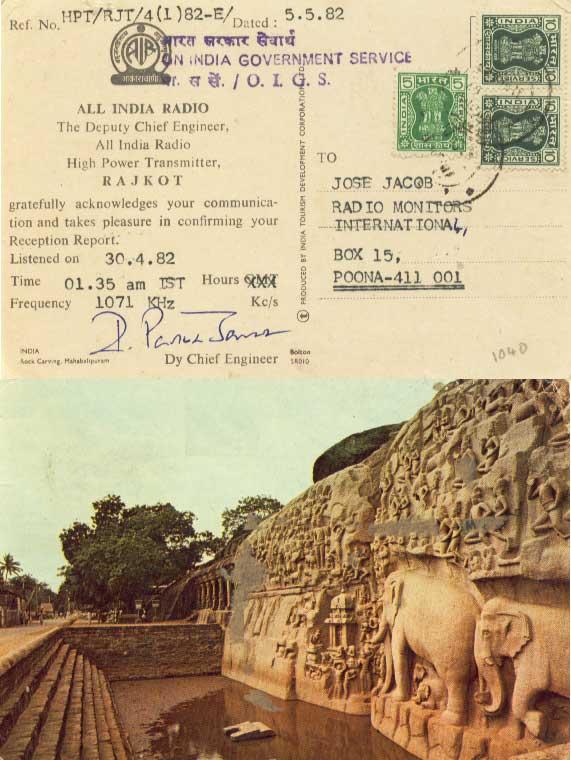
Dear Friends,It is now confirmed that the 1000 kW transmitteroperating from Rajkot on 1071 kHz for ExternalServices of AIR has closed down in June 2004. Itstarted tranmsisions sometime around (August) 1970 andused to beam towards Pakistan and Afghanistan.They used to issue nice QSL cards. To view the one Igot please click: http://www.qsl.net/vu2jos/qsls/rajkot_1071.jpg
Jose Jacob, VU2JOS
National Institute of Amateur Radio
Raj Bhavan Road, Hyderabad 500082, India
Tel: 91-40-5516 7388 Telefax: 91-40-2331 0287
EchoLink: Node No. 133507 VU2NRO
Note: This QSL picture shows that Mamalapuram, Tamil Nadu.
I think this is the only QSL AIR published the Tamil Nadu tourism place.
Monday, September 26, 2005
The Eton E1 is assembled in India
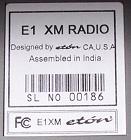
The E1 is assembled in India and sports Eton's new rubberized finish that has tremendous tactile appeal. All of the controls feel solid and sturdy and the radio absolutely exudes quality…it is a joy to hold and operate. Only the initial batch of E1's had been shipped as of this writing…my radio is serial number 186, but initial quality has been outstanding. Eton may have taken their time bringing the E1 to market, but it appears the wait has been well worth it.
The Eton E1 retails for $500 in the U.S. (XM antenna a $50 option). I have put the E1 through exhaustive comparisons with several reference receivers and those results will appear throughout this article.
Eton E1AM/FM/SW/XM receiver is assembled in India
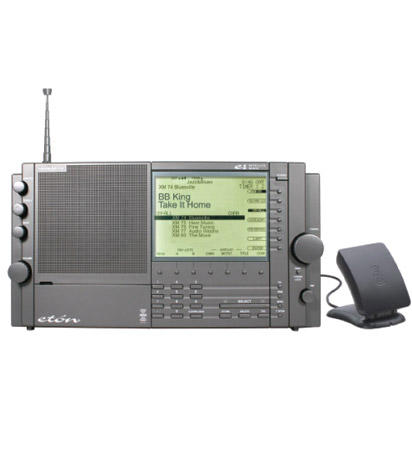
August 2005…the date the long awaited, much anticipated Eton E1 receiver finally made it to market. Why is this particular product introduction so noteworthy? Well for one thing we've waited 10 years for it. Originally unveiled in prototype form at the Consumer Electronics Show in Chicago in 1996 as the Grundig Satellit 900, the E1 has followed a long road from those first mockup models to commercial realization. Originally sidelined because a critical circuit component was discontinued (at least that's one of the stories), the never-to-be Satellit 900 was promised time and time again with new delivery dates which came and went with no Satellit 900 ever marketed.
There's another reason as well…the Eton E1, as a replacement for the recently discontinued, somewhat controversial Grundig Satellit 800, marks the end of the famous Grundig Satellit name plate and is Eton's statement that they are indeed the corporate entity behind this new radio. (The Satellit 800 is controversial for a few reasons. First, it was made to resemble its predecessor, Satellit 650, but internally is a completely different design. This really offended lovers of the 650 series. Secondly, although its ultimate performance is considered to be excellent, its quality control was horrendous. A high percentage of 800's had to serviced by R.L. Drake before they would perform to specifications. However, once you had a "good one", either through Drake's excellent service or just by luck of the draw, you had a radio which is astounding anywhere near it's price point). Through a somewhat secretive collaboration with R.L. Drake and XM Satellite radio the E1 is a bold and fresh new contender in the World Band portable radio market. The E1 heads up a line of radios which also include the smaller E10 and E100 portables. And even though this is no longer referred to as a "Grundig Satellit" radio, it is indeed "XM Satellite Ready." Satellite Ready is a new, official XM standard and means that the radio that will provide XM when attached to an optional, external XM antenna.
The E-1 is in many ways a departure from those classic Grundigs. Although the Satellit’s could all be classified as portables because they contain built-in antennas and run on battery or AC power, they were very large heavy radios. There were a few smaller Grundig Satellit models, the most recent of which, the Satellit 700, was a prime example of quality and features and is highly regarded by Grundig aficionados. The E-1 is a lap-sized portable at approximately 13” x 7” ½ x 3”. It is the largest World Band portable available right now, somewhat larger than the Sony 2010 or SW77 portables but small compared with the Satellit 800 which is is over 20 3/8” x 10 1/4 x 8”. In fact Eton’s own literature refers to the E-1 as a Porta-Top…a cross between a portable and a tabletop set, and for many reasons that is appropriate as we shall see.
For all these reasons the radio industry is anxious to know how the new E1 compares with the Satellit 800, the famous Sony 2010, arguably one of the most successful and highly respected portable SW receivers of all time, and the Sony SW77, the most recently discontinued top of the line Sony portable. Will it be a new benchmark world band receiver that other radios will be compared with or will it be just ok with lots of bells and whistles but little substance for the serious radio enthusiast? Finally, what new features does the E1 offer, and how does the XM function work in the scheme of a World Band receiver? I was as anxious as anyone to find all I could about the E1 for myself and I was fortunate to receive one from the first shipment for evaluation, so let's get to it!
DESCRIPTION & FEATURES
There's another reason as well…the Eton E1, as a replacement for the recently discontinued, somewhat controversial Grundig Satellit 800, marks the end of the famous Grundig Satellit name plate and is Eton's statement that they are indeed the corporate entity behind this new radio. (The Satellit 800 is controversial for a few reasons. First, it was made to resemble its predecessor, Satellit 650, but internally is a completely different design. This really offended lovers of the 650 series. Secondly, although its ultimate performance is considered to be excellent, its quality control was horrendous. A high percentage of 800's had to serviced by R.L. Drake before they would perform to specifications. However, once you had a "good one", either through Drake's excellent service or just by luck of the draw, you had a radio which is astounding anywhere near it's price point). Through a somewhat secretive collaboration with R.L. Drake and XM Satellite radio the E1 is a bold and fresh new contender in the World Band portable radio market. The E1 heads up a line of radios which also include the smaller E10 and E100 portables. And even though this is no longer referred to as a "Grundig Satellit" radio, it is indeed "XM Satellite Ready." Satellite Ready is a new, official XM standard and means that the radio that will provide XM when attached to an optional, external XM antenna.
The E-1 is in many ways a departure from those classic Grundigs. Although the Satellit’s could all be classified as portables because they contain built-in antennas and run on battery or AC power, they were very large heavy radios. There were a few smaller Grundig Satellit models, the most recent of which, the Satellit 700, was a prime example of quality and features and is highly regarded by Grundig aficionados. The E-1 is a lap-sized portable at approximately 13” x 7” ½ x 3”. It is the largest World Band portable available right now, somewhat larger than the Sony 2010 or SW77 portables but small compared with the Satellit 800 which is is over 20 3/8” x 10 1/4 x 8”. In fact Eton’s own literature refers to the E-1 as a Porta-Top…a cross between a portable and a tabletop set, and for many reasons that is appropriate as we shall see.
For all these reasons the radio industry is anxious to know how the new E1 compares with the Satellit 800, the famous Sony 2010, arguably one of the most successful and highly respected portable SW receivers of all time, and the Sony SW77, the most recently discontinued top of the line Sony portable. Will it be a new benchmark world band receiver that other radios will be compared with or will it be just ok with lots of bells and whistles but little substance for the serious radio enthusiast? Finally, what new features does the E1 offer, and how does the XM function work in the scheme of a World Band receiver? I was as anxious as anyone to find all I could about the E1 for myself and I was fortunate to receive one from the first shipment for evaluation, so let's get to it!
DESCRIPTION & FEATURES
Upon removing the E1 from the packaging I was immediately taken with its apparent quality. This is a solid feeling set…nothing flimsy about it except possibly the rod antenna. It swivels about loosely enough that if the radio is tilted back on its stand you have to keep the antenna vertical or it will swivel over and flop down onto the table. This is not a problem when the radio is standing vertically and it is literally the only mechanical weakness I would like to see Eton address. Quality control seems to be superb for a new model introduction - it is typical for new world band radios to arrive with design flaws which are only ironed out after the first production runs. So far this has not been the case with the E1. Of the first shipment of units I have heard of only 1 sample defect so far and that is amazing in itself. I did experience a small problem with my E1…it was not packed properly by the seller and arrived with its outer box almost totally destroyed. Inside the box the styrofoam was broken, also indicating that the unit had been abused in shipment. Sure enough the radio was dead when I first powered it on - was I the unlucky recipient of one of the first defective E1's? I opened the radio up (very simple - 4 screws and the front and rear halves separate…see pictures). I was relieved to see several connectors which weren't fully seated. I pushed them all firmly back into place and the radio was now operational. Whew!!! Well at least I got to see the insides…nice clean layout, fully connectorized, and the XM module looks like it could easily be swapped out if Eton decides to offer a different module in the future, say for Sirius Satellite or possibly even DRM. At least their options will be open.
The E1 is a very full-featured AM/FM/SW/XM-ready radio. In addition to the traditional WorldBand features it has a few unique ones which I will detail as I go through the discussion. Some examples include 1700 non-volatile station memories (meaning they will not get lost if power is removed or if the radio needs to be "reset"), 3 IF bandwidths of 7, 4 and 2.3 KHz, automatic or manual AGC speed selection, synchronous detection that functions in double sideband mode in addition to the traditional upper and lower sideband modes, passband tuning, three tuning speeds and 3 frequency readout resolutions in AM and SW modes, automatic time setting, dual timers, a huge LCD display, an unusually intuitive control interface with "soft" keys which change function depending upon mode of operation, a switchable antenna pre-amplifier available in all modes except XM, a clever squelch control for all modes except XM, auto battery backup when AC power fails, three level illumination (Eton says 4 levels but one level is "Off")…I could go on and on because this radio is so rich with features the list seems almost endless.
The E1 is assembled in India and sports Eton's new rubberized finish that has tremendous tactile appeal. All of the controls feel solid and sturdy and the radio absolutely exudes quality…it is a joy to hold and operate. Only the initial batch of E1's had been shipped as of this writing…my radio is serial number 186, but initial quality has been outstanding. Eton may have taken their time bringing the E1 to market, but it appears the wait has been well worth it.
The Eton E1 retails for $500 in the U.S. (XM antenna a $50 option). I have put the E1 through exhaustive comparisons with several reference receivers and those results will appear throughout this article.
Tuning Facilities
The E1 is unusually versatile in the way it stores and manages your station presets. It allows up to 1700 memories to be stored along with all the associated settings for each preset. There are 500 standard memories which can be set up in pages of up to10 entries per page. They each have alpha-numeric labeling capability for easy retrieval. There are also 1200 Country pages pre-loaded with countries from A to Z, however, no frequencies are entered as they would mostly be out of date or not relevant to one's location. It is left to the user to save his own frequencies on any of these pages, which can also be renamed or deleted as one sees fit. But the real fun starts once you have programmed some stations into the memories, because it is so easy to access them. You can flip through the pages with lightning speed, and within each page you can either scan all the frequencies manually or use the advanced scanning options to find the best ones for you, Here is where the unique squelch control comes in. As with any squelch control you simply advance it until background noise is muted; thereafter any signal above that point will get through. In the E1, as you increase the squelch setting, a small curser underneath the signal level display indicates squelch level relative to received signal strength. If the signal bar travels further to the right than the squelch bar, the audio is unmuted. This same threshold is also the "Seek Stop level"…in seek mode, stations above the Squelch threshold will be found. This, along with the fact that you can seek through any Memory page, Country page, or band you select makes the E1's seek control unusually useful. For example, you select a memory page, say Voice Of Russia, and within that page the Seek button will stop only on active channels. You can also "tag" favorite stations, then access them quickly with the E1's "T. Scan" feature. It's very, very nice and a fast way to find things to listen to. Of all the digitally-tuned radios I own this is by far the most flexible, easy to use system I've encountered.
XM
The E1 is "XM Ready," and as such, requires an XM Ready antenna to be used. XM currently has two sets of standards: One for automotive products, the other for home and portable use. In the home versions much of the receiver circuitry actually resides in the XM antenna accessory. In fact, when you subscribe you provide your unique XM serial number. That number is determined by the antenna…it is printed on the antenna itself and revealed on the E1's display when called up. This means you are licensing the antenna, not the radio. You could therefore use one XM antenna with any number of E1 radios. However, if you want a second XM antenna, for another location for instance, you will have to purchase an add-on subscription for it. Right now XM is about $13 per month and additional licenses are $6 per month. The XM setup screen in easy to follow…it shows signal strength for each of the two XM satellites, named "Rock" & "Roll". It also shows Terrestrial signal strength…XM has placed these terrestrial repeaters strategically in places where the satellite signal might not get through, such as downtown in a city with many tall buildings. You can learn more about XM Satellite Radio at the XM website:http://www.xmradio.com/ . Suffice it to say that while it may not be for everyone, it does offer a wealth of listening options, from dedicated "decade" channels, such as "The 40's on 4", the "50's on 5" etc, plus many music format channels, talk channels, BBC World service and even Old Time Radio on channel 164. One caveat: do not plan to use the E1 as a portable XM radio…battery drain in XM mode is way too high for that. Depending on volume level battery life can be as short as 3 or 4 hours before the radio quits due to low battery voltage when in XM mode. (It will still play for days and weeks in other modes which require far less power). For XM, plan on using the supplied AC Adapter. That requirement, as well as the accessory antenna virtually mandate that for XM mode the E1 be left in a fixed position. Of course, you can also use the Stereo Line Out or Stereo Headphone jack to enjoy XM music in full fidelity stereo as well.
The sound quality of XM is much better than the XM specifications would suggest. (I am referring to XM's specs, not the E1's). At a maximum bit rate of 128 KBPs, it would be considered to be "near CD" quality in mp3 circles. However there is generally much less audio processing on the XM music channels so the sound is much more like listening to a CD than the same music would be on FM, where broadcasters manipulate their signals to make them as loud and punchy as possible. You will find, though, that some of the talk channels use a far lower bit rate which can cause the human voice to have an odd, metallic quality. XM uses different bit rates on various channels in order to conserve overall bandwidth for all their channels combines, so don't expect most of the talk channels to be full fidelity…they are more comparable to AM sound quality, especially if you are listening on external speakers or headphones. Not bad, but not the full fidelity of the music channels.
Antenna positioning for XM is relatively non-critical in my wood frame home in the Northeast US. Although you are instructed to aim the XM antenna in a South facing window I found good signal in some rooms with the antenna sitting on a desk or table not even aimed at a window. Obviously some signal was able to penetrate right through the roof or walls. In other rooms with no South facing windows, I still got good reception with little problem. One you find a spot where the XM antenna works it seems solid day after day…the 20 foot cord is more than adequate in my situation, but extensions are available.
PERFORMANCE & COMPARISONS
The E1 is a very full-featured AM/FM/SW/XM-ready radio. In addition to the traditional WorldBand features it has a few unique ones which I will detail as I go through the discussion. Some examples include 1700 non-volatile station memories (meaning they will not get lost if power is removed or if the radio needs to be "reset"), 3 IF bandwidths of 7, 4 and 2.3 KHz, automatic or manual AGC speed selection, synchronous detection that functions in double sideband mode in addition to the traditional upper and lower sideband modes, passband tuning, three tuning speeds and 3 frequency readout resolutions in AM and SW modes, automatic time setting, dual timers, a huge LCD display, an unusually intuitive control interface with "soft" keys which change function depending upon mode of operation, a switchable antenna pre-amplifier available in all modes except XM, a clever squelch control for all modes except XM, auto battery backup when AC power fails, three level illumination (Eton says 4 levels but one level is "Off")…I could go on and on because this radio is so rich with features the list seems almost endless.
The E1 is assembled in India and sports Eton's new rubberized finish that has tremendous tactile appeal. All of the controls feel solid and sturdy and the radio absolutely exudes quality…it is a joy to hold and operate. Only the initial batch of E1's had been shipped as of this writing…my radio is serial number 186, but initial quality has been outstanding. Eton may have taken their time bringing the E1 to market, but it appears the wait has been well worth it.
The Eton E1 retails for $500 in the U.S. (XM antenna a $50 option). I have put the E1 through exhaustive comparisons with several reference receivers and those results will appear throughout this article.
Tuning Facilities
The E1 is unusually versatile in the way it stores and manages your station presets. It allows up to 1700 memories to be stored along with all the associated settings for each preset. There are 500 standard memories which can be set up in pages of up to10 entries per page. They each have alpha-numeric labeling capability for easy retrieval. There are also 1200 Country pages pre-loaded with countries from A to Z, however, no frequencies are entered as they would mostly be out of date or not relevant to one's location. It is left to the user to save his own frequencies on any of these pages, which can also be renamed or deleted as one sees fit. But the real fun starts once you have programmed some stations into the memories, because it is so easy to access them. You can flip through the pages with lightning speed, and within each page you can either scan all the frequencies manually or use the advanced scanning options to find the best ones for you, Here is where the unique squelch control comes in. As with any squelch control you simply advance it until background noise is muted; thereafter any signal above that point will get through. In the E1, as you increase the squelch setting, a small curser underneath the signal level display indicates squelch level relative to received signal strength. If the signal bar travels further to the right than the squelch bar, the audio is unmuted. This same threshold is also the "Seek Stop level"…in seek mode, stations above the Squelch threshold will be found. This, along with the fact that you can seek through any Memory page, Country page, or band you select makes the E1's seek control unusually useful. For example, you select a memory page, say Voice Of Russia, and within that page the Seek button will stop only on active channels. You can also "tag" favorite stations, then access them quickly with the E1's "T. Scan" feature. It's very, very nice and a fast way to find things to listen to. Of all the digitally-tuned radios I own this is by far the most flexible, easy to use system I've encountered.
XM
The E1 is "XM Ready," and as such, requires an XM Ready antenna to be used. XM currently has two sets of standards: One for automotive products, the other for home and portable use. In the home versions much of the receiver circuitry actually resides in the XM antenna accessory. In fact, when you subscribe you provide your unique XM serial number. That number is determined by the antenna…it is printed on the antenna itself and revealed on the E1's display when called up. This means you are licensing the antenna, not the radio. You could therefore use one XM antenna with any number of E1 radios. However, if you want a second XM antenna, for another location for instance, you will have to purchase an add-on subscription for it. Right now XM is about $13 per month and additional licenses are $6 per month. The XM setup screen in easy to follow…it shows signal strength for each of the two XM satellites, named "Rock" & "Roll". It also shows Terrestrial signal strength…XM has placed these terrestrial repeaters strategically in places where the satellite signal might not get through, such as downtown in a city with many tall buildings. You can learn more about XM Satellite Radio at the XM website:http://www.xmradio.com/ . Suffice it to say that while it may not be for everyone, it does offer a wealth of listening options, from dedicated "decade" channels, such as "The 40's on 4", the "50's on 5" etc, plus many music format channels, talk channels, BBC World service and even Old Time Radio on channel 164. One caveat: do not plan to use the E1 as a portable XM radio…battery drain in XM mode is way too high for that. Depending on volume level battery life can be as short as 3 or 4 hours before the radio quits due to low battery voltage when in XM mode. (It will still play for days and weeks in other modes which require far less power). For XM, plan on using the supplied AC Adapter. That requirement, as well as the accessory antenna virtually mandate that for XM mode the E1 be left in a fixed position. Of course, you can also use the Stereo Line Out or Stereo Headphone jack to enjoy XM music in full fidelity stereo as well.
The sound quality of XM is much better than the XM specifications would suggest. (I am referring to XM's specs, not the E1's). At a maximum bit rate of 128 KBPs, it would be considered to be "near CD" quality in mp3 circles. However there is generally much less audio processing on the XM music channels so the sound is much more like listening to a CD than the same music would be on FM, where broadcasters manipulate their signals to make them as loud and punchy as possible. You will find, though, that some of the talk channels use a far lower bit rate which can cause the human voice to have an odd, metallic quality. XM uses different bit rates on various channels in order to conserve overall bandwidth for all their channels combines, so don't expect most of the talk channels to be full fidelity…they are more comparable to AM sound quality, especially if you are listening on external speakers or headphones. Not bad, but not the full fidelity of the music channels.
Antenna positioning for XM is relatively non-critical in my wood frame home in the Northeast US. Although you are instructed to aim the XM antenna in a South facing window I found good signal in some rooms with the antenna sitting on a desk or table not even aimed at a window. Obviously some signal was able to penetrate right through the roof or walls. In other rooms with no South facing windows, I still got good reception with little problem. One you find a spot where the XM antenna works it seems solid day after day…the 20 foot cord is more than adequate in my situation, but extensions are available.
PERFORMANCE & COMPARISONS
ETON E1 Versus Sony 2010, SW77 & Grundig Satellit 800
The E1 is a top-of-the-line radio and in most ways it delivers the kind of top-of-the-line performance we have been hoping for. However it is not without a few compromises. As I mentioned earlier the big question in many people's minds is "How does it compare with its predecessor, the Grundig Satellit 800 and the legendary Sony 2010 and SW77". I am happy to say that although each of these models has its strengths and weaknesses (after all, no radio is perfect), the E1's overall mix of features and performance at least equals them when taken as a total package, and the E1 does break new ground in several important areas. Here's what I found.
Shortwave Comparisons: I first compared these radios as true portables, using only their built-in antennas and battery power. Using daytime extremely faint shortwave signals it was obvious that the Sony 2010 is still the "raw sensitivity" champ. When signals are near the threshold of audibility the Sony 2010 still beats the Grundig Satellit 800 and the Eton E1 by a hair. The SW77 was last in this test. I used weak signals that were fading in and out and the 2010 would just barely maintain audio while both the Eton and Grundig had faded completely. The SW77 lost the signal the earliest. For these tests:
SW Sensitivity: Faint DX Signals: Sony 2010 - BestEton E1/Grundig Satellit 800 - Tied For Second - Very CloseSony SW77 - Third place
However, that doesn't mean the 2010 always provided the best overall shortwave reception. For one thing, the excellent synchronous detection on both the Grundig and the Eton held lock far below the level the 2010 could, meaning that listenability was often better on either of them than on the Sony. I noted that both the Grundig and the Eton had a slight trace of synthesizer noise which set the background noise level on some frequencies. This is fairly typical of synthesized receivers and again, affected only signals at the limits of detectability, but the 2010 was completely free of this noise by comparison.
Next I tested crowded bands at night for the ability to find weak signals buried in the noise caused by many other signals fighting to cover them up. This test reveals not only basic selectivity but also the dynamic range of the front end - the ability to receive weak signals in the presence of stronger ones, not necessarily right next to them in frequency. This so-called desensitization is the result of many areas of performance such as front end dynamic range, image rejection, blocking and basic selectivity. Here the results changed.
SW Selectivity, Image Rejection & Overload Resistance:
Eton E1/Grundig Satellit 800 - Tied For First Place - Virtually identicalSony 2010 - Second placeSony SW77 - Third
The SW77 actually had to be switched to Local for some of these tests…it revealed some symptoms of overload even on its whip antenna at night. It was the only radio that overlaid an image of another signal over a relatively strong Radio Havana Cuba on 6000 MHz…the interference disappeared if I used the Local switch or lowered the whip antenna partway The 2010 didn't do badly by comparison, but the E1 and 800 revealed many signals with much less background interference or noise and the audio seemed to emerge against a "cleaner" background making them more listenable. Also the 2010's wide bandwidth is so wide that it often had to be set to narrow, which causes the sound to be very muffled…not enjoyable for a program listener, although useful for a dxer. The E1 and 800 have 3 bandwidths and only in the worst cases did I have to resort to the medium bandwidth setting which sounds quite reasonable compared with the 2010's narrow setting. And while you can often use the 2010's sync to eliminate some interference that won't help if there is an interfering signal on both sides of the desired one.
AM Sensitivity with batteries and internal antennas:
The lack of a ferrite rod antenna for AM in the E1 turns out to be a hindrance and is, to me, the most important design compromise Eton chose to make. For weak signal AM sensitivity the E1 does fairly well, but the 2010 is more sensitive in a side by side comparison. The 800 was very close to the 2010 as well while the SW77 was clearly the least sensitive on AM, delivering noticeably noisier AM reception on weak signals than the others. But when there is local electrical interference to contend with (the all-too familiar "buzz") all the ferrite rod-equipped radios could be rotated so as to null the noise but I was not able to null it with the E1's whip. At night with many strong signals the whip fares much better and works fine for general program listening even on distant skywave signals. So the bottom line: the E1's whip performs surprisingly well on AM with good sensitivity until there is electrical interference, then it becomes the worst of the group by far.Sony 2010 - First placeSatellit 800 - Second placeEton E1/Sony SW-77 - Tied for third place*
*Note: The E1 is noticeably more sensitive on AM than the SW77 but if there is any local interference the E1 is completely swamped by it whereas the SW77 can be rotated to null the noise. Again this is because the E1's whip antenna is non-directional on AM.
External Antennas:
The E1 uses a PAL Antenna input jack. This is not a very common jack here in the US, but it is rugged for its size, and is decidedly better than the typical mini jacks found on most portable radios. The owner's manual states that a PAL connector is provided but my E1 did not come with one. You will need an adapter to connect most antennas to the E1's PAL antenna connector. You can use the Radio Shack Catalog #278-265 or Universal's #1156 PAL Female to F Female adapters. I also needed an RCA Female adapter for one of my antennas. I further recommend a right angle F connector be used in addition to make your installation neater and to reduce strain on the jack and cable. Unlike the Satellit 800 the E1 sports only a low impedance antenna input suitable for 50 to 75 ohm antennas. If you wish to use a high impedance antenna, such as a random wire, you can either clip it to the whip or use a balun to convert it to low impedance. Either method should work…the low impedance solution has the added benefits of more consistent reception across different frequencies and less local interference if that is an issue in your area.
I verified that the E1 works extremely well with several external antennas I had available. The Justice/C.Crane Twin Coil Ferrite works beautifully on AM with a direct connection to the E1. I also tried a Select-A-Tenna Model M (the version with a jack which can be used for input or output), a 70 foot random wire and a Wellbrook ALA330S. On AM the Twin Coil eliminates all the drawbacks of the whip. You now have a rotatable ferrite rod antenna, extreme sensitivity and AM reception that's about as good as it gets without a much more sophisticated antenna. The Wellbrook provided excellent AM and SW reception far exceeding with I could her clearly on the whip antenna. The comparisons among the 4 radios were similar to the nighttime whip results above but were even more obvious. More signals and stronger ones were being fed to the radios putting the dynamic range of their front ends to the test once again.
Comparing the 800 and the E1 with these antennas it was difficult to detect many meaningful differences in reception on AM or SW. Here both the E1 and the 800 were able to resolve several tough signals that were either non-existent on the Sony's or were severely attenuated by comparison.The E1 versus 800 revealed seemingly identical noise floors, sensitivity and selectivity. I used the three filter settings on each radio to isolate a weak dx signal on 1350 adjacent to a relatively strong local on 1360. In Wide mode both the E1 and SAT 800 had loud splatter. In their medium settings they were very close...each allowed just a small amount of splatter through. Small differences in fine tuning swamped any perceivable differences in their ability to separate them. And each radio was able to reveal the weak signal in full fidelity in it's wide mode with the sync on lsb. The SW77 and 2010, with only two bandwidths mandated the use of sync to clear up the splatter unless I wanted to listen in their extremely muffled narrow bandwidth settings.But when I tried to separate a very weak SW signal near a much stronger signal the 2010 fared less well than the E1 or the 800. Each of those radios was able to render the weaker signal clearly using sync and their medium bandwidth setting, but the 2010's wide was too wide and although the narrow mode separated the signal out, it was too muffled to enjoy. Again, the 2010 and SW77 would do it for a dx-er, but a program listener will recover a better signal with the E1 or the 800. I also noted that overall best reception with the Sony's required the use of the Local setting of the RF Gain...in the usual DX position many signals seem suppressed although there was no obvious overload interference...it was clear that the front ends were not as comfortable with the higher signal levels as the E1 or the 800. Some signals were better in DX but many were not. The 2010 did reveal a few signals I couldn't get on the SW77 which had to remain on "Local" all the time. Again, this form of overload or poor blocking performance isn't readily apparent except on a side by side comparison. It's not the gross kind of overload we know by that shimmering mess that covers everything up. The E1 and 800 really demonstrated the wide dynamic ranges of their front ends and seemed to behave amazingly similarly.
Also note the SW77 is the only radio in this group which does not disconnect the internal AM ferrite antenna when an external antenna is plugged into the antenna jack…a limitation for those who use external antennas for AM.
By the way, you will not be able to use any antennas that operate via inductive coupling with the E1…they require the radio be equipped with a ferrite rod to radiate their signal into. However, I used several antennas with a direct connection with great results. The C. Crane Twin Coil Ferrite antenna works extremely well with the E1 in this mode and makes the E1 a very "hot" am dx portable, giving not only extreme sensitivity but also directionality when needed.
External Antennas: AM & SW:Eton E1/Grundig Satellit 800: Tied For First PlaceSony 2010 - Second PlaceSony SW77 - Third Place
Synchronous Detection:The E1's sync is phenomenal, holding lock right down to virtually zero signal just like the 800. In fact the E1 and 800 show similar sync lock behavior even to the way they recover after signal loss or retuning. The 2010 by comparison needs more signal to lock in. A welcome new feature, the E1 is the first radio I have seen with the option of double sideband sync and that is the preferred sync mode unless you have to use upper or lower sideband sync to eliminate interference as it generally sounds best. An example: On AM stations using IBOC, sync generally causes a rushing noise in the background rendering it useless...but there is no such noise in the E1's double sideband mode. However, each radio had instances where its sync behavior caused quirks not present on the others. For example the E1 won't do upper or lower sync mode on my local AM without causing a whine in the background while neither the 800 nor the two Sony's had that problem. The E1's sync was fine on this same station in double sideband mode however. Yet on other signals the E1's sync was noticeable nicer sounding than the SAT 800 or Sony's which changed the basic sound quality of the stations more, making it either thinner or duller, usually with the two sidebands noticeably different. I am talking about very fine distinctions here and overall I would say the E1 and SAT 800 sync circuits were as close as they could be with the Sony's clearly less able to hold lock on weak signals. The E1 also offers the option to engage an enhanced sync mode which gives an additional 30 db of sideband rejection which can be a tremendous asset when the interfering signal is nearby and over powering.
Synchronous Detection:
Eton E1: First place SAT 800: Second Place: Locks as well ad the E1 and sounds as good but does not offer the flexibility of Double Sideband modeSony 2010: ThirdSony SW-77: Fourth Place - Sync is actually excellent but the radio needs a bit more signal due to lower sensitivity
SSB The E1 is superb in Single Sideband Mode. With its fine 10 Hz resolution I was able to resolve voices until they sounded totally natural. Although the E1 defaults to its narrowest bandwidth when you engage SSB, all three bandwidths can still be selected. I was able to listen to AFRTS in wide bandwidth position with no artificial sounding artifacts, and the Passband Tuning control allowed precise control for great sound and no interference. I tuned around the Ham bands and found equally terrific results. Due to time constraints I didn't directly compare the E1 with the other radios for these tests but my feeling was that the E1 was the best portable I've heard on SSB. The 800 and SW77's 50 Hz resolution is good but not as fine as the E1's and the 2010's 100 Hz is courser still and by definition that will translate into poorer SSB performance
Sound QualitySound quality is highly subjective but there are still many objective things one can say about the sound of the E1. For its size the sound is first rate. There are some older non shortwave portables with a fuller sound, but there are no current models and no world band portables which sound as good to me. The E1 is rich and full sounding, with good tone control action. The three bandwidths are a big help, allowing a wide frequency response on good AM and SW signals but still allowing you to narrow the bandwidth when needed. By comparison to the Satellit 800, it didn't surprise me that the much larger 800 sounds like a bigger radio…it can fill a room more convincingly, has better depth and overall a "bigger" sound. The Sony 2010 is considered to sound "thin" by many users. I prefer to think of its sound as crisp, and indeed, intelligibility is one of the hallmarks of the 2010. Clearly though the E1 is a better sounding radio for general program listening with a pleasing tonal balance and good tone controls and audio power. The SW77 has the least good sound here…it's extremely "midrangy" by comparison, with little bass or treble, even though it has individual bass and treble controls. It manages to sound both muffled and thin at the same time on AM & SW.Grundig Satellit 800: First place Eton E1: Second placeSony 2010: Third placeSopny SW77: Fourth Place
General CommentsThe E1 exhibits a very slight amount of synthesizer noise on AM and SW which is only audible in some conditions of extremely faint signals and only on some frequencies. Sometimes the noise, which sounds like interference from a small motor such as a hand mixer was the factor which set the noise floor on the E1. It was very well suppressed so that it wouldn't really be a limiting factor on any listenable signal, but if you're scanning around you will note that the noise floor contains that electrical hash on some frequencies. Other radios could pick up this hash from the E1 from several inches away. Interestingly, using a ground connection, an external antenna or the AC Power Adapter (which at least in the U.S. is three-pronged and grounds the E1's chassis directly) totally eliminates the synthesizer noise just as it does for the SAT 800. The characteristics of the synthesizer noise and the facts that it changes from frequency to frequency and that grounding stops it seem amazingly identical on the E1 and 800. Again, many will read this and be alarmed at the mere mention of synthesizer noise. Let me re-iterate…the synthesizer noise is way down in the noise and won't be a limiting factor unless you are hunting the faintest of dx signals. It is hard to hear in many cases and can also be easily dealt with.
S-MeterI also noticed that the E1's S-Meter matches the 800's S-Meter when E1 DX mode is Off...engaging DX boosts signal levels 10 db. However, with DX on the E1 and 800 showed virtually identical weak signal sensitivity, so evidently the two meters are not calibrated similarly. (Incidentally, the S meter on my particular 800 was calibrated by R.L. Drake at my request). This point shouldn't be taken too seriously…it is widely accepted that no two S-meters on different models of radio track similarly and they are best used for relative indications of signal strength and for antenna aiming purposes. I do prefer the mechanical S-meter of the 800…any mechanical meter will show finer variations than a digital bar graph display, but I am picking nits here. In many cases, turning DX on and off caused only a slight difference in perceived signal quality even though the meter jumped 10 db, indicating that the signal-to-noise ratios was being determined ahead of that gain stage.
E1 ComplaintsAs I always say, no radio is perfect, and there are indeed a few complaints one could have about the E1.
No Ferrite rod antenna - It would dramatically improve the E1's AM performance. Why does Eton's top of the line radio lack one?
No Handle - although neither Sony has a handle either, only a carrying strap which I've never liked.
No RDS - not a biggie for me but many enthusiasts feel it should have been included.
Flimsy whip antenna - One could wish for a longer, more robust antenna on such an expensive portable - one that could hold any position without swiveling down and one which approached the length of the Grundig Satellit antennas.
High Battery Drain In XM Mode: Battery life on AM/FM/SW modes is moderate, but in XM mode the drain is approximately doubled. In fact Eton recommends using the AC Adapter in XM mode. Also note the less expensive E10 contains a built-in charger…that would have been a natural for the E1.
ConclusionsMany enthusiasts are waiting to hear whether or not The E1 "blows away" the Satellit 800, or vice versa, or if it diminishes the "legend" status of the Sony 2010. Some early owners have already made such claims. The reality is a bit more mundane than that. The fact is that these are all excellent radios, so the possibility that one could "blow the other one away" is unlikely. Indeed, modern radios have so far pushed the envelope of what is possible that only incremental improvements are likely. Such is the case here. So if you're looking for me to say the E1 trashes all the competition you are going to be disappointed.
The E1 is in many ways a remarkable product. Comparing it with the Satellit 800 I found them to be extremely similar in technical performance. This is good news for owners of both models because in World Band portables, these are about as good as it gets at this price. I find the two radios to be uniquely suited for slightly different applications, although each is flexible enough to be your only radio. The Satellit 800 is 5 times the size of the E1 and seems best suited as a desktop radio. It's sheer size and large well-spaced controls make it easy to use and it fills a room with sound more convincingly than the much smaller E1. It also features a built-in stereo amplifier with stereo speaker outputs - not just stereo line outs - plus heavy duty SO-239/PL 259 antenna connections and switchable high and low impedance antenna inputs.
The E1 is well suited to portable use as an AM/FM/SW receiver, but AM won't be its strong suit due to the whip antenna. If you are going to use XM (and there are a lot of good reasons to consider it) the E1 virtually requires AC power. It also offers an amazing array of memory and tuning features which can greatly enhance the 'fun factor" of this radio. The E1 is a genuine joy to use.
For now my Satellit 800 remains in my den and the E1 is my new nightstand radio. There it gets AC Power to feed the XM, is connected to an external AM antenna and its stereo line outs are connected to a stereo sound system for times when I want to crank the XM. But I can still disconnect it to carry around the house as a portable and it works well that way too as long as I am not going to use XM.
The Sony 2010 can still claim to be the most sensitive SW portable anywhere near this size category, and I won't be getting rid of my 2010 any time soon. But even though it is a tad more sensitive off the whip, the E1's enhanced dynamic range and other rf capabilities, it's superior sync circuit and it's excellent SSB performance make most listenable signals sound better than on the Sony.
The SW77 is the least capable in this group. It's once novel "Page Tuning" feature (which I still like) simply doesn't compare with the flexibility and scope of the E1's memory system.
In total the E1 is a huge success and Eton is to be congratulated for giving us what stands as the current "Leader Of The Pack" among World Band portable radios. At this moment it's the best World Band portable on the market and I highly recommend it. Comments or questions? Email me at jay@radiointel.com
Thanks to Jay Allen http://www.radiointel.com/review-etone1.htm
Saturday, September 24, 2005
CQ Magazine publish our India Ham Photo in the cover.
CQ URGES HAMS TO AVOID INTERFERING WITH ASIAN DISASTER EMERGENCY NETS
Posted: 2005-01-01 10:01:41.593 http://images.amazon.com/images/P/B00006KAIS.01.LZZZZZZZ.jpg
(Hicksville, New York) -- In light of the ongoing disaster in Southern Asia, CQ magazine is urging all amateurs -- and particularly those participating in its 60th anniversary on-air activity -- to be particularly aware of, and avoid interfering with, disaster-related communications on the HF bands. Emergency nets have been reported operating on various frequencies and modes in the 40-meter, 20-meter and 15-meter bands, including on some of the most popular DX calling frequencies, such as 14.195 and 21.295 MHz. "First of all, if you can use your radio to be of assistance, do that and forget about our anniversary or whatever else you were planning to do on the air," says CQ Editor Rich Moseson, W2VU. "Secondly, if you are not in a position to provide direct help -- as most of us are not -- be very careful not to interfere with disaster related nets and similar communications." "It's always good practice to listen before transmitting, and that's never been more important than it is right now," Moseson continued. "If someone tells you you're near or on top of an emergency net, don't argue. Move. And remember, our event lasts for 60 days so there is no rush to get on and make contacts right away." Moseson added that as the magnitude of the disaster in South Asia became apparent, CQ management had discussed postponing or cancelling the CQ/60 event, but determined that with just hours to go before its start time, there would be no practical way to reach everyone planning to participate. In addition, it was felt that having more stations on the air would create more opportunities for people in the affected areas to make contact with the outside world even if they are not in an organized net.
Posted: 2005-01-01 10:01:41.593 http://images.amazon.com/images/P/B00006KAIS.01.LZZZZZZZ.jpg

(Hicksville, New York) -- In light of the ongoing disaster in Southern Asia, CQ magazine is urging all amateurs -- and particularly those participating in its 60th anniversary on-air activity -- to be particularly aware of, and avoid interfering with, disaster-related communications on the HF bands. Emergency nets have been reported operating on various frequencies and modes in the 40-meter, 20-meter and 15-meter bands, including on some of the most popular DX calling frequencies, such as 14.195 and 21.295 MHz. "First of all, if you can use your radio to be of assistance, do that and forget about our anniversary or whatever else you were planning to do on the air," says CQ Editor Rich Moseson, W2VU. "Secondly, if you are not in a position to provide direct help -- as most of us are not -- be very careful not to interfere with disaster related nets and similar communications." "It's always good practice to listen before transmitting, and that's never been more important than it is right now," Moseson continued. "If someone tells you you're near or on top of an emergency net, don't argue. Move. And remember, our event lasts for 60 days so there is no rush to get on and make contacts right away." Moseson added that as the magnitude of the disaster in South Asia became apparent, CQ management had discussed postponing or cancelling the CQ/60 event, but determined that with just hours to go before its start time, there would be no practical way to reach everyone planning to participate. In addition, it was felt that having more stations on the air would create more opportunities for people in the affected areas to make contact with the outside world even if they are not in an organized net.
Friday, September 23, 2005
இலங்கை வானொலி அறிவிப்பாளர் கே.எஸ்.ராஜா நினைவலைகள்.
தூங்க வைப்பதல்ல வானொலி அறிவிப்பு
உற்சாகம் பொங்க வைப்பது தான்
உயிர்த்துடிப்பான அறிவிப்பு என்று
எழுபதுகளில் எழுந்து வந்த
மின்சாரத் தமிழே... வணக்கம் ! ...
வீட்டுக்கு வீடு வானொலிப் பெட்டிக்கு அருகில்
ஆவலுடன் கூடியிருக்கும் எங்கள்
வானுயர்ந்த ரசனைகள் வற்றாத வரை...
உங்களை
மறக்க முடியுமா அய்யா ?
சென்னைக்குச் சுற்றுலா சென்று திரும்பிய
எங்கள் ஊர் ரசிக முகங்களிடம்...
எம்.ஜி.ஆர்., சிவாஜியைப் பார்த்தீர்களா ? என்று
என் விசில் வயதுகளில் நான் விசாரித்ததுண்டு.
பத்து வருடங்கள் கழித்து நான் இந்தியாவுக்கு வந்திருந்தபோது...
இந்திய நண்பர்கள் என்னிடம் கேட்ட கேள்விகளில்
எனக்கு இமய வியப்பைக் கொடுத்தது எது தெரியுமா ?
நீங்கள் கே.எஸ். ராஜாவைப் பார்த்திருக்கிறீர்களா ?
அவர் எப்படி இருப்பார் ?
மின்னல் வேகம்...
ஆனாலும் வார்த்தைக்கு வார்த்தை விளங்கிக் கொள்ளும்படியான
தெளிவான உச்சரிப்பு...
இந்த இரண்டும் இணைந்து ஜொலித்த ஒரு பிறவி அறிவிப்பாளர்
உங்களைப்போல்... இனி பிறக்க முடியுமா?...
உங்கள் அருமையை சுருங்கச் சொல்லி...
விரிய விளங்க வைக்க இப்படியும் சொல்லலாம்.
ஒரு எம்.ஜி.ஆர்....
ஒரு கண்ணதாசன்...
ஒரு சிவாஜி...
ஒரு டி.எம். சௌந்தரராஜன்...
ஒரு கே.எஸ்.ராஜா...
தனித்துவமாக நடிக்கும் திறமை இருந்தாலும் புது முகங்கள்
சில காட்சிகளிலாவது...சிவாஜியின் பாதிப்பில் சிக்கிக் கொள்வதைப் போல
முதன் முதலாக ஒலிவாங்கிக்கு முன்னே நிற்கும் அறிவிப்பாளர் பலரை...
தொப்பி அணிந்து வரும் உங்கள் தோழமைக்குரல்
அப்பிப் பிடித்து ஆட்சி செய்வதை அவதானித்திருக்கிறன்.
பேசாதவர்களைப் பேச வைத்த..
பார்க்காதவர்களைப் பார்க்க வைத்த...
நடக்காதவர்களை நடக்க வைத்த...
சித்தர்களைப் பற்றி நான் கேள்விப்பட்டிருக்கிறேன்.
ஆனால்... ஓடாததை எல்லாம் ஓடவைத்த சித்தரை
நேரில் பார்த்தேன்.
உங்களைத் தான் சொல்கிறேன் !
இந்தியாவில் ஓடாத படங்கள் இலங்கையில்
உங்கள் மந்திர உச்சாடனம் கேட்டதால்
100 நாள்.. வெள்ளி விழா... என வெற்றி நடை போட்டனவே...
அதைத் தான் சொல்கிறேன்...
இந்தியாவிலும் கூட பின்னணியில் இருந்த பல படங்கள்...
திரை விருந்து நிகழ்ச்சிகளில்
உங்கள் தங்கக் குரல் கட்டி விட்ட தாயத்து மகிமையால்
சிங்க நடை போட்டு
விநியோகஸ்தர்களை வசூல் மழையில் நனைத்ததைப் பற்றிய
வியப்புச் செய்திகளையும்
பத்திரிகைச் செய்திகளில் படித்திருக்கிறேன்.
உங்கள் உற்சாக குரலுக்காக மட்டுமன்றி அந்த வார நிகழ்ச்சியில்
புதிதாக நீங்கள் செய்யப்போகும் ஒட்டு வேலைகளையும்,
விளம்பர சாதுர்யங்களையும் தவறாது ரசிப்பதற்காக
சலிக்காத ரசிக வேட்கையுடன்
வானொலிப் பெட்டிக்கு அருகில் காத்துக் கிடந்தேன் என்பதை
அறிவீர்களா ராஜா ?
நடிகர் திலகத்தின் எங்கள தங்க ராஜா படத்துக்கு
நீங்கள் விளம்பரம் வாசித்தபோது
எங்கள் என்று குதூகலமாக ஆரம்பித்து...
தங்க என்ற இடத்துக்கு வரும்போது
குரலில் குழைவு கூட்டி அவசரமாக நெகிழ்ந்து..
ராஜா என்று கம்பீரமாக முடிப்பீர்களே...
அன்று கேட்ட அந்த தங்க
இன்றும் என் செவியோரங்களில் மங்காமல் தங்கி விட்டது.
நான் ஏன் பிறந்தேன் படத்தில்
கே.ஆர்.விஜயாவிடம் எம்.ஜி.ஆர் பேசுவதாக வரும்
அழறவங்களை சிரிக்க வைக்கிறதும், சிரிக்கிறவங்களை சிந்திக்க
வைக்கறதும் தான் என்னோட லட்சியம்...
என்ற வசனத்தை மட்டும் தனியே பிரித்தெடுத்து...
மக்கள் திலகம் எம்.ஜி.ஆர். அவர்களே உங்கள் இலட்சியம் என்ன ?
என்று நீங்கள் பேசிவிட்டு
அந்த இடத்தில் கொண்டு வந்து
லிங்க் (link) கொடுப்பீர்களே... அடடா !
நீயா, குரு, நிறம் மாறாத பூக்கள். பட்டாக்கத்தி பைரவன், மீனவநண்பன், என்று பல படங்களுக்கு... நீங்கள் செய்து காட்டிய
இது போன்ற ரேடியோ கிராபிக்ஸை எல்லாம் இன்றும் கூட என் செவிகள் அசை மீட்டு ரசிப்பதுண்டு.
ஈர்ப்புத் தமிழே... எனக்கு மட்டும்
இந்த ரகசியம் சொல்வீர்களா ?
சந்திர வதனன் எம்.ஜி.ஆரின்
காந்தச் சிரிப்பைக் கண்டதும் வந்திடும் உற்சாகம்...
உங்கள் சுந்தரக் குரலால்
எம்.ஜி.ஆர் என்று சொன்னதைக் கேட்டதும் வந்ததே எப்படி ?
ஈர்ப்புத் தமிழே எனக்கு மட்டும்..
இந்த ரகசியம் சொல்வீர்களா ?
கவியரசர் கண்ணதாசன் காலமானார் என்ற சேதி அறிந்தவுடன்
மூச்சிரைக்க ஓடி வந்து...
இலங்கை வானொலி இசைத்தட்டுக் களஞ்சியத்துக்குள் பார்வை பதித்து...
உங்களுக்கே இயல்பான தேர்ந்த அவசரத்துடன்
கண்ணதாசன் எழுதிய முதல் இசைத் தட்டைத் தேடிப்பிடித்து...
இன்னும்... இன்னும்... அவர் கவிப்புலமைக்கு
மகுடம் சூட்டிய இசைத் தட்டுக்களை எல்லாம் அள்ளிக்கொண்டு அவசர அவசரமாக அன்றைய திரை விருந்து நிகழ்ச்சியை
அரசவைக் கவிஞருக்கு கண்ணீர் அஞ்சலியாக்கி...
அயல்நாட்டு வானொலிகளையும் முந்தி நின்றீர்களே...
அறிவிப்பு பாணியில் மட்டுமன்றி
உழைப்பிலும்...
கடமையிலும்...
தமிழன் என்ற துடிப்பிலும்...
உங்களுக்கு இருந்த வேகத்தை
அன்றைய நிகழ்ச்சியில் உணர்ந்து நெகிழ்ந்தேன்.
யாழ்ப்பாணம் புகையிரத நிலையத்தில்
யாழ்தேவிக்காக காத்திருந்த பயணிகள் மத்தியில்
எதிர்பாராதவிதமாக உங்களை இனங்கண்டு...
இன்ப அதிர்ச்சிக்குத் திரைபோடத் தெரியாத பாமரன் போல்
உங்கள் பக்கம் பாய்ந்து வந்து...
ரசிகன் என்ற அடைமொழியுடன் அறிமுகம் செய்து கொள்ம்றேன்.
புன்னகையுடன் அங்கீகாரம் தருகிறீர்கள்.
அந்த அங்கீகாரமும், உங்கள் எளிமையும் தந்த தைரியத்தில்
அதிக உரிமை எடுத்துக் கொண்டு அளவளாவுகிறேன்.
தகரம் வேய்ந்த திரைஅரங்குகளின் பெயர்களையும்
ஸ்டைலோடு சொல்லி அவற்றிற்கு
சிகரகம்பீரம் கொடுக்கும் உங்கள் சிறப்புக் குரல் பற்றி -
(இதை விட்டால் வேறு சந்தர்ப்பம் ம்டைக்குமோ என்ற அங்கலாய்ப்புடன்) பட்டியல் போட்டுப் பாராட்டுகிறேன்.
நீங்கள்... நெகிழ்வது தெரிகிறது...
அதற்குப் பிறகு நிறையவே பேசினீர்கள்.
எண் ஜோதிடம் பற்றியும் பேசினோம்.
உங்கள் பிறந்த தேதி கேட்டேன்
சொன்னீர்கள்.
(அடடா நீங்களும் எட்டா? இந்த விஷயத்தில் உங்களை ஒத்திருப்பதை உள்ளுக்குள் உரத்து மகிழ்கிறேன்.)
புகையிரத நிலைய பூபால சிங்கம் புத்தகக் கடை...
சிவராசா எழுதிய எண் ஜோதிட நூலை
என்னிடம் வாங்கிய நீங்கள்...
முகவரி தந்து கடிதம் போடச் சொல்கிறீர்கள்
யாழ்தேவி புறப்படுகிறது...
அன்றைக்கு மட்டும் யாழ்தேவியின் கம்பீரம்
சற்று கூடியிருப்பதாகவே எனக்குத் தெரிகிறது
உள்ளே... நீங்கள் அல்லவா ?
அதற்குப் பிறகு... ஓரிரு வருடங்கள் கழித்து...
ஈச்சமோட்டை சனசமூக நிலையம் நடத்தப்போகும்
பாட்டுக்குப் பாட்டு நிகழ்ச்சியை நீங்கள்
தொகுத்து வழங்க இருப்பதாகக் கேள்விப்பட்டேன்.
இதற்கு முன்பு ஒரு முறை வீர சிங்கம் மண்டபத்தில்
உங்கள் போட்டி நிகழ்ச்சியொன்றில் கலந்து கொள்ள முயன்று
முடியாமல் போனது நினைவுக்கு வந்தது
இருந்தாலும் நம்பிக்கையுடன்
நடுவர்களிடம் பெயர் கொடுத்தேன்.
போட்டியில் பங்கேற்கும் நூற்றுக்கணக்கான
நேயர்களில் என்னையும் ஒருவனாக தேர்ந்தெடுத்தார்கள்.
மேடையில் எனது முறை வருகிறது...
போட்டியின் ஆரம்பத்தில் என்னைப் பற்றிய மேடை அறிமுகத்துக்காக
என்னிடம் சில கேள்விகள் கேட்கிறீர்கள்.
ராஜாவுடன் ஒலிவாங்கி பிடித்துப் பேசுகிறோம் என்ற
உயர மிதப்பில் உற்சாகமாக பதில்களை சொல்லுகிறேன்...
சுதாகர்... உங்கள் பொழுது போக்கு என்ன ? என்று கேட்கிறீர்கள்.
எம்.ஜி.ஆர் படங்களைப் பார்த்து ரசிப்பது என்கிறேன்.
கரகோஷத்தில் ஈச்சமோட்டை அதிர்கிறது.
கரகோஷத்திற்காகத் தானே எம்.ஜி.ஆர் பெயரைச் சொன்னீர்கள் சுதாகர் ?
மறுபடியும் என்னைப் பேச வைக்க விரும்புகிறீர்கள்.
கரகோஷத்திற்காக நான் அவர் பெயரைச் சொல்லவில்லை. வானொலி உலகில் எப்படி ஒரே ஒரு கே.எஸ்.ராஜா இருக்க முடியுமோ அது போல மக்கள் திலகமாக திரை உலகில் ஒரே ஒரு எம்.ஜி.ஆர் தான் இருக்க முடியும்... என்று துவங்கிய என் எம்.ஜி.ஆர் புராணத்தில் சாமர்த்தியமாக உங்கள் பெயரையும் நுழைத்த பெருமிதத்துடன் பேச்சை முடிக்கிறேன்.
இரண்டு மடங்கானது கரகோஷம்!.
நெல்லியடி மகாத்மா திரையரங்கில்...
உலகம் சுற்றும் வாலிபன் வெளிவருவதற்கு சில தினங்கள் முன்பு...
அப்படம் நகரங்களில் ஓடும்போது நீங்கள் வழங்கிய வானொலி விளம்பரத்தை ஒலிநாடாவில் பிடித்து வைத்திருந்து, வேறொரு படத்தின் இடைவேளை சமயத்தில் அதை ஒலிக்கச் செய்ததை எதிர்பாராதவிதமாக கேட்டபோது உங்கள் ரசிகனாக துள்ளி குதித்ததையும்,
சுமார் 15 ஆண்டுகள் கழித்து சென்னை கமலா திரையரங்கில் ஏதோ ஒரு படத்தின் இடைவேளையில்... ஆடியோ விளம்பரங்களின் நடுவில் எதிர்பாராதவிதமாக உங்கள் மின்னல் தமிழைக் கேட்டு அந்த 20 நொடிகளும் எங்கள் கந்தர் மடம் வீட்டுக்குள் நான் கால் பதித்ததையும் -
சீனி மாமாவிடம் வாங்கிய அவர் உயரத்தில் பாதி நீளம் கொண்ட பழங்காலத்து ரேடியோ பெட்டியின் பேசும் முகத்தை முத்தமிட்டதையும் -
உங்கள் குரல் நின்றுபோனதும் மீண்டும் வெறுமைக்குள் வந்து விழுந்ததையும் இங்கு சொல்லாவிட்டால்....
வேறு எங்கு சொல்வது ஐயா ?
அதற்குப் பிறகு....
1986 என்று நினைக் கிறேன்.
நீங்கள் சென்னை விவித்பாரதியில் இசை மலர் நிகழ்ச்சியை வழங்கிக் கொண்டு இருக்கிறீர்கள்.
சென்னையில் திரைப்படப் பத்திரிகையாளனாக நான் பணியாற்றி கொண்டிருக்கின்றேன்.
டி.எம். சௌந்தரராஜன், சிவகுமார், கமல்ஹாசன் என்று கலையுலக சாதனையாளர்களை செவ்வி கண்டு எழுதிய நான்... அந்த வரிசையில் எங்கள் மண்ணைச் சேர்ந்த உங்களைப் பற்றியும் எழுதிக் குளிர ஆசைப்பட்டு - எங்கெல்லாமோ தேடி அலைந்து... கடைசியில் தங்கக் குரலின் தங்குமிடம் திருவல்லிக்கேணி வாலாஜா சாலையில் உள்ளமாடி வீடு என்கின்ற தகவல் அறிந்து உங்களை நாடி வந்து செவ்வி கண்டேன்.
இசை மலர் நிகழ்ச்சியில் உங்கள் ஊஞ்சல் தமிழை ரசித்தவர்கள் இதயம் கனிந்து அனுப்பிய ஆயிரக்கணக்கான பாராட்டு மடல்களையெல்லாம் உங்கள் இல்லத்தில் ஆசையோடு அடுக்கி வைத்திருந்தீர்கள்.
எத்தனையோ ஆண்டுகளுக்கு முன்பு இலங்கை வானொலியில் ஒலித்த உங்கள் வர்த்தக விளம்பரங்களையெல்லாம் ஒலிநாடாவில் பதிவு செய்த வைத்திருந்து... நீங்கள் இந்தியாவில் இருப்பதை அறிந்ததும் அந்த ஒலிநாடாவை உங்களுக்கு அனுப்பி வைத்த தமிழ்நாட்டு ரசிகர் ஒருவரைப் பற்றி என்னிடம் பெருமிதத்தோடு சொல்லி நெகிழ்ந்தீர்கள்.
ஒரு குழந்தையின் குதூகலத்துடன் அந்த ஒலிநாடாவை எனக்காக ஒலிக்கச் செய்து என்னையும் பத்து வருடங்கள் பின்னோக்கி அழைத்து சென்று பரவசப்படுத்தினீர்கள்.
1987, ஜூலை 27ம் தேதி, மாலை 6.30 மணி.
சென்னை மியூசிக் அகாடமியில் என் இசைத் தோழன் உதயா வழங்கும் இன்னிசை மழை நிகழ்ச்சி.
அரங்கு வழிந்த கூட்டம்.
வணக்கம் என்று சொல்லி உங்கள் பாணியில் கரங்களை உயர அசைத்தவாறே மேடையில் தோன்றுகின்றீர்கள்.
நீங்கள் மேடைக்கு வந்ததும் சொல்லி வைத்தது போல அத்தனை ரசிகர்களும் எழுந்து நின்று கரகோஷம் செய்து உங்களுக்கு மரியாதை செய்ம்றார்கள்.
நீங்கள் உணர்ச்சிப் பெருக்குடன் உங்கள் கழுத்தில் இருந்த மாலையைக் கழற்றி... எனக்கு போடப்பட்ட மாலை.... உங்களுக்கு போடப்படவேண்டிய மாலை... என்று சொல்லி ஆடியன்° மத்தியில் தூக்கிப் போடுகிறீர்கள்...
அந்த நிகழ்ச்சியின் இடைவேளையில் - மேடையின் பின்புற வாயிலில் நின்று கொண்டிருந்த உதயாவை ஒரு ரசிகர் நெருங்குகிறார்.
நீங்கள் தானே இந்த இசை நிகழ்ச்சியின் பொறுப்பாளர் ?
ஆமாம்.... உங்களுக்கு என்ன வேண்டும்? என்று கேட்கிறார் உதயா
கலைந்து போய் வாரப்படாத தலையுடனும், கசங்கிப் போன ஆடையுடனும், கலையாத ஆர்வத்துடனும் காணப்பட்ட அந்த ரசிகர் உடனே உதயாவின் கரங்களைப் பற்றுகிறார்.
கே.எஸ் . ராஜாவை நேரில் பார்க்கணும்னு திருவண்ணாமலையில் இருந்து புறப்பட்டு வந்திருக்ம்றேன். அவரோட சில நிமிஷங்களாவது பேச ஆசைப்படும்றேன். தயவு செய்து ராஜாகிட்டே என்னை கூட்டிட்டுப் போய் அறிமுகப்படுத்திவைங்க என்று கக்கத்தில் இருக்கும் மஞ்சள் பை நழுவுவது தெரியாமல் உதயாவை கெஞ்சுகிறார் அந்த ரசிகர்.
உடனே அந்த ரசிகரை கே.எ°. ராஜா இருக்குமிடத்திற்கு அழைத்துச் செல்கிறார் உதயா. திரை நட்சத்திரங்களின் நடுவில் நின்று கொண்டிருந்த ராஜாவை நெருங்கி அந்த ரசிகரைப் பற்றி சொல்லி அறிமுகப்படுத்துகிறார் உதயா.
உடனே... ராஜா அந்த ரசிகரை சேர்த்து அணைத்துக் கொள்கிறார். நம் இருவரையும் ஒரு போட்டோ எடுங்கள் என்று அருகில் நின்ற புகைப்படக் கலைஞரிடம் கட்டளையிடுகிறார். தோழமையுடன் அந்த ரசிகருடன் அளவளாவுகிறார்.
அறிவிப்பு தீபத்தை தரிசித்த திருப்தியுடன் திருவண்ணாமலை திரும்புகிறது.
இந்த செய்திகளையெல்லாம் பின்பு உதயா என்னிடம் சொன்ன போது இலங்கைத் தமிழனாக என்னுள் பெருமிதம் பெருக்கெடுத்தது.
வீட்டுக்கு வீடு வானொலிப் பெட்டிக்கு அருகில்
ஆவலுடன் கூடியிருக்கும் எங்கள்
வானுயர்ந்த ரசனைகள் வற்றாத வரை...
உங்களை
மறக்க முடியுமா அய்யா ?
-யாழ் சுதாகர்
உற்சாகம் பொங்க வைப்பது தான்
உயிர்த்துடிப்பான அறிவிப்பு என்று
எழுபதுகளில் எழுந்து வந்த
மின்சாரத் தமிழே... வணக்கம் ! ...
வீட்டுக்கு வீடு வானொலிப் பெட்டிக்கு அருகில்
ஆவலுடன் கூடியிருக்கும் எங்கள்
வானுயர்ந்த ரசனைகள் வற்றாத வரை...
உங்களை
மறக்க முடியுமா அய்யா ?
சென்னைக்குச் சுற்றுலா சென்று திரும்பிய
எங்கள் ஊர் ரசிக முகங்களிடம்...
எம்.ஜி.ஆர்., சிவாஜியைப் பார்த்தீர்களா ? என்று
என் விசில் வயதுகளில் நான் விசாரித்ததுண்டு.
பத்து வருடங்கள் கழித்து நான் இந்தியாவுக்கு வந்திருந்தபோது...
இந்திய நண்பர்கள் என்னிடம் கேட்ட கேள்விகளில்
எனக்கு இமய வியப்பைக் கொடுத்தது எது தெரியுமா ?
நீங்கள் கே.எஸ். ராஜாவைப் பார்த்திருக்கிறீர்களா ?
அவர் எப்படி இருப்பார் ?
மின்னல் வேகம்...
ஆனாலும் வார்த்தைக்கு வார்த்தை விளங்கிக் கொள்ளும்படியான
தெளிவான உச்சரிப்பு...
இந்த இரண்டும் இணைந்து ஜொலித்த ஒரு பிறவி அறிவிப்பாளர்
உங்களைப்போல்... இனி பிறக்க முடியுமா?...
உங்கள் அருமையை சுருங்கச் சொல்லி...
விரிய விளங்க வைக்க இப்படியும் சொல்லலாம்.
ஒரு எம்.ஜி.ஆர்....
ஒரு கண்ணதாசன்...
ஒரு சிவாஜி...
ஒரு டி.எம். சௌந்தரராஜன்...
ஒரு கே.எஸ்.ராஜா...
தனித்துவமாக நடிக்கும் திறமை இருந்தாலும் புது முகங்கள்
சில காட்சிகளிலாவது...சிவாஜியின் பாதிப்பில் சிக்கிக் கொள்வதைப் போல
முதன் முதலாக ஒலிவாங்கிக்கு முன்னே நிற்கும் அறிவிப்பாளர் பலரை...
தொப்பி அணிந்து வரும் உங்கள் தோழமைக்குரல்
அப்பிப் பிடித்து ஆட்சி செய்வதை அவதானித்திருக்கிறன்.
பேசாதவர்களைப் பேச வைத்த..
பார்க்காதவர்களைப் பார்க்க வைத்த...
நடக்காதவர்களை நடக்க வைத்த...
சித்தர்களைப் பற்றி நான் கேள்விப்பட்டிருக்கிறேன்.
ஆனால்... ஓடாததை எல்லாம் ஓடவைத்த சித்தரை
நேரில் பார்த்தேன்.
உங்களைத் தான் சொல்கிறேன் !
இந்தியாவில் ஓடாத படங்கள் இலங்கையில்
உங்கள் மந்திர உச்சாடனம் கேட்டதால்
100 நாள்.. வெள்ளி விழா... என வெற்றி நடை போட்டனவே...
அதைத் தான் சொல்கிறேன்...
இந்தியாவிலும் கூட பின்னணியில் இருந்த பல படங்கள்...
திரை விருந்து நிகழ்ச்சிகளில்
உங்கள் தங்கக் குரல் கட்டி விட்ட தாயத்து மகிமையால்
சிங்க நடை போட்டு
விநியோகஸ்தர்களை வசூல் மழையில் நனைத்ததைப் பற்றிய
வியப்புச் செய்திகளையும்
பத்திரிகைச் செய்திகளில் படித்திருக்கிறேன்.
உங்கள் உற்சாக குரலுக்காக மட்டுமன்றி அந்த வார நிகழ்ச்சியில்
புதிதாக நீங்கள் செய்யப்போகும் ஒட்டு வேலைகளையும்,
விளம்பர சாதுர்யங்களையும் தவறாது ரசிப்பதற்காக
சலிக்காத ரசிக வேட்கையுடன்
வானொலிப் பெட்டிக்கு அருகில் காத்துக் கிடந்தேன் என்பதை
அறிவீர்களா ராஜா ?
நடிகர் திலகத்தின் எங்கள தங்க ராஜா படத்துக்கு
நீங்கள் விளம்பரம் வாசித்தபோது
எங்கள் என்று குதூகலமாக ஆரம்பித்து...
தங்க என்ற இடத்துக்கு வரும்போது
குரலில் குழைவு கூட்டி அவசரமாக நெகிழ்ந்து..
ராஜா என்று கம்பீரமாக முடிப்பீர்களே...
அன்று கேட்ட அந்த தங்க
இன்றும் என் செவியோரங்களில் மங்காமல் தங்கி விட்டது.
நான் ஏன் பிறந்தேன் படத்தில்
கே.ஆர்.விஜயாவிடம் எம்.ஜி.ஆர் பேசுவதாக வரும்
அழறவங்களை சிரிக்க வைக்கிறதும், சிரிக்கிறவங்களை சிந்திக்க
வைக்கறதும் தான் என்னோட லட்சியம்...
என்ற வசனத்தை மட்டும் தனியே பிரித்தெடுத்து...
மக்கள் திலகம் எம்.ஜி.ஆர். அவர்களே உங்கள் இலட்சியம் என்ன ?
என்று நீங்கள் பேசிவிட்டு
அந்த இடத்தில் கொண்டு வந்து
லிங்க் (link) கொடுப்பீர்களே... அடடா !
நீயா, குரு, நிறம் மாறாத பூக்கள். பட்டாக்கத்தி பைரவன், மீனவநண்பன், என்று பல படங்களுக்கு... நீங்கள் செய்து காட்டிய
இது போன்ற ரேடியோ கிராபிக்ஸை எல்லாம் இன்றும் கூட என் செவிகள் அசை மீட்டு ரசிப்பதுண்டு.
ஈர்ப்புத் தமிழே... எனக்கு மட்டும்
இந்த ரகசியம் சொல்வீர்களா ?
சந்திர வதனன் எம்.ஜி.ஆரின்
காந்தச் சிரிப்பைக் கண்டதும் வந்திடும் உற்சாகம்...
உங்கள் சுந்தரக் குரலால்
எம்.ஜி.ஆர் என்று சொன்னதைக் கேட்டதும் வந்ததே எப்படி ?
ஈர்ப்புத் தமிழே எனக்கு மட்டும்..
இந்த ரகசியம் சொல்வீர்களா ?
கவியரசர் கண்ணதாசன் காலமானார் என்ற சேதி அறிந்தவுடன்
மூச்சிரைக்க ஓடி வந்து...
இலங்கை வானொலி இசைத்தட்டுக் களஞ்சியத்துக்குள் பார்வை பதித்து...
உங்களுக்கே இயல்பான தேர்ந்த அவசரத்துடன்
கண்ணதாசன் எழுதிய முதல் இசைத் தட்டைத் தேடிப்பிடித்து...
இன்னும்... இன்னும்... அவர் கவிப்புலமைக்கு
மகுடம் சூட்டிய இசைத் தட்டுக்களை எல்லாம் அள்ளிக்கொண்டு அவசர அவசரமாக அன்றைய திரை விருந்து நிகழ்ச்சியை
அரசவைக் கவிஞருக்கு கண்ணீர் அஞ்சலியாக்கி...
அயல்நாட்டு வானொலிகளையும் முந்தி நின்றீர்களே...
அறிவிப்பு பாணியில் மட்டுமன்றி
உழைப்பிலும்...
கடமையிலும்...
தமிழன் என்ற துடிப்பிலும்...
உங்களுக்கு இருந்த வேகத்தை
அன்றைய நிகழ்ச்சியில் உணர்ந்து நெகிழ்ந்தேன்.
யாழ்ப்பாணம் புகையிரத நிலையத்தில்
யாழ்தேவிக்காக காத்திருந்த பயணிகள் மத்தியில்
எதிர்பாராதவிதமாக உங்களை இனங்கண்டு...
இன்ப அதிர்ச்சிக்குத் திரைபோடத் தெரியாத பாமரன் போல்
உங்கள் பக்கம் பாய்ந்து வந்து...
ரசிகன் என்ற அடைமொழியுடன் அறிமுகம் செய்து கொள்ம்றேன்.
புன்னகையுடன் அங்கீகாரம் தருகிறீர்கள்.
அந்த அங்கீகாரமும், உங்கள் எளிமையும் தந்த தைரியத்தில்
அதிக உரிமை எடுத்துக் கொண்டு அளவளாவுகிறேன்.
தகரம் வேய்ந்த திரைஅரங்குகளின் பெயர்களையும்
ஸ்டைலோடு சொல்லி அவற்றிற்கு
சிகரகம்பீரம் கொடுக்கும் உங்கள் சிறப்புக் குரல் பற்றி -
(இதை விட்டால் வேறு சந்தர்ப்பம் ம்டைக்குமோ என்ற அங்கலாய்ப்புடன்) பட்டியல் போட்டுப் பாராட்டுகிறேன்.
நீங்கள்... நெகிழ்வது தெரிகிறது...
அதற்குப் பிறகு நிறையவே பேசினீர்கள்.
எண் ஜோதிடம் பற்றியும் பேசினோம்.
உங்கள் பிறந்த தேதி கேட்டேன்
சொன்னீர்கள்.
(அடடா நீங்களும் எட்டா? இந்த விஷயத்தில் உங்களை ஒத்திருப்பதை உள்ளுக்குள் உரத்து மகிழ்கிறேன்.)
புகையிரத நிலைய பூபால சிங்கம் புத்தகக் கடை...
சிவராசா எழுதிய எண் ஜோதிட நூலை
என்னிடம் வாங்கிய நீங்கள்...
முகவரி தந்து கடிதம் போடச் சொல்கிறீர்கள்
யாழ்தேவி புறப்படுகிறது...
அன்றைக்கு மட்டும் யாழ்தேவியின் கம்பீரம்
சற்று கூடியிருப்பதாகவே எனக்குத் தெரிகிறது
உள்ளே... நீங்கள் அல்லவா ?
அதற்குப் பிறகு... ஓரிரு வருடங்கள் கழித்து...
ஈச்சமோட்டை சனசமூக நிலையம் நடத்தப்போகும்
பாட்டுக்குப் பாட்டு நிகழ்ச்சியை நீங்கள்
தொகுத்து வழங்க இருப்பதாகக் கேள்விப்பட்டேன்.
இதற்கு முன்பு ஒரு முறை வீர சிங்கம் மண்டபத்தில்
உங்கள் போட்டி நிகழ்ச்சியொன்றில் கலந்து கொள்ள முயன்று
முடியாமல் போனது நினைவுக்கு வந்தது
இருந்தாலும் நம்பிக்கையுடன்
நடுவர்களிடம் பெயர் கொடுத்தேன்.
போட்டியில் பங்கேற்கும் நூற்றுக்கணக்கான
நேயர்களில் என்னையும் ஒருவனாக தேர்ந்தெடுத்தார்கள்.
மேடையில் எனது முறை வருகிறது...
போட்டியின் ஆரம்பத்தில் என்னைப் பற்றிய மேடை அறிமுகத்துக்காக
என்னிடம் சில கேள்விகள் கேட்கிறீர்கள்.
ராஜாவுடன் ஒலிவாங்கி பிடித்துப் பேசுகிறோம் என்ற
உயர மிதப்பில் உற்சாகமாக பதில்களை சொல்லுகிறேன்...
சுதாகர்... உங்கள் பொழுது போக்கு என்ன ? என்று கேட்கிறீர்கள்.
எம்.ஜி.ஆர் படங்களைப் பார்த்து ரசிப்பது என்கிறேன்.
கரகோஷத்தில் ஈச்சமோட்டை அதிர்கிறது.
கரகோஷத்திற்காகத் தானே எம்.ஜி.ஆர் பெயரைச் சொன்னீர்கள் சுதாகர் ?
மறுபடியும் என்னைப் பேச வைக்க விரும்புகிறீர்கள்.
கரகோஷத்திற்காக நான் அவர் பெயரைச் சொல்லவில்லை. வானொலி உலகில் எப்படி ஒரே ஒரு கே.எஸ்.ராஜா இருக்க முடியுமோ அது போல மக்கள் திலகமாக திரை உலகில் ஒரே ஒரு எம்.ஜி.ஆர் தான் இருக்க முடியும்... என்று துவங்கிய என் எம்.ஜி.ஆர் புராணத்தில் சாமர்த்தியமாக உங்கள் பெயரையும் நுழைத்த பெருமிதத்துடன் பேச்சை முடிக்கிறேன்.
இரண்டு மடங்கானது கரகோஷம்!.
நெல்லியடி மகாத்மா திரையரங்கில்...
உலகம் சுற்றும் வாலிபன் வெளிவருவதற்கு சில தினங்கள் முன்பு...
அப்படம் நகரங்களில் ஓடும்போது நீங்கள் வழங்கிய வானொலி விளம்பரத்தை ஒலிநாடாவில் பிடித்து வைத்திருந்து, வேறொரு படத்தின் இடைவேளை சமயத்தில் அதை ஒலிக்கச் செய்ததை எதிர்பாராதவிதமாக கேட்டபோது உங்கள் ரசிகனாக துள்ளி குதித்ததையும்,
சுமார் 15 ஆண்டுகள் கழித்து சென்னை கமலா திரையரங்கில் ஏதோ ஒரு படத்தின் இடைவேளையில்... ஆடியோ விளம்பரங்களின் நடுவில் எதிர்பாராதவிதமாக உங்கள் மின்னல் தமிழைக் கேட்டு அந்த 20 நொடிகளும் எங்கள் கந்தர் மடம் வீட்டுக்குள் நான் கால் பதித்ததையும் -
சீனி மாமாவிடம் வாங்கிய அவர் உயரத்தில் பாதி நீளம் கொண்ட பழங்காலத்து ரேடியோ பெட்டியின் பேசும் முகத்தை முத்தமிட்டதையும் -
உங்கள் குரல் நின்றுபோனதும் மீண்டும் வெறுமைக்குள் வந்து விழுந்ததையும் இங்கு சொல்லாவிட்டால்....
வேறு எங்கு சொல்வது ஐயா ?
அதற்குப் பிறகு....
1986 என்று நினைக் கிறேன்.
நீங்கள் சென்னை விவித்பாரதியில் இசை மலர் நிகழ்ச்சியை வழங்கிக் கொண்டு இருக்கிறீர்கள்.
சென்னையில் திரைப்படப் பத்திரிகையாளனாக நான் பணியாற்றி கொண்டிருக்கின்றேன்.
டி.எம். சௌந்தரராஜன், சிவகுமார், கமல்ஹாசன் என்று கலையுலக சாதனையாளர்களை செவ்வி கண்டு எழுதிய நான்... அந்த வரிசையில் எங்கள் மண்ணைச் சேர்ந்த உங்களைப் பற்றியும் எழுதிக் குளிர ஆசைப்பட்டு - எங்கெல்லாமோ தேடி அலைந்து... கடைசியில் தங்கக் குரலின் தங்குமிடம் திருவல்லிக்கேணி வாலாஜா சாலையில் உள்ளமாடி வீடு என்கின்ற தகவல் அறிந்து உங்களை நாடி வந்து செவ்வி கண்டேன்.
இசை மலர் நிகழ்ச்சியில் உங்கள் ஊஞ்சல் தமிழை ரசித்தவர்கள் இதயம் கனிந்து அனுப்பிய ஆயிரக்கணக்கான பாராட்டு மடல்களையெல்லாம் உங்கள் இல்லத்தில் ஆசையோடு அடுக்கி வைத்திருந்தீர்கள்.
எத்தனையோ ஆண்டுகளுக்கு முன்பு இலங்கை வானொலியில் ஒலித்த உங்கள் வர்த்தக விளம்பரங்களையெல்லாம் ஒலிநாடாவில் பதிவு செய்த வைத்திருந்து... நீங்கள் இந்தியாவில் இருப்பதை அறிந்ததும் அந்த ஒலிநாடாவை உங்களுக்கு அனுப்பி வைத்த தமிழ்நாட்டு ரசிகர் ஒருவரைப் பற்றி என்னிடம் பெருமிதத்தோடு சொல்லி நெகிழ்ந்தீர்கள்.
ஒரு குழந்தையின் குதூகலத்துடன் அந்த ஒலிநாடாவை எனக்காக ஒலிக்கச் செய்து என்னையும் பத்து வருடங்கள் பின்னோக்கி அழைத்து சென்று பரவசப்படுத்தினீர்கள்.
1987, ஜூலை 27ம் தேதி, மாலை 6.30 மணி.
சென்னை மியூசிக் அகாடமியில் என் இசைத் தோழன் உதயா வழங்கும் இன்னிசை மழை நிகழ்ச்சி.
அரங்கு வழிந்த கூட்டம்.
வணக்கம் என்று சொல்லி உங்கள் பாணியில் கரங்களை உயர அசைத்தவாறே மேடையில் தோன்றுகின்றீர்கள்.
நீங்கள் மேடைக்கு வந்ததும் சொல்லி வைத்தது போல அத்தனை ரசிகர்களும் எழுந்து நின்று கரகோஷம் செய்து உங்களுக்கு மரியாதை செய்ம்றார்கள்.
நீங்கள் உணர்ச்சிப் பெருக்குடன் உங்கள் கழுத்தில் இருந்த மாலையைக் கழற்றி... எனக்கு போடப்பட்ட மாலை.... உங்களுக்கு போடப்படவேண்டிய மாலை... என்று சொல்லி ஆடியன்° மத்தியில் தூக்கிப் போடுகிறீர்கள்...
அந்த நிகழ்ச்சியின் இடைவேளையில் - மேடையின் பின்புற வாயிலில் நின்று கொண்டிருந்த உதயாவை ஒரு ரசிகர் நெருங்குகிறார்.
நீங்கள் தானே இந்த இசை நிகழ்ச்சியின் பொறுப்பாளர் ?
ஆமாம்.... உங்களுக்கு என்ன வேண்டும்? என்று கேட்கிறார் உதயா
கலைந்து போய் வாரப்படாத தலையுடனும், கசங்கிப் போன ஆடையுடனும், கலையாத ஆர்வத்துடனும் காணப்பட்ட அந்த ரசிகர் உடனே உதயாவின் கரங்களைப் பற்றுகிறார்.
கே.எஸ் . ராஜாவை நேரில் பார்க்கணும்னு திருவண்ணாமலையில் இருந்து புறப்பட்டு வந்திருக்ம்றேன். அவரோட சில நிமிஷங்களாவது பேச ஆசைப்படும்றேன். தயவு செய்து ராஜாகிட்டே என்னை கூட்டிட்டுப் போய் அறிமுகப்படுத்திவைங்க என்று கக்கத்தில் இருக்கும் மஞ்சள் பை நழுவுவது தெரியாமல் உதயாவை கெஞ்சுகிறார் அந்த ரசிகர்.
உடனே அந்த ரசிகரை கே.எ°. ராஜா இருக்குமிடத்திற்கு அழைத்துச் செல்கிறார் உதயா. திரை நட்சத்திரங்களின் நடுவில் நின்று கொண்டிருந்த ராஜாவை நெருங்கி அந்த ரசிகரைப் பற்றி சொல்லி அறிமுகப்படுத்துகிறார் உதயா.
உடனே... ராஜா அந்த ரசிகரை சேர்த்து அணைத்துக் கொள்கிறார். நம் இருவரையும் ஒரு போட்டோ எடுங்கள் என்று அருகில் நின்ற புகைப்படக் கலைஞரிடம் கட்டளையிடுகிறார். தோழமையுடன் அந்த ரசிகருடன் அளவளாவுகிறார்.
அறிவிப்பு தீபத்தை தரிசித்த திருப்தியுடன் திருவண்ணாமலை திரும்புகிறது.
இந்த செய்திகளையெல்லாம் பின்பு உதயா என்னிடம் சொன்ன போது இலங்கைத் தமிழனாக என்னுள் பெருமிதம் பெருக்கெடுத்தது.
வீட்டுக்கு வீடு வானொலிப் பெட்டிக்கு அருகில்
ஆவலுடன் கூடியிருக்கும் எங்கள்
வானுயர்ந்த ரசனைகள் வற்றாத வரை...
உங்களை
மறக்க முடியுமா அய்யா ?
-யாழ் சுதாகர்
Subscribe to:
Posts (Atom)