Saturday, July 30, 2005

SUNSPOT : AN INTRODUCTION


A sunspot is a region on the Sun's surface (photosphere) that is marked by a lower temperature than its surroundings, and intense magnetic activity. Although they are blindingly bright, at temperatures of roughly 5000 K, the contrast with the surrounding material at some 6000 K leaves them clearly visible as dark spots. Interestingly, if they were isolated from the surrounding photosphere they would be brighter than an electric arc.

Sunspot variation

Sunspot numbers have been measured since 1700 AD and estimated back to 11,000 BP. The recent trend is upward from 1900 to 1960s then somewhat downward [1]. The Sun was last similarly active over 8,000 years ago.
The number of sunspots correlates with the intensity of solar radiation. Since sunspots are dark it is natural to assume that more sunspots means less solar radiation. However the surrounding areas are brighter and the overall effect is that more sunspots means a brighter sun. The variation is small (of the order of 0.1%) and was only established once satellite measurements of solar variation became available in the 1980s.
During the Maunder Minimum there were hardly any sunspots at all and the earth may have cooled by up to 1°C.

History
Apparent references to sunspots were made by Chinese astronomers in 28 BC, who probably could see the largest spot groups when the sun's glare was filtered by wind-borne dust from the various central Asian deserts.
They were first observed telescopically in late 1610 by Frisian astronomers Johannes and David Fabricius, who published a description in June 1611. At the latter time Galileo had been showing sunspots to astronomers in Rome, and Christoph Scheiner had probably been observing the spots for two or three months. The ensuing priority dispute between Galileo and Scheiner, neither of whom knew of the Fabricius' work, was thus as pointless as it was bitter.
Sunspots had some importance in the debate over the nature of the solar system. They showed that the Sun rotated, and their comings and goings showed that the Sun changed, contrary to the teaching of Aristotle. The details of their apparent motion could not be readily explained except in the heliocentric system of Copernicus.
The cyclic variation of the number of sunspots was first observed by Heinrich Schwabe between 1826 and 1843 and led Rudolf Wolf to make systematic observations starting in 1848. The Wolfer number is an expression of individual spots and spot groupings, which has demonstrated success in its correlation to a number of solar observables.
Wolf also studied the historical record in an attempt to establish a database on cyclic variations of the past. He established a cycle database to only 1700, although the technology and techniques for careful solar observations were first available in 1610. Gustav Spörer later suggested a 70-year period before 1716 in which sunspots were rarely observed as the reason for Wolf's inability to extend the cycles into the seventeenth century.
Edward Maunder would later suggest a period over which the Sun had changed modality from a period in which sunspots all but disappeared from the solar surface, followed by the appearance of sunspot cycles starting in 1700. Careful studies revealed the problem not to be a lack of observational data but included references to negative observations. Adding to this understanding of the absence of solar activity cycles were observations of aurorae, which were also absent at the same time. Even the lack of a solar corona during lunar eclipses was noted prior to 1715.
Sunspot research was dormant for much of the 17th and early 18th centuries because of the Maunder Minimum, during which no sunspots were visible for some years; but after the resumption of sunspot activity, Heinrich Schwabe in 1843 reported a periodic change in the number of sunspots.
Significant events
An extremely powerful flare was emitted toward Earth on 1 September 1859. It interrupted telegraph service and caused visible Aurora Borealis as far south as Havana, Hawaii, and Rome with similar activity in the southern hemisphere.
The most powerful flare observed by satellite instrumentation began on 4 November 2003 at 19:29 UTC, and saturated instruments for 11 minutes. Region 486 has been estimated to have produced an X-ray flux of X28. Holographic and visual observations indicate significant activity continued on the far side of the Sun.
Physics

Although the details of sunspot generation are still somewhat a matter of research, it is quite clear that sunspots are the visible counterparts of magnetic flux tubes in the convective zone of the sun that get "wound up" by differential rotation. If the stress on the flux tubes reaches a certain limit, they curl up quite like a rubber band and puncture the sun's surface. At the puncture points convection is inhibited, the energy flux from the sun's interior decreases, and with it the surface temperature. The Wilson effect tells us that sunspots are actually depressions on the sun's surface.
This model is supported by observations using the Zeeman effect that show that prototypical sunspots come in pairs with opposite magnetic polarity. From cycle to cycle, the polarities of leading and trailing (with respect to the solar rotation) sunspots change from north/south to south/north and back. Sunspots usually appear in groups.
The sunspot itself can be divided into two parts :
umbra (temperatures around 2200°C)
penumbra (temperatures around 3000°C)
Magnetic field lines would ordinarily repel each other, causing sunspots to disperse rapidly, but sunspot lifetime is about two weeks. Recent observations from the Solar and Heliospheric Observatory (SOHO) using sound waves travelling through the Sun's photosphere to develop a detailed image of the internal structure below sunspots show that there is a powerful downdraft underneath each sunspot, forming a rotating vortex that concentrates magnetic field lines. Sunspots are self-perpetuating storms, similar in some ways to terrestrial hurricanes.

Sunspot activity cycles about every eleven years. The point of highest sunspot activity during this cycle is known as Solar Maximum (Solar Max for short), and the point of lowest activity is Solar Minimum (Solar Min). At the start of a cycle, sunspots tend to appear in the higher latitudes and then move towards the equator as the cycle approaches maximum: this is called Spörer's law.
Today it is known that there are various periods in the Wolfer number sunspot index, the most prominent of which is at about 11 years in the mean. This period is also observed in most other expressions of solar activity and is deeply linked to a variation in the solar magnetic field that changes polarity with this period, too.
A modern understanding of sunspots starts with George Ellery Hale, in which magnetic fields and sunspots are linked. Hale suggested that the sunspot cycle period is 22 years, covering two polar reversals of the solar magnetic dipole field. Horace W. Babcock later proposed a qualitative model for the dynamics of the solar outer layers. The Babcock Model explains the behavior described by Spörer's law, as well as other effects, as being due to magnetic fields which are twisted by the Sun's rotation.

Application

Sunspots are relatively easily observed -- a small telescope with a projection facility suffices. In some circumstances (low sunsets) sunspots can be observed with the naked eye. Note: Never look directly into the Sun; it can cause permanent, incurable damage to the retina before you know that anything is happening.
Due to their link to other kinds of solar activity, they can be used to predict the space weather and with it the state of the ionosphere. Thus they can help predict conditions of short-wave propagation or satellite communications.

References
Solanki, S.K., I.G. Usoskin, B. Kromer, M. Schussler and J. Beer (2004). "Unusual activity of the Sun during recent decades compared to the previous 11,000 years". Nature 431 (7012): 1084-1087. DOI:10.1038/nature02995 "11,000 Year Sunspot Number Reconstruction". Global Change Master Directory. URL accessed on [[11 March]], 2005.

External links
Belgium World Data Center for the sunspot index
http://www.tvweather.com/awpage/history_of_the_atmosphere.htm
Current conditions: See Space weather
NOAA Solar Cycle Progression: Current solar cycle.

Sunspot data
"11,000 Year Sunspot Number Reconstruction". Global Change Master Directory. URL accessed on 11 March 2005.
"Unusual activity of the Sun during recent decades compared to the previous 11,000 years". WDC for Paleoclimatology. URL accessed on 11 March 2005.
"Sunspot Numbers from Ancient Times to Present from NOAA/NGDC". Global Change Master Directory. URL accessed on 11 March 2005.
"SUNSPOT NUMBERS". NOAA NGDC Solar Data Services. URL accessed on 11 March 2005.
International Sunspot Number -- sunspot maximum and minimum 1610-present; annual numbers 1700-present; monthly numbers 1749-present; daily values 1818-present; and sunspot numbers by north and south hemisphere. The McNish-Lincoln sunspot prediction is also included.
American sunspot numbers 1944-present
Ancient sunspot data 165 BC to 1684 AD
Group Sunspot Numbers (Doug Hoyt re-evaluation) 1610-1995
Retrieved from "http://en.wikipedia.org/wiki/Sunspot"


From Wikipedia, the free encyclopedia.

Friday, July 29, 2005

Radio Broadcasting in India before Radio Broadcasting Began!

According to the official records, radio broadcasting in India began on July 23, 1927, when the Indian Broadcasting Company, IBC, inaugurated its first radio station, 7BY, in Bombay. As time went by, 7BY became the more familiar VUB, and the Indian Broadcasting Company was taken over by AIR, All India Radio.
However, in the eight year period stretching from early 1920 until regular broadcasting was established in 1927, a dozen or more radio stations were established in several of the major cities in India. All of these stations were experimental in nature, and some were very temporary, lasting no more than a few days.
The very first radio broadcast in India was made by Giandchand Motwane from Bombay in 1920. This low powered station was on the air for just one day under the callsign 2KC.
In the following year there was another experimental radio station on the air in Bombay, and this was a co-operative venture between the
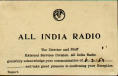
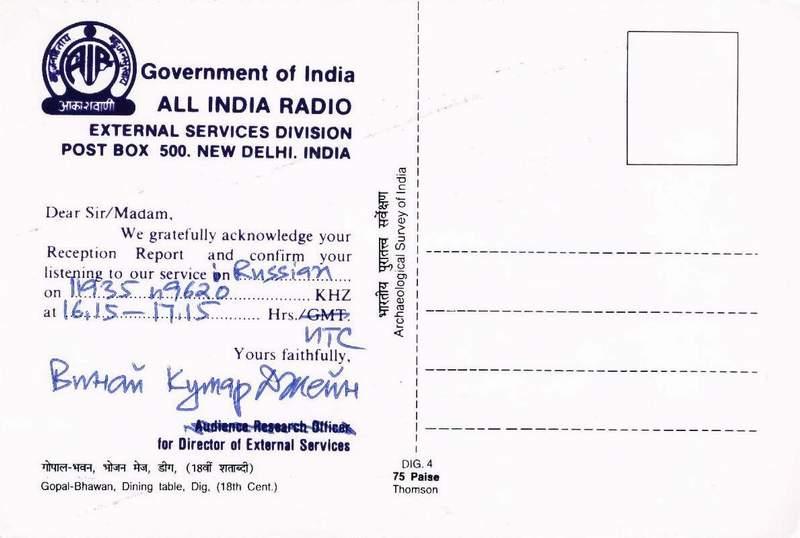
All India Radio QSL

ìTimes of Indiaî newspaper and the Post & Telegraph office in Bombay. The P&T transmitter carried these experimental broadcasts in August 1921, and they were noted more than 100 miles away in Poona.
A third, and this time a more substantial, station was established in Bombay two years later again and it was on the air with 1.5 kw. on 750 kHz. under the callsign 2FV. This station left the air when the government approved station 7BY-VUB was inaugurated in 1927.
The fourth experimental station in Bombay was operated by the Walter Rogers Company as 2AX. This station was inaugurated in 1925, and on September 6 of that year Pastor Robert Hare made a historic broadcast from this station. It was the very first radio broadcast from the Seventh-day Adventist Church in the territories of what was then British India. Station 2AX also left the air when 7BY-VUB was inaugurated two years later.
Over in West Bengal, the Marconi Company from England conducted several test broadcasts from different locations in Calcutta. The first concert program was heard at a distance of three miles, and subsequently a discourse from the local gulf club was heard at a distance of 72 miles. This same transmitter was made available on loan to the Calcutta Radio Club, who launched their own radio station in November 1923 under the callsign 2BZ.
The Marconi company made another transmitter available to the government in West Bengal who operated their station as 5AF. Both stations in Calcutta, 2BZ and 5AF, were closed when the national government established its own station, 7CA-VUC, in 1927.
Madras, now known as Chennai, was another city in India that received a radio station in this pre-broadcasting era. This early experimental station was operated by the Madras Presidency Radio Club under the callsign 2GR.
This station was closed in 1927 due to financial problems and the equipment was donated to the Corporation of Madras who re-opened the station under the international callsign VUM. This station was closed in 1938 when All India Radio established its own station for coverage of Madras and the callsign VUM was transferred from the old club station to the new AIR station.
We could also mention that there is a listing in an old radio directory for a station operated by the Crompton Electric Company in Madras, and another station in Bangalore, both in the same year 1926, though it is not known whether these stations were ever established.
Perhaps we could also mention the tiny one watt station that a postal official established at his home in Hyderabad back in the year 1933. And it would appear that there were a few other early radio stations during this pre-broadcasting era, the details of which have been lost over the years. Maybe there were just four or five in this category, and who knows, maybe the information about some of these other stations may yet come to light. Source: http://www181.pair.com/otsw/Wavescan/wavescan465.html

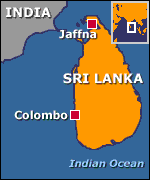
Wartime Radio in Sri Lanka

During those decisive years in the middle of the last century, there was a spate of rapid development in the radio scene on the island of Sri Lanka, or Ceylon as it was known in those days. This is what happened.
In the year 1943, the BBC in London began the broadcast of a forces radio program for the benefit of English servicemen on duty in India. Shortly afterwards, the production and broadcast of this program was transferred to All India Radio in Delhi. Then it was that Lord Louis Mountbatten moved the headquarters of his South East Asia Command to Ceylon, first in Kandy and then in Colombo.
While the headquarters were located in Kandy, an English army transmitter was used as a broadcast service, and also for the relay of voice broadcasts back to the BBC in London. This station was on the air from October 1944 until early in 1946.
Around the same time, the American forces in Kandy established their own entertainrnent radio station. This was a small 50 watt unit which was on the air without callsign on the mediumwave channel 1355 kHz. This somewhat unofficial AFRS station was launched in August 1944, and it was on the air for a little over a year.
When the SEAC headquarters were transferred to Turret Road in Colombo, a production studio was installed, and a program service was commenced over a 7.5 kw shortwave transmitter with the callsign ZOJ. We could guess that this transmitter was co-sited with the Radio Ceylon transmitter ZOH at Welikada on the edge of Colombo.
In the meantime, work began on the construction of a big new shortwave station at Ekala, some twenty miles north of Colombo. However, on a temporary basis, a new 7.5 kw RCA unit was installed in the transmitter hall at the Royal Signals base adjacent to the new station. One of the Marconi communication transmitters at this location was hurriedly pressed into service for the opening ceremonies of the new facility on April 25, 1945.
Work continued on the big new station, and on May 1, 1946 the Marconi 100 kw entered regular service. Soon afterwards, three RCA units at 7.5 kw and one at 1 kw were co-installed with the ìBig One.î The little 1 kw unit carried the SEAC service for listeners within Ceylon.
The large 100 kw Marconi was heard almost worldwide, and at certain times each day it carried a relay from the BBC. During the cricket season in Australia, the SEAC transmitter acted as an intermediate relay from Radio Australia in Shepparton to the BBC in London.
The SEAC station at Ekala was in use for forces programming for a period of four years, and then the whole facility was handed over to Radio Ceylon, with cooperation and input from the BBC. The first regional director for the BBC in Ceylon was a man who had been a prisoner of war in Singapore, James Mudie. (He was a relative of mine.)
SEAC Colombo was noted as a very reliable verifier, and their black and white card was considered at the time to be quite plain, though today it is a valued possession. Source:http://www181.pair.com/otsw/Wavescan/wavescan445.html

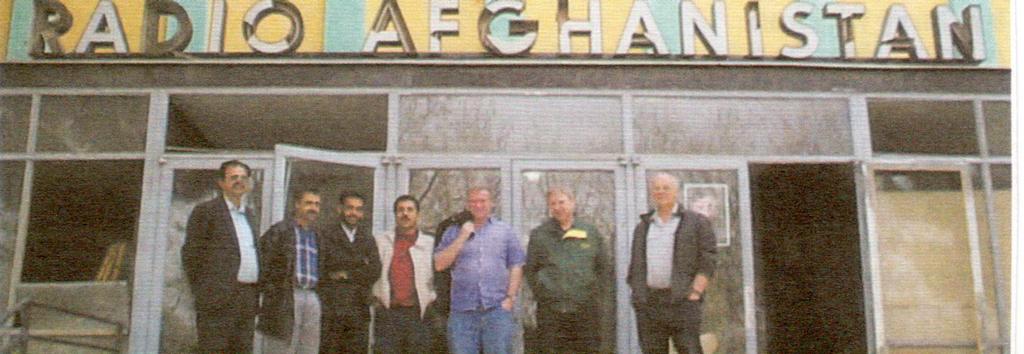
Radio Backgrounds in Afghanistan - Part 1,2 and 3

Recent events in the United States, and for that matter, in several other countries as well, have gripped the attention of the news media throughout the world. In view of these dramatic events, we interrupt our regular scheduling here in Wavescan and we begin a new series of topics in which we feature the radio scene in several of these countries. Just as soon as we can assemble the information, we also plan to present a topic on the radio scene in New York on that eventful day, Tuesday, September 11. However, in this edition of Wavescan we think of western Asia and we present "Radio Backgrounds in Afghanistan."
The country of Afghanistan, with its quarter million square miles, is sandwiched in between Pakistan and Iran. The 25 million inhabitants are made up of 20 diverse ethnic groups, each with its own culture and language, though Dari and Pushto are the twin official languages.
Back more than 30 years ago, we as a family were transferred from Perth in Western Australia on a five year assignment to Lahore in Pakistan. During this era, I made many visits into Afghanistan, sometimes by car or bus, and sometimes by plane.
The drive through the famed Khyber Pass is most dramatic, with high barren cliffs, wide colorful vistas, and dramatic, deep gorges. In this area, the Kabul River is very steep, and the water runs at an amazing 35 miles per hour.
At the top of the Kabul Gorge, the landscape levels out at a mile high, and it is here that a high powered mediumwave transmitter was established in 1964 under the supervision of Deutsche Welle in Germany. This unit was located in a country area at Pole-i-Tcharche, just a mile off the main highway.
In addition to the 100 kw. Siemens transmitter on 1280 kHz. at this location, there was a large MAN diesel engine which supplied electric power for the entire facility. Programming was fed from the main studios in the city by two different telephone circuits as well as by a backup FM link.
Some reports indicate that this showplace radio station was damaged, or perhaps even destroyed, during the uprisings that began in the year 1981. In more recent times, it is reported, a new 100 kw. mediumwave transmitter was installed at a new location considerably closer to Kabul, though I have never heard it, even when visiting in nearby areas.
The main two-story studio building at Answari Wat, located on the edge of the main highway running out to the airport, was also constructed in 1964 under German supervision. For a short period of time an experimental 10 watt FM transmitter, made by Rhode & Schwartz, was on the air at the studio location on 96.1 MHz. The AWR Historic Collection contains the only QSL card ever issued for this low powered relay unit.
In the entry way of the studio building was a large wall map of the world, and on this map were hundreds of marker pins showing the location of listeners who had sent reception reports to the station. Back in this era, one of the studio technicians also served as the official monitor, and at specified times during the day he would tune an old Telefunken receiver for the broadcasts coming from Deutsche Welle, ORF-Austria, and several other international shortwave stations.
It is understood that this studio facility was largely destroyed some 20 years ago during the era of fighting, though apparently it has been restored subsequently, and it is again serving as the main studio location.
On one occasion, the Seventh-day Adventist church staged an international temperance convention in the five story Hotel InterContinental in Kabul. This convention attracted 140 delegates from 40 countries, and late one night there was a fire that burned out the entire top floor of the hotel. Fortunately there were no injuries nor fatalities. It was around this era that small FM transmitters and receivers were introduced into the world market so that people attending large conventions could hear the proceedings in their own language. At this convention in Kabul, translation was available through four of these little transmitters in four languages. Just one QSL-card was issued for these limited broadcasts, for the transmitter on 102.8 MHz, and this card is also in the AWR collection in Indianapolis.
Next week, as our opening feature in Wavescan, we plan to present the next episode in this sequence of topics on "Radio Backgrounds in Afghanistan."
Radio Backgrounds in Afghanistan - Part 2
The rugged Khyber Pass is straddled by the international border between Pakistan and Afghanistan. In some places the pass is quite wide, and in other places it is quite narrow and just sufficiently wide for the highway to pass through.
This famous pass has featured frequently in history, and to this day you can still see a part of the old stone-paved highway that was constructed in the days of Alexander the Great when he made his ancient conquest as far east as the Punjab in India. At the entrance to the Khyber Pass is a huge notice in Urdu and English, drawing attention to the fact that it is considered dangerous to drive through the Khyber Pass in the afternoon and at night.
Back some 40 years ago, there were two daily flights by small passenger plane from the main Kabul airport into the Bamiyan Valley. The Afghan pilot took a great delight in inviting passengers to come and sit in the co-pilot's seat and "help" him to fly the plane. For the return journey in the afternoon, it was necessary to sit and wait in the fully loaded plane until the temperature dropped to a safe level in order to give the plane sufficient lift to take off.
A few months ago, the Taliban ordered the destruction of the two massive statues of Buddha carved into the cliff face on the edge of the Bamiyan Valley. These statues were considered to be the largest in the world, and they were pictured on QSL cards issued by Radio Afghanistan some 30 years ago.
There is a well-paved highway running north from Kabul up through the very long Salang Tunnel. The area is so high and the air is so rarified that motor cars will not run properly. On one occasion, insurgents sealed both ends of the tunnel, effectively suffocating and killing several thousand people in their motor vehicles.
This highway runs up to the border with Uzbekistan, and in those days the Russian guards were quite friendly and they would invite visitors to walk across the wooden bridge to visit with them. In these northern provinces of Afghanistan it was impossible to hear Radio Afghanistan Kabul on mediumwave because of the high mountain range in between. The local people listened instead on mediumwave to the relay service from Radio Moscow in their own languages.
There have been several attempts on the part of the Afghan government to install a network of local mediumwave stations thoughout their country. Back in the year 1925, two Russian made transmitters were imported into Afghanistan; one was installed in the palace of the king and the other was intended for installation in the regional city Kandahar, south of Kabul and close to the Pakistan border. However, because of unrest in the area, this station was never constructed.
Back in the 1970's, tenders were called for the installation of a network of mediumwave stations in the major cities throughout Afghanistan, but again, these were never constructed. Another project was to import several mobile radio stations and establish them in regional cities, but again, this project was never fully implemented
Because of the difficulties encountered in establishing a network of local mediumwave stations thoughout Afghanistan, instead a regional service in local languages was on the air for several years using two transmitters in the tropical shortwave bands. At one stage, these two transmitters carried a health program from Adventist World Radio translated into the two official languages, Dari and Pushto.
However, Bengt Ericson in Sweden observes that there are now four mediumwave stations on the air in Afghanistan. These stations can be heard on 657, 864, 1107 and 1584 kHz, and they are located in Kabul, Kandahar and Mizar-i-Sharif.
Radio Backgrounds in Afghanistan - Part 3
The main highway running from the Khyber Pass into the city of Kabul runs through the suburban area of Yakatut. Stretched across the highway on the outer edge of Yakatut were the antennas for the shortwave service of Radio Afghanistan.
It was back in the year 1925 that a small longwave transmitter was imported from Russia and installed in the palace of the king on the edge of Kabul. In addition, a consignment of crystal wireless sets, ultimately 1,000 in number, was also imported and these were distributed throughout the city. However, in the year 1929 this transmitter was destroyed during civil disturbances in the city.
Four years later, in 1933, a German made Siemens transmitter was installed in a new building at Yakatut, an outer suburb of Kabul. This huge mediumwave unit, variously described as 100 kw, 50 kw and 25 kw, was installed inside a series of cages on the top floor of this new building.
Seven years later, this huge old unit was replaced by another 20 kw unit on the ground floor of the same building, and in 1970 this one was replaced by yet another unit, made by BBC in Switzerland. However, all throughout these eras, the original old unit in the cages was kept alive with test transmissions each Tuesday evening.
A second building was erected at Yakatut back in the middle of the last century to house a series of transmitters for use in communication traffic, both within Afghanistan and with countries in Asia and Europe. Half a dozen medium-powered transmitters have been housed in this building, some of which were also used at times for program broadcasting.Back in the year 1948, a series of program broadcasts from two different locations in Afghanistan were heard in Australia. One station was located in Herat, and the other was probably a utility transmitter located at Yakatut near Kabul. These hour-long broadcasts were on the air two days a week in local languages. It is probable that these test broadcasts were intended as a prelude for the establishment of a new shortwave service for local and international coverage.
A little over a year later, the Director General of Broadcasting in Afghanistan went to Berlin seeking German assistance in establishing the projected new shortwave service. Ultimately, a third new transmitter building was constructed at Yakatut with three shortwave transmitters from West Germany, rated at 20 kw, 50 kw and 100 kw. The antenna system for this new shortwave service under the callisgn YAK was constructed on both sides of the highway, with several aerials stretched over the highway itself.
The showplace radio station at Pole-i-Charke was constructed in 1964, along with the two story studio building at Answari Wat. However, in the ensuing fighting after the Russian invasion in 1979, most of the radio facilities at all of the various locations were damaged and destroyed.
Meanwhile, in an unexpected move around mid year 1979, the radio world suddenly discovered that Radio Afghanistan was on the air via relay stations in Russia. At least four different locations were on the air over a period of 12 years.
The program feed for this relay service was at first direct off-air from Kabul, though later it was by satellite. This relay service closed on December 31, 1991. Many QSL cards were issued from Kabul for this Russian relay service.
As time and turmoil went by, the shortwave transmitter base at Yakatut was again damaged and destroyed, and two new units at 100 kw were imported from Russia. Again, these were badly damaged in subsequent fighting. It would appear that one of these units was refurbished by the Taliban, and this is the unit that has been on the air as "The Voice of Shariah."
In a dispatch from Jose Jacob in India, he states that the newspaper "Times of India" reported that the Voice of Shariah was on the air now from another location. Next day, Jose reports hearing the Voice of Shariah at a lower level.
However, CNN news states that the radio stations near Kabul were destroyed in subsequent bombing raids, and both Victor Goontelilleke in Colombo as well as Jose Jacob in India note that the Voice of Shariah is no longer heard on shortwave.
In the latest episode of events in the radio scene in Afghanistan, as heard on CNN, it is probable that by now the American "Blue Eagle" aeroplanes are on the air to Afghanistan. Mediumwave coverage from ground-based stations is also planned. Source: AWR "Wavescan"
"Wavescan" is a weekly program for long distance radio hobbyists produced by Dr. Adrian M. Peterson, Coordinator of International Relations for Adventist World Radio. AWR carries the program over many of its stations (including shortwave). Adrian Peterson is a highly regarded DXer and radio historian, and often includes features on radio history in his program. http://www181.pair.com/otsw/Wavescan/wavescan356.html

Wednesday, July 27, 2005

Hear me?

`Podcasting' is what the buzz is all about. Tune in for some pleasurable news on the technology front.

HAVING outgrown his fame as the creator of the Blogger.com web logging service that was later bought by Google, Evan Williams is working these days to give finishing touches to his latest start-up Odeo.
Odeo intends to `humanise' the new Web-based broadcast medium known as podcasting.
For the uninitiated, podcasting is the latest promise for those addicted to Internet audio programming, but unable to catch up with their favourite shows or take the time to download them manually.
Podcasting spells added convenience as the audio content is sent directly to an iPod or portable MP3 player.
"Not only do these devices play it, but you don't have to put it there yourself... it happens automatically," says Adam Curry, the brain behind the first podcasting aggregator named iPodder.
Availing of audio feeds was never so easy: simply connect your MP3 player to the computer, go online, subscribe to the feeds (a la audio magazines) you want of the podcasting service and sit back for the audio content to be pushed from the original source to the reader or aggregator and then to you for your shot of aural pleasure at your own convenience. What's more, you don't even need to check for updates.
The term podcasting may well be a portmanteau of `iPod' and `broadcasting', but let that not mislead you into thinking that gadget from Apple is a prerequisite to use this technology.
Podcasting works just as well with any digital audio player or computer that can run an appropriate aggregator to convert podcasts for playback. And while most podcasts are MP3 audio as of now, a way out of common bandwidth constraints could lead us to video podcasts as well.
Think this could be your key to unlocking the universe of audio content? You're no longer alone.
For one, you've got company in Williams. Given the raging success of the blog phenomenon Williams kick-started a few years ago, his passion for podcasting could well be a sign of its potential when it goes mainstream.
According to Cark Franklin, the host of an online technology talk show, podcasting brings convenience of choice to Internet audio that was previously the preserve of digital video recorder users.
While it is true that most of the podcast content now available largely appeals only to geeks, easier technology looks poised to draw more people, even amateurs, into creating and disseminating audio content — on anything from weekly musings, music, travel and gardening to quilting, college hockey and even `sexcapades'.
Curry even sees traditional radio advertising models being applied to podcasting. That the radio has made a resounding comeback in most societies augurs well for this technology. Also, with regulatory complications shrouding radio spectrum and broadcast licences in most countries, podcasting is seen an easy alternative.
How else can podcasters like Walter Anaruk and Mark Cuebas, a Web developer and a waiter, record their podcasts on football and wine from the former's Palm Harbour garage without as much as shutting the garage doors? Or how can Michael Oster, a New Tampa sound engineer, take to the microphone with a pot of macaroni to describe a bobcat in his backyard?
It is therefore no surprise the Pew Internet and American Life Project reveals that nearly a third of the adults possessing iPod and MP3 player (half of them aged 18-28) have downloaded podcasts. Odeo's Williams associates this with the "democratisation of media."
Several radio stations, such as New York's WNYC, Boston's WGBH, Seattle's KOMO or Toronto's CBC Radio One - have already gone into the podcasting mode. Interestingly, the short segments of Internet programming being promoted by Al Gore and other prominent entrepreneurs in the US is called `Pods'.
Close on the heels of Viacom's Infinity Broadcasting announcing plans to convert a talk radio station in San Francisco to an all-podcast format, Sirius Satellite Radio is reported to be launching a podcast featuring a daily selection of its popular do-it-yourself programmes.
Even local radio stations such as the Santa Monica-based KCRW have started displaying their podcast availability. While the Heineken Beer Company is using a podcast to distribute DJ Daniele Divoli's interview for its Thirst DJ competition, students of music and foreign languages at the Duke University are using university-provided iPods to download shows and audio material from an internal Web site, instead of going to the library to listen to them.
For the moment though, it's Odeo that podcasting aficionados are eagerly awaiting. As a distribution and creation platform for audio content, Odeo, which will offer downloads in the MP3 and AAC formats, aims to "make it easier to discover, subscribe to and create podcasts" and make popular audio "more consumable."
According to Williams: "The discovery part includes Web-based aggregation of all the available audio content that we can find... The subscribe-to part allows people to get the content on an ongoing basis and synch it with their iPod or MP3 player. And the creation side involves various tools for publishing audio."
Now, why wouldn't we want to believe this is nothing short of a cultural breakthrough?
Picture by Parth Sanyal
The author is a freelance journalist and can be reached at harshkabra@vsnl.net by Harsh Kabra http://www.blonnet.com/ew/2005/05/30/stories/2005053000150200.htm

Apple brings iPod models

Mr Darren Sng (left), Product Marketing Manager-Software, Apple-Asia Pacific, with Mr Yeo Eng Yiong, Product Marketing Manager-Portables, Apple-Asia Pacific, at the launch of Mac Mini and iPod Shuffle in the Capital on Tuesday. - - Ramesh Sharma
New Delhi , Feb. 1
THERE is some good news for iPod aspirants. Apple has brought to India its most affordable iPod ever - the iPod shuffle, priced at Rs 8,500 for a 512 MB capacity model and Rs 12,400 for a 1GB model.
"The product is targeted at music lovers who want a portable device, which does not have a large capacity and is available at a low price point. iPod shuffle is based on iPod's widely-used shuffle feature which randomly selects songs from the user's music library and play-list," Mr Yeo Eng Yiong, Product Marketing Manager (Portables), Asia Pacific, Apple, said at a news conference here.
iPod shuffle is smaller and lighter than a pack of gum, and comes in two models -- 512MB that holds up to 120 songs and a 1GB version that holds up to 240 songs.
The company has also introduced its new Mac mini, touted as the most affordable and compact Mac ever.
With this, Apple aims to target not only the new desktop users but also existing PC users aspiring for a Mac experience.
The Mac mini priced at Rs 32,200 onwards includes a CPU and a combo drive. Mac mini offers the processing and graphics performance with either a 1.25 GHz or 1.42 GHz PowerPC G4 processor and ATI Radeon 9200 graphics with 32 MB of dedicated DDR memory.
Both the models come with a slot-load Combo drive for watching DVD movies and burning CDs, and up to 80GB hard drive for storing digital media creations. http://www.thehindubusinessline.com/2005/02/02/stories/2005020202080500.htm

Rapping out the Message – India’s Radio Deejays and Veejays Learn to Get Loose on Air about HIV/AIDS

Internews’ MEDIAIDS project will hold two “Young Voices” workshops for young radio deejays and television veejays July 25 – August 7 in Chennai, India.
The goal is to train young disc jockeys from the campus radios, the local commercial radio and TV stations to talk about HIV/AIDS in a way that the message will appeal to their young audiences: youth talking to youth through a highly popular, interactive medium that can inform, entertain and promote a healthy culture of safer behaviors among young listeners and viewers.
A significant number of HIV infections in India occur in people below the age of 25 years old. Young people in India are especially vulnerable to HIV as they often fall outside the purview of targeted intervention programs.

“School and university based HIV education programs are often challenged by the restrictive classroom environments in which they are held; environments that rarely encourage frank discussions about HIV risk or about where youth might turn to for more information and services. However, this is a group that increasingly needs to be reached with such information,” says Dr. Jaya Shreedhar, Internews Health Advisor.
The deejay training will focus on helping young people understand the basic facts about HIV/AIDS. It will clarify myths and misperceptions such as ‘it can’t happen to me!’ It will also tackle the roots of HIV related stigma and discuss related legal issues.
“UNICEF’s experience with young people shows that even if a majority are aware of HIV, many do not have correct information on prevention. There are also many myths and misconceptions related to HIV, sex and sexuality,” says Thomas George, Communications Officer, UNICEF Chennai.
The training will be conducted by internationally known DJ Georges Collinet, who has successfully held similar trainings in Kenya and Nigeria for Internews; Jaya Shreedhar, health advisor for Internews; and Götz Buerki, technical trainer from Deutsche Welle, Germany.
The trainees will include deejays from Suryan FM, Radio Mirchi and the All India Radio as well as from the two campus community radio stations in the country. Video jockeys from Sun TV and other private TV stations are also expected to attend. In addition, there will be a young award winning student music band based in Chennai. During the training, the musicians will compose a song on young people and HIV and the deejays will compose jingles on the theme, as well as learning to 'vamp' or 'rap' about HIV and VCT as they spin their records.
“When the DJs and musicians leave this training, they have a new appreciation for the key role they can play in reaching their young audiences with life-saving information,” says Internews HIV/ AIDS Advisor Liz Gold.
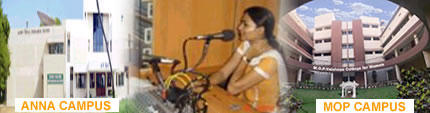
The workshops will be held in partnership with the UNICEF regional office in Chennai, the country’s first two community radio stations to go on air – Anna FM at the Anna University and MOP FM at the MOP Vaishnav College for Women – and with the support of the European Commission under the EU-India Economic Cross Cultural Programme.
The Audio Visual Research Center at Anna University was the first campus radio station to go on air in India. Anna FM began its broadcasts in January 2004 and can be heard over a 5 km radius. The station is run entirely by students from the media stream and regularly features the voices of the urban and semi rural communities within the broadcast radius – college students, vendors, farmers, housewives and young workers. It also features distinguished guest speakers on a variety of topics such as health and civic responsibility, local musicians and several educational programs.
The MOP Vaishnav Collge for Women launched its FM Community Radio – MOP 91.2 – in March 2005. Nearly a dozen schools and colleges, as well as several health centers fall within the broadcast radius of this station.

Chennai tunes in iPod

Do the iPod and similar devices enjoy good reception in Chennai? A snapshot of the scene

THIS Valentine's Day the most sought after gift was the iPod. Think that's unromantic? Think again. Most people simply love being gifted such `small wonders.'
It's been six-odd months since the iPod hit Chennai. Sony has launched its version, the Network Walkman. A homemade version also exists. Richie Street, a busy lane off the arterial Anna Salai in Chennai, sells many more at unthinkable prices. Brands abroad may soon enter the home markets. eWorld takes a look at how comfortable Chennaiites are with this technology...
Talking of the Apple iPod series, Suresh, marketing manager, Auto Media Inc, a reseller of Apple products, says, "This product is only a small external hard disk to store songs. It is customised and has many capacities. It has better clarity than a CD during playback. The apple Shuffle is a 512 MB device and selling well across the markets. Sales for the last six months have been 2-3 pieces per month in the 20 GB model and 4-5 in the Shuffle model. In the future we expect at least 60 per cent growth in sales."

But with hardly any publicity or advertisements, how can one expect to see more people buying the product? He replies, "It is very easy to learn to use this device. It is the technology of the future. Once people get hooked, there is no turning back. Word of mouth will work. The day is not far when lay men will feel comfortable using it."
Priced from Rs 6,200 onwards (the Shuffle) and ranging from Rs 14,000 to Rs 25,000 for high-end models, is the product worth the price?
Partha Sarathi Bhattacharyya, Branch Manager, Ample Technologies, says, "The iPod is affordable for the features it offers, such as photo storage, hard disk space and music playback facility." Will we see a war of the brands?
Mohammed Aashiq, Trade and Marketing, Sony India, says, "As far as the customer is concerned, Sony means quality. We have customers for life. They don't mind the pricing. This product (Sony's Network Walkman) is much sleeker than the iPod. In the first month we sold around 20 numbers. We get 4-5 enquiries every day about the product. Our model E50 is selling well and we expect at least a 40 per cent growth over the next six months. We are going in for publicity, and this too will draw more customers."
Exclusive showrooms have the advantage of product visibility. But what are a retail store's chances?
Farook, salesman at Digital World, VGP Mall, Mount Road, feels only the affluent class can afford these devices. "For those without computers, it would be a waste to buy a product just to listen to songs."
But for students, especially hostelites, such a product may come in handy as they cannot carry music systems around. The store has a similar product for Rs 4,975 — the Transcend, JetFlash. Primarily used to store data (256 MB), it has features similar to an iPod's. "We have sold 20 pieces of this in the last 6 months," he says.
An assistant at BOSE showroom, Ispahani Centre, says, "People coming from abroad know about these products. Theybuy it there as it is cheaper and bring it to us to learn the operations and for servicing it. As of now, it can be of use to music lovers who travel frequently."
But would Chennaites be willing to shell out money just to listen to songs?
Arun, a hostelite, says, "Where will we download the music from? Even to transfer songs from CDs one needs a computer, which is not allowed in the hostel room. It is not worth buying costly products just to listen to songs.
It is not safe to carry it on the train as it can be stolen easily. My friends have lost cell-phones and Walkmans! So this, being small in size, will not be missed until one gets home."
Avinash, an IT professional, says the iPod"gives amazing clarity of music. The scroll option is great. I am saving money to buy one soon."
Revathy, homemaker, feels "These things are very costly. I am happy with the Walkman I use. The extra features will be of no use to me."
Neelakantan, who retired from his job seven years ago, watches TV to pass time. Ask him about the iPod and he says, "I don't know what it is." After one explains its use, he says " But why is it so costly? It's another diversion for youngsters. Their parents have to pay the price for these products!"
(A portable storage device is one that stores data in a small device that can fit into your palm. It can be connected to the computer through the USB port to transfer data. Music is an option that is becoming popular. As opposed to a floppy or a CD, it gives large space (upto 20 GB space is available in most devices). By Archana Venkatratnam
[Source: The Hindumailto:Hindueworld@thehindu.co.in ]

Saturday, July 23, 2005

Sarvadesavanoli July 2005


In this Issue..
INTERNATIONAL DX BOOKS SPECIAL

* International DX Books-An Introduction

* BBC Ms.Anathi Surayaprakasam Speech

* BBC Mr.Sampathkumar Speech

* DX Clubs and their DX books

* Radio Guide: "Oli Alayil En Ninaivalagal"

* Digital Page: Mason Digital Two-in-One reveiw

* Short Wave -An Introduction

* Radio in Newspaper

* Radio Competition details

* DX Club News

* Dxing Q&A

* On the Short Waves

* This is 4 U..

* Free: SLBC Sticker

Thursday, July 21, 2005

AIR QSL

AIR Chennai, 4, 920 kHz., f /d prepared and stamped card returned signed and rubber stamped by K.S. Ramakrishnan, Superintending Engineer, in 74 days after 3rd followup for an August 1997 reception.E.Tilbury-ALS direct to QIPDez 98
AIR Chennai 7270 QSL - E mail confirmation was received from AIR Chennai within 3 days for an email report for their new frequency of 7270. According to that reply, they are replacing 10330 by 7270 and it is of 100 kw. Their email id is : airavadi@vsnl.com Their postal adress is: Mr.K.PALANISAMY, Asst. Station Engineer, All India Radio, Avadi, Chennai-100062 This adress can be used for sending reports to AIR Chennai. J.Jacob-IND DX-India-ML Mrz 03
AIR CHENNAI 7270 kHz. Full data picture post card signed by Mr.A.K.Bhatnagar, Director (Frequency Assignments). Report was sent to Chennai but reply came from Delhi in two and half months. Other reports from members abroad indicate that Mr.Mr.Bhatnagar is busy replying to reports lately. J.Jacob-IND DX India-ML Jun 03
AIR Coimbatore Index India Index Asia
AIR Coimbatore 999 letter (dir) 45 days v/s M. Goury, Assistant Station Engineer O.Alm-S Norwegian DX News Feb 97

Thursday, July 14, 2005

Nobody Does Web Radio Better Than BBC


Nobody Does Web Radio Better Than BBC Live streams of music, news, entertainment -- plusarchives -- are so good they can lure you to areas youmight never have thought about.The first Internet radio station broadcast was inDecember 1993. The subject: a speech by Larry King atthe National Press Club in Washington. The number ofpeople who tuned in: nine.King gets a bigger audience than that when he hasbreakfast at Nate 'n Al's.Now there are 3,834 broadcast radio stations in 151countries that stream online, according to a tallycompiled by Live-Radio.net in London, not to mentionthe thousands of personal Internet channels thatemanate from bedrooms and basements around the world.These stations include the highly official — ChinaRadio International (en.chinabroadcast.cn) — and thehighly obsessive — the all-"Ave Maria" channel(www.avemariaradio.tv) that plays the song 24/7,performed by the likes of Cecilia Bartoli, JoseCarreras, Barry Manilow and Jewell.But no one does Internet radio better than the grandedame of broadcast radio itself: the BritishBroadcasting Corp.At the BBC radio site, http://www.bbc.co.uk/radio ,you'll find live broadcasts of the network's hallowedWorld Service — in 43 languages — that debuted in 1932and set the standard for international radio.But the Internet has also brought the rest of BBCradio — designed for domestic consumption — to a farwider audience. It is some of the most vibrant,entertaining radio in the world.The domestic service consists of 10 English-language,live channel streams with programming on business,current affairs, drama, comedy, science, religion anda variety of music genres, including pop, classical,hip-hop, jazz, country-western and world music.It's also a site that many people apparently turn tofor breaking news. Shortly after the London publictransit bombings Thursday morning, I tried to accessthe BBC's all-news Five Alive channel online, but itwas so overloaded with people seeking its live localcoverage that I couldn't get to it for nearly twohours. Under normal circumstances, however, the service is sogood that it can lure you into areas you never thoughtyou'd find engaging.Take hip-hop, for example. Even if you're one of thosepeople who thought you'd never like the genre (my handis raised), it would be hard to find the mixes byannouncer Ras Kwame on the Radio 1 channel as anythingless than enthralling. Conversely, any open-eared listener to "DiscoveringMusic" — probably the best show explaining classicalmusic since Leonard Bernstein's "Young People'sConcerts" half a century ago — would find it hard todismiss dead-composer music as no longer vibrant.In addition to the live streams, hundreds of archivedprograms are just a click away. And in the last fewweeks, the BBC has begun making a few of the showsavailable via podcasting. BBC executives decline to release figures on how manyforeigners are tuning in to these domestic channels,which went online in 1999. But given that aboutone-third of the visitors to the radio website arefrom outside Britain, there's no doubt they areglobally popular.Maybe too popular. Enjoy it while you can; they mightbe taking it back.Sending BBC's domestic programs around the world forfree amounts to subsidizing foreign consumption of aservice that British citizens have to pay for, and BBCmanagement is considering ending it.The domestic service, including the online streams, issubsidized out of the annual license fee charged toevery household in Britain that has a television set.The fee, which also supports a variety of othernoncommercial BBC radio and television operations,comes to about $230 per household. The fact that we outsiders get the service withouthaving to pay a fee probably would not be an issue ifthis was standard broadcast radio, which costs thesame to distribute no matter how many people arelistening.But the more people listen to online radio, the morebandwidth the broadcaster has to purchase."It's a complex situation," said Simon Nelson,controller of the BBC's radio and music interactiveservices."I'm proud that we deliver a service that is valuedall over the world. But I have to make sure we are notusing the public license fee to subsidize freeinternational services. We need to find the rightbalance."Nelson said no decision has been made on thepossibility of restricting the online domestic servicein some way — possibly to listeners who have Internetaddresses inside Britain. The message is that it's probably not going todisappear right away. But just in case, go for it now.You'll need access to a broadband connection. Thechannels stream at the fairly bountiful rate of 44kilobits per second. That information stream is fatenough to provide quite adequate stereo quality, butit's too rich in digital content for dial-upconnections to comfortably handle.(The World Service, meant for an internationalaudience and subsidized by a separate government fund,streams at a 16-kbps rate that accommodates listenerswith dial-up connections.)At the BBC radio home page, a list of music andspoken-word categories can be found on the right.Clicking on one leads to archived shows — mostbroadcasts on the domestic service are held in thearchive for a week and some for far longer.Access to the live broadcasts are in the center of thepage. Here are some highlights: • Radios 1, 2 and 6 are pop/rock stations withvarious degrees of edginess.• The 1Xtra channel is billed as "new black music,"encompassing hip-hop, R&B, garage, dancehall and otherstyles.• Radio 3 is the killer classical service, withnearly 150 of the aforementioned "Discovering Music"shows — each of which typically examines one piece ofmusic to explore its themes, history and importance.• Radios 4 and 7 are the spoken-word channels, withbusiness news, drama, comedy (Radio 4 streamsadaptations of the late Douglas Adams' "Hitchhiker'sGuide to the Galaxy") and children's shows.There are also general news and sports channels, butthe news — unlike on the World Service, which providesan international perspective — is weighted to localcoverage, and the sports coverage is of limitedinterest unless you are into professional soccer andcricket.I hope it doesn't all go away. When I was a kidgrowing up in a small town, there was a retiredneighbor who had on her screened-in porch an oldshortwave radio in a cabinet the size of a washingmachine. I would sit there for hours, slowly twistingthe frequency knob to work my way across the dial,looking for stations.That was a long time ago, but I still get a bit of akick out of listening to live radio that isoriginating from the other side of the world. The factthat the stations are of such high quality addsimmeasurably to the experience.I hope it stays around for generations to come.Ten channels from the BBC's domestic service areavailable at http://www.bbc.co.uk/radio . In additionto the live broadcasts, many of the programs arearchived for at least a week for listening later.Here's a guide to the channels and a sample of theirofferings:Channel: Radio 1Genre: Top 40, dance, hip-hop, live concertsCurrent programs: "Radio 1's Chart Show," "OneMusicWith Ras Kwame," "Dance Anthems"Channel: 1XtraGenre: "New black music," including hip-hop,dancehall, garage, R&B; documentariesCurrent programs: "Destination Africa," "Mixlab,""Dancehall Splurt," "Sounds of Soca"Channel: Radio 2Genre: Album pop/rock, oldies, jazz, folk, musicals,gospelCurrent programs: "Lulu," "Elaine Paige," "Beverley'sGospel Nights," "Masters of Rock"Channel: Radio 3Genre: Classical, jazz, world musicCurrent programs: "Discovering Music," "Composer ofthe Week," "Early Music Show," "Jazz Legends"Channel: Radio 4Genre: Current affairs, arts, business, science,history, religion, philosophyCurrent programs: "Adventures in Science," "A GoodRead," "Poetry Please," "Year in the Arab/IsraeliCrisis"Channel: Radio 5 LiveGenre: News, business, sports, call-in showsCurrent programs: "Morning Reports," "Wake Up toMoney," "Sport on Five," "The Rumor Mill"Channel: Radio 5 Live Sports ExtraGenre: Live sportsCurrent programs: Live coverage of sports eventsChannel: Radio 6Genre: Archived studio sessions, documentaries, albumpop/rockCurrent programs: "Dream Ticket," "Tom Robinson'sEvening Sequence"Channel: Radio 7Genre: Drama, comedy, children's programsCurrent programs: "Anna Karenina," "Big Toe RadioShow," "Comedy Monologues"Channel: Asian NetworkGenre: News, music, discussion, soap operasCurrent programs: "Devotional Music," "Silver Street,""Film Cafe," "Weekend Punjabi Show"By David Colker (Via www.latimes.com)

Wednesday, July 13, 2005

தமிழ் நேயர் மன்றத்தின் செயல் முன்னேற்றப் போக்கு


னைத்தின்திய சீன வானொலி தமிழ் நேயர் மன்றத்தின் செயல் முன்னேற்றப் போக்கை பாருங்கள். மன்றத்தின் தலைவர் திரு எஸ் செல்வம் மின்னஞல் மூலம் தி கலையரசிக்கு தெரிவித்த தகவல் இதோ. படியுங்கள் நாங்கள் 5 நேயர்கள் இணைந்து கூட்டாகத் துவக்கியிருக்கும் CRI Listeners SMS net என்ற செல்லிடைத் தொலைபேசி அமைப்பு பற்றி ஏற்கனவே உங்களுக்கு நான் தெரிவித்துள்ளேன். இவ்வமைப்பு நாள்தோறும் வானொலிச் செய்திகளை செல்லிடைத் தொலைபேசி மூலம் அனுப்பி வருகிறது. ஒவ்வொரு நாளும் சில நேயர்கள் இதில் சேர்ந்தவாறு உள்ளனர். இந்த நிலையில், மேலும் ஒரு புதிய முயற்சியில் நாங்கள் ஈடுபட்டுள்ளோம். நேற்று முதல் சீன வானொலி நிகழ்ச்சிகளை அடிப்படையாகக் கொண்டு, நாள் ஒரு கேள்வி கேட்கத் துவங்கியுள்ளோம். தினமும் கேட்கப்படும் கேள்விகளுக்கு அடுத்த நாள் நிகழ்ச்சி தொடங்குவதற்கு முன் இரவு 7.30 மணிக்கு முன் நேயர்கள் தொலைபேசி மூலம் விடைகளைத் தெரிவிக்க வேண்டும். ஒரு திங்கள் காலத்தில் கேட்கப்படும் கேள்விகளுக்கு யார் அதிக எண்ணிக்கையில் சரியான விடைகளை அளிக்கிறார்களோ அவர்களுக்கு பரிசளிக்கப்படும். முதல் பரிசாக ரூ.200 இரண்டாம் பரிசாக ரூ.100 மதிப்புள்ள செல்லிடைத் தொலைபேசி அட்டை அல்லது அஞ்சல் தலைகள் வழங்கப்படும். திங்களுக்கு மொத்தம் ரூ.300 செலவாகும். நாங்கள் 5 பேரும் தலா ஆளுக்கு ரூ.60 செலவிடுவோம். சீன வானொலியில் திங்கள் வினாவிடைப் போட்டி தற்போது இல்லாத குறையை இப்போட்டி ஓரளவு தீர்த்து வைக்கலாம். செல்லிடைத் தொலைபேசிப் பயன்பாடு நாளுக்கு நாள் அதிகரித்து வருமĮ! 1; நிலையில், அதைப் பயன்படுத்தி பலருக்கும் சீன வானொலியை அறிமுகம் செய்து வைக்கவும், தினந்தோறும் நேயர்களை நிகழ்ச்சிகளை முழுமையாகக் கேட்க வைக்கவும் ஒரு முயற்சி இது. நேற்று முதல் கேள்விகளை அறிவிக்கத் துவங்கிவிட்டோம்.

கேள்விகளை மட்டும் நான் தயார் செய்வேன். பல நேயர்களுக்கும் இப்போட்டி பற்றி தெரிவிக்கும் வகையில் 16.3.2005 கேள்வியும் பதிலும் நிகழ்ச்சி துவங்குவதற்கு முன் இதுபற்றிய அறிவிப்பை பின்வருமாறு வெளியிடுமாறு அன்புடன் கேட்டுக் கொள்கிறேன். 'நமது நேயர்களால் நடத்தப்படும் 'சீன வானொலி நேயர்கள் செல்லிடைத்தொலைபேசி செய்திக் குழு' நேயர்களுக்கு போட்டி ஒன்றினை மார்ச் திங்கள் 13ஆம் நாள் முதல் துவக்கியுள்ளது. நமது நிகழ்ச்சிகளின் அடிப்படையில் நாள்தோறும் இரவு 8 மணி முதல் 9 மணிக்குள் ஒரு கேள்வி கேட்கப்படும். கேள்விக்கான சரியான விடையை செல்லிடைப் பேசியில் SMS மூலமாகவோ அல்லது தொலைபேசி வாயிலாகவோ குழுவிற்கு மறுநாள் இரவு 7.30 மணிக்குள் தெரிவிக்க வேண்டும். சரியான விடைகளின் எண்ணிக்கை அடிப்படையில் முதல் பரிசாக ரூ.200, இரண்டாம் பரிசாக ரூ.100 மதிப்புள்ள செல்லிடைத் தொலைபேசி அட்டை அல்லது அஞ்சல்தலைகள் நேயர்களுக்கு வழங்கப்படும். போட்டியின் முடிவு ஒவ்வொரு திங்களின் முதலாம் நாள், குழு வாயிலாக அறிவிக்கப்படும். இப்போட்டியில் கலந்து கொள்ள விரும்பும் நேயர்களும், இக்குழுவில் உறுப்பினர்களாக சேர விரும்பும் நேயர்களும் பின்வரும் நேயர்களுடன் தொடர்பு கொள்ளுமாறு கேட்டுக் கொள்கிறோம்.


For more details...

வளவனூர் புதுப்பாளையம் S.செல்வம் .. 9842038770, பெருந்துறை பல்லவி K.பரமசிவன் .. 9842976475 , பாண்டிச்சேரி N.பாலக்குமார் .. 9842313233, பாண்டிச்சேரி G.இராஜகோபால் .. 9843779442, கோயம்புத்தூர் K.இராதாகிருஷ்ணன் .. 9842661291 [OR]

http://ta1.chinabroadcast.cn/1/2005/03/15/21@18649.htm