Saturday, February 15, 2014

SDXF broadcasts


A reminder that one of the SDXF broadcasts is today (Sat 15-Feb) at 1200-1300 UTC on 7265 kHz via Hamburger Lokalradio (see below).

The Swedish DX Federation will have three broadcasts on mediumwave  and shortwave in early 2014 as follows:

Sunday  5 January at 1800-1900 UTC on 1485 kHz (Radio Merkurs, Latvia)
Saturday  11 January at 1200-1300 UTC on 7265 kHz (Hamburger Lokalradio)
Sunday  9 February at 1800-1900 UTC on 1485 kHz (Radio Merkurs)
Saturday  15 February at 1200-1300 UTC on 7265 kHz (Hamburger Lokalradio)
Sunday  9 March at 1800-1900 UTC on 1485 kHz (Radio Merkurs)
Saturday  15 March at 1200-1300 UTC on 7265 kHz (Hamburger Lokalradio)

The  programmes will be produced and presented by Ronny Forslund and they will  be mainly in Swedish. In addition to DX News and details about the Swedish DX  scene there will be lots of nice music.//
Christer  Brunström
(via bclnews.it)

Wednesday, February 12, 2014

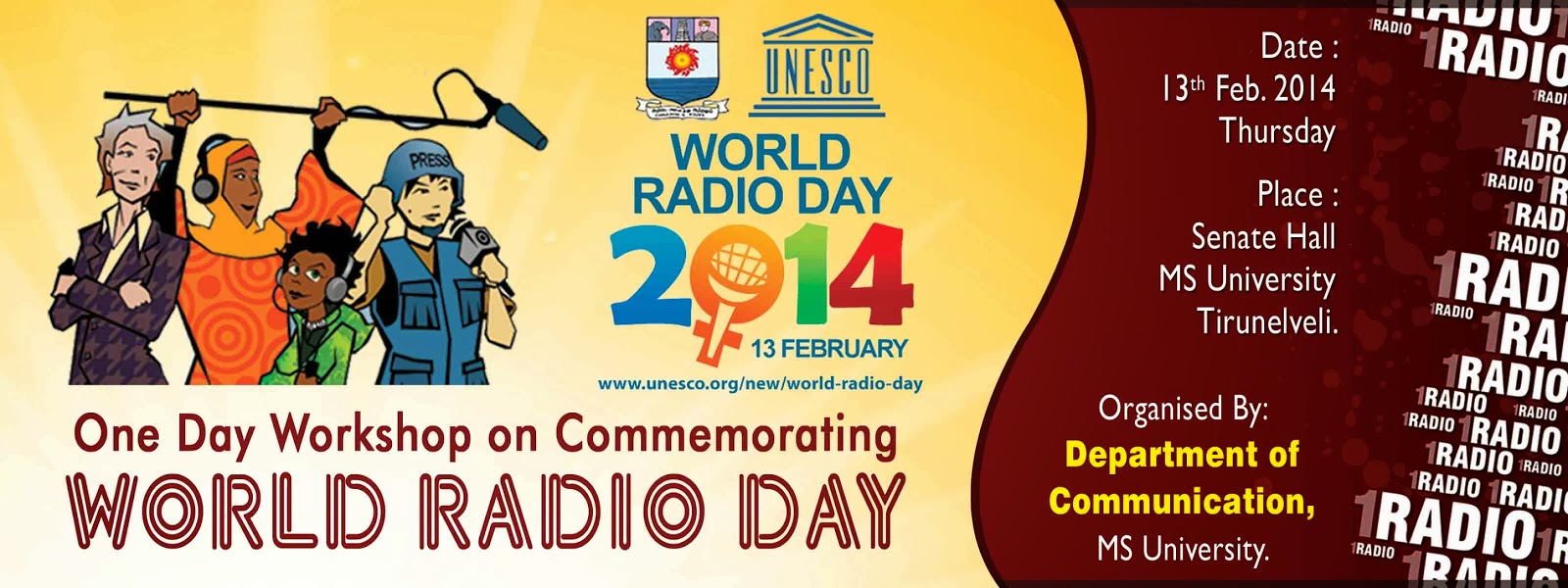
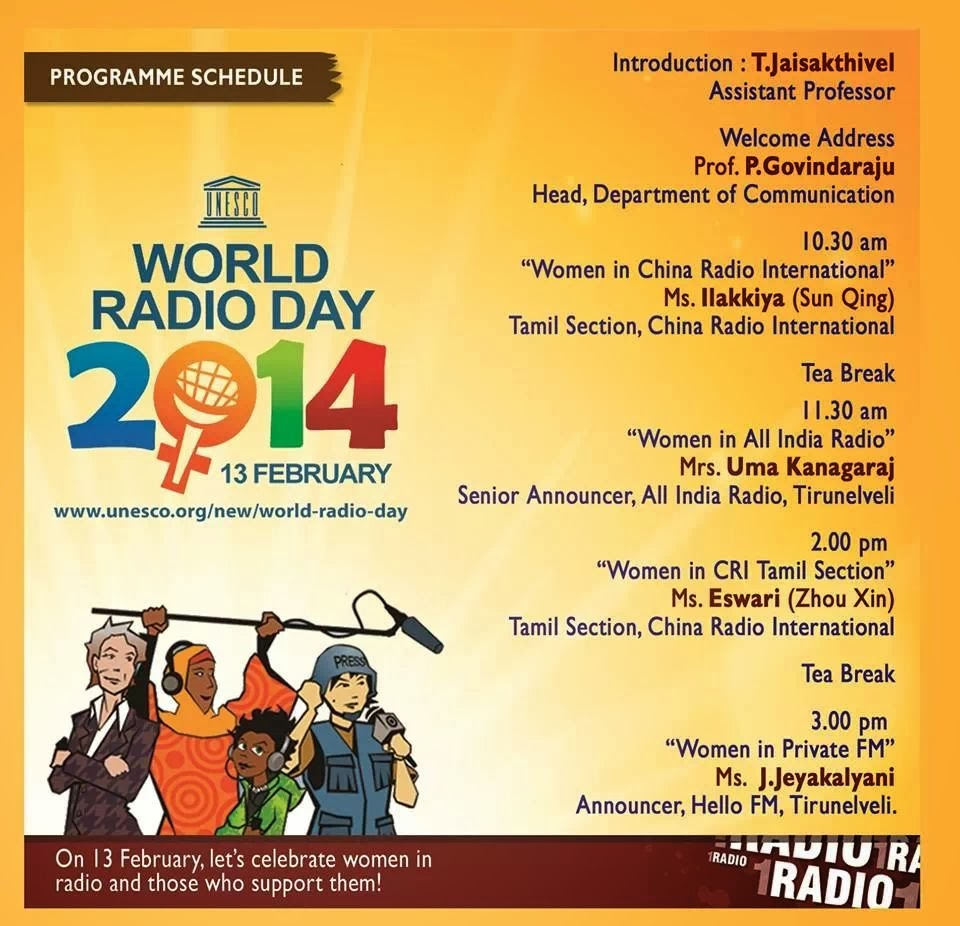
World Radio Day celebration in MS univeristy

Special Sticker
Tamil Banner

English Banner

Invitation front side

Invitation back side


UN special poster


Monday, February 10, 2014

World Radio Day 2014 celebaration in Tamil Nadu

World Radio Day - 2014 Celebration in 
Manonmaniam Sundaranar University, Tirunelveli, Tamil Nadu, India. 

ALL ARE WELCOME


Sunday, February 09, 2014

Wavescan NWS259


* Theme - 00:00
            “Birthday Serenade” - Willi Glahe

* Opening Announcement - 00:17
            Welcome to “Wavescan”, international DX program from Adventist World Radio
            Researched and written in Indianapolis, produced in studios of shortwave WRMI
            Program outline
                        1. Review: WRTVHB 2014
                        2. Radio Conventions
                        3. International DX News
                        4. Philippine DX Report
                       
* Review: WRTVHB 2014 - 01:00
            The long awaited 2014 edition of the World Radio TV Handbook has finally arrived, and we take delight in giving you an audio preview of this important annual publication. 

      Ray Robinson KVOH
            All 672 pages are chock full of interesting and uptodate information that is fundamentally necessary for any and every international radio monitor.
            This 68th edition of the WRTVHB is compiled, as always, from information obtained directly from thousands of mediumwave, shortwave and FM stations located in all countries around the world, together with monitoring information provided by a panel of well known international radio monitors who specialize in different areas of the international radio spectrum.  The publisher is Nicholas Hardyman, the International Editor is Sean Gilbert, and the high quality annual volume is printed and published in England.
            All of the several articles in this year’s WRTVHB are, as always, of real interest, and the first tells the radio story of international radio monitor Max van Arnhem in Holland.  Listed also are the names of the many international radio monitors who provide monitoring assistance to WRTVHB.  Some of these men you may know personally, some you know by name only, and others are equally well known in other parts of the world.  You will note for example, that Jose Jacob VU2JOS in India is listed representing his country.
            Listed also are reviews of half a dozen new radio receivers varying in price from $245 right up to  $6500.  Some of these receivers are stand alone units, and others are attached to a computer system.
            Two men who stand high in the international radio world have contributed major feature articles.  Jerome Berg of suburban Boston presents “The History of Shortwave Broadcasting in a Nutshell”, together with half a dozen mouth-watering QSL cards in full color.  Victor Goonetilleke of Colombo Sri Lanka tells the story of “Broadcasting in Sri Lanka” with on the spot photos.  Another feature article presents the story of the Voice of Vietnam from Hans Johnson in Florida.
            A total of 13 maps in shiny full color show you the locations of the world’s shortwave stations; then begins the listing of mediumwave and FM stations with postal addresses in every country in alphabetic order, beginning with Afghanistan.  The listing of mediumwave stations in Australia shows a total of only 14 transmitters in 5 states operating at 50 kW, all on the air with government ABC programming.       
            The highest power for a commercial station on mediumwave in Australia is 10 kW, with just three stations, 4KQ (693 kHz) & 4TAB (1008 kHz) both in Brisbane, and 6PR (882 kHz) in Perth.  The Public Broadcasting Station 2WEB in Bourke NSW also operates at 10 kW on a mediumwave channel, 585 kHz.
            The listing for Brazil shows nearly 2,000 mediumwave stations with 100 on shortwave; China & Russia have just as many, and the United States has even more..  Lonely Pitcairn Island is shown with two FM stations at very low power; 87.5 MHz with 2½ watts and 107 MHz at 1 watt.  Zimbabwe is at the end of the alphabetic list in the section for national radio.  The international shortwave section is followed by a listing of all clandestine stations currently on the air. 
            Just as appealing is all of the advertising presented in full color.  Many receivers are shown, as is also transmission equipment for broadcasters, and radio magazines with a wide appeal too.

* Program Announcement - 06:30
            Allen Graham

* International DX News - 07:16
     Spy Numbers Stations
            Item from Radio World

    New Time Zone for India
            Reports from North East India indicate that serious consideration is currently being given to the introduction of a new time zone for all of the north eastern states.  At the present time, there is only one time zone in all of India, UTC plus 5½ hours, and this is 90 minutes wide right across India.  Unofficially, the tea gardens in North East India observe their own time zone, one hour later than the official local time.

     Chinese News Reporters Visit Northern Finland
            The New Zealand DX Times reports that a group of news reporters from China visited a DX camp in northern Finland to investigate the mediumwave DX scene.  A total of 14 beverage antennas each 3,000 feet long is established at the DX camp, and one of their major interests is to tune in to mediumwave stations that are on the air in mainland China.
            And while we are talking about China, we can mention another item in a recent edition of the New Zealand DX Times.  A giant radio receiver was placed on display in the radio museum in the lobby  of the Central People’s Broadcasting Station in Yunnan province.  This radio was built at a nearby radio factory, it measures 14 ft long, 8 feet high & 4½ feet thick, and it was designed to tune in the four local radio channels.
            A recent edition of the magazine Radio Maailma in Finland reports that a new longwire beverage antenna was installed at their DX camp at Aihkinienmi.  The antenna was beamed at 160 degrees and a multitude of mediumwave stations in Iran were logged.

     London England
            The American radio magazine Popular Communications reported a while ago that a radio has been produced in London with the use of a printed circuit board which is in the shape and the form of a map of the underground railway system in London.

     New Radio Stations in New Skyscraper in New York City
            The American news magazine Radio World reported recently that the new skyscraper in New York City is now ready to accept organizations that would like to establish radio and TV stations in their building.  This new tower, One World Trade Center, is constructed on the site of the previous buildings that were destroyed in the air attack designated 911, September 11, 2001.  The height of the new building stands at 1776 feet at the top of the spire, ⅓rd mile high.  This is 49 feet taller than the previous building on the same site.
            In another report, Radio World printed a photograph of a wireless transmitter that was in use in Berlin for the broadcast of speech transmissions in the year 1906.

     AWR on FM in India:
            Currently, Adventist World Radio is on the air on five FM stations in India.  The scheduling is as follows; and we might add, that reception reports would be appreciated:-
            Hyderabad      AIR      Vividh Bharathi            102.8 MHz      10 kW  Telugu Daily 1730 IST
            Pune (Poona)  AIR      Vividh Bharathi            101.0               10                    Fri Sat Sun 1845 IST
            Shillong           AIR      FM Rainbow               103.6               10                     Fri Sat Sun 1645 IST
            Trivandrum                 Big FM                          92.7                 5                     Fri Sat Sun 1330 IST
            Bengaluru        AIR      FM Rainbow               101.3               10        English Fri Sat Sun 1645 IST
                                                                                                                                    Also via AIR DTH

            And while we are talking about AWR FM transmissions, we report that the first AWR FM station in Indonesia was inaugurated recently at Menado in the province of North Sulawesi.  This station is currently on the air on 90.6 MHz 12 hours daily according to the license requirements, and it is expected that a full time schedule will be introduced during the earlier part of this year 2014.  The station identifies on air as Radio Angkat Nafiri in Bahasa Indonesia, a title that is taken from the AWR theme melody under the title, “Jesus is Coming Again”.

     Special Amateur Callsign AU3NIAR Celebrates Three Decades in India
            The National Institute of Amateur Radio was established with its headquarters at Hyderabad, Andhra Pradesh, India in the year 1983. The activities of the organisation include Awareness Programs, Training, Technical Workshops, Advocacy, DX-pedititions, Contesting and Emergency Communications to promote people participating in Communication through Amateur Radio.  Celebrating three decades of continuous service to society, the NIAR Club station will operate a special callsign AU3NIAR throughout this year 2014, for which a special QSL card is available.

     Norfolk Island Radio Broadcasts Programs from New Zealand
            The mediumwave station VL2NI on Norfolk Island carries a relay of radio programming from New Zealand, states David Ricquish in a recent edition of the New Zealand DX Times.  Norfolk Island is an Australian territory out in the Pacific some 877 miles from the Australian coastline.  Station VL2NI operates on mediumwave 1566 kHz and the programming from Radio National in New Zealand is received on Norfolk Island via satellite.

     Usage of Spark Gap Morse Code Officially Ended
            A recent feature article states that the transmission of spark gap Morse Code in the United States was prohibited by law, beginning on January 1, 1940.

* Radio Conventions - 13:42
            HFCC 2014 Kuala Lumpur
            SWL Winterfest

* Philippine DX Report - 21:55
            Henry Umadhay

* Music of the World - 26:56
            USA Death Valley: Theatre organ, Streets of Laredo


* Closing Announcement - 27:30
            Thanks for listening to “Wavescan”, international DX program from Adventist World Radio
            Researched and written in Indianapolis
            Next week:-
                        1. Focus on Asia Philippines - 6: Navy Wireless at Cavite
                        2. Bangladesh DX Report
            Two QSL cards available - AWR & WRMI
            Wavescan address:-
                        Box 29235
                        Indianapolis
                        Indiana 46229 USA
            Wavescan @ AWR.org
            Jeff White, shortwave WRMI

* Music Outrun - 28:29

* Program Ends - 28:55

Monday, February 03, 2014

Wavescan NWS258


* Theme - 00:00
“Birthday Serenade” - Willi Glahe

* Opening Announcement - 00:16
Welcome to “Wavescan”, international DX program from Adventist World Radio
Researched and written in Indianapolis, produced in studios of shortwave WRMI
Program outline:
1. The Early Shortwave Stations by Jerome Berg
2. An International Call!
3. QSL Calendar
4. HFCC Kuala Lumpur: Interview WWCR Brady Murray with Jerry Plummer
5. Japan DX Report

* The Early Shortwave Stations by Jerome Berg - 01:00
The 4th book on the 90 year old history of shortwave radio broadcasting, all authored by the noted radio historian, Jerome Berg in suburban Boston, USA, is now on the market and available to all who have a keen interest in the fascinating backgrounds to international radio broadcasting.

     Ray Robinson KVOH
This new volume, The Early Shortwave Stations, is replete with more than 300 pages of information on the early shortwave stations and it makes for very interesting reading.  The new book completes the four volume compendium on shortwave broadcasting and shortwave listening, running from the earliest year, 1923, right up to the present time.
The 1st book in this series, under the title On the Short Waves, was issued in 1999, and it covers the early shortwave scene from 1923 up to the end of World War 2 in 1945.  Because of its popularity, this volume has already completed its 2nd printing.
The 2nd book, Listening on the Short Waves, covering the era from the end of World War 2 up to the present time, was published in 2008, and this one also has already gone through its 2nd printing.
The 3rd volume, Broadcasting on the Short Waves, covering the era from the end of World War 2 up to the present time, was also released in 2008, and as we would expect, a 2nd printing was issued just two years back.
And now, Book 4 is available, and in this volume with the title The Early Shortwave Stations, Jerry Berg has gone back to the beginning and covered the era from 1923 up to the end of World War 2.  Thus it is that these four volumes, Listening on the Short Waves 1 & 2, and Broadcasting on the Short Waves 1 & 2, cover the entire spectrum of shortwave history during the past 90 years.
Volume 4, The Early Short Wave Stations, was released just before the end of last year, and it begins with the story of the earliest radio broadcast programming on shortwave via the well known mediumwave station KDKA in Pittsburgh Pennsylvania in 1923.  Back then, most of the programming via Westinghouse shortwave 8XS was a relay from the mediumwave unit KDKA itself.  Although KDKA shortwave was the dominant shortwave station in those very earliest days, yet other stations quickly followed, not only in the United States, but also in other countries overseas, including England, Germany and Australia.  
The book documents a year by year progression in the book as many other shortwave stations, large and small, took to the air in so many different countries around the world.  By the end of the era covered in this book (1945), volume 4, the shortwave bands were full of stations all around the globe, as it still is to this day.
Among the many almost forgotten and interesting observations that are brought to light in this new volume, we could mention that:-
* Station KDKA began a regular international shortwave service to the scattered inhabitants in the frozen areas of northern Canada
* Holland came into the act with station PCJJ in 1926 with a 300 watt transmitter on 3313 kHz
* The General Electric station W2XAF in Schenectady New York broadcast a special program to the Falkland Islands in 1933
* Early broadcasting stations in Madras, Bombay & Calcutta in India under such calls as 2GY, 7BY & 7CA, eventually gave way to VUM VUB & VUC
* General Electric had a cat called Kilowatt and a dog named Short, and they gave their calls occasionally in shortwave programming
* Station CSW in Lisbon Portugal announced its callsign phonetically as C Canada, S Spain, W Washington
* Amateur station EA9AI in Mellila, Spanish Morocco in North Africa, was on the air for an hour each Saturday and Sunday evening with broadcast programming on 7180 kHz
* And many more interesting items of early shortwave information in the sections year by year

When we come to the concentrated radio events associated with World War 2, we find ample detail regarding many interesting mediumwave and shortwave stations in a multitude of countries, and these are covered effectively in volume 4.  For example:-
* The first callsign for a 200 watt experimental shortwave transmitter in Budapest Hungary was HAAQ2, and this was soon afterwards regularized as HAD
* Tiny Andorra established its own shortwave voice as Radio Andorra; and Ireland launched its own shortwave service with just 1½ kW
* The Bahamas also launched a low power operation on shortwave with just 200 watts as a relay from mediumwave ZNS
* Callsigns in Czechoslovakia under the German administration were changed from OLR2A & OLR3C to DHE2A & DHE3C
* The German station XGRS in Shanghai China sent IRC International Reply Coupons to its listeners in an endeavor to increase its mail response
* The British established a small 1½ kW clandestine shortwave station on the island of Mauritius that claimed to be located in Madagascar
* Under the Japanese administration, Radio Saigon broadcast programming in the Dutch language pretending to be Radio Batavia in what is now Indonesia
* The Chinese shortwave station XGOY planned the production of a broadcast service to Latin America and they asked California based KWID to relay this programming

We might also add that the detailed information contained in the appendix makes for very interesting reading.  And, in addition, you will appreciate the many pictures of QSL cards, letters and documents that are reproduced in volume 4.
The complete set of four volumes of Jerome Berg’s monumental series on the history of shortwave broadcasting and listening has set a standard of excellence in this area of radio broadcasting that is not met in any other way by any other publications.  No other histories cover the intricate details of the widespread impact that has been accomplished to the peoples of the world during the past nearly one century of shortwave broadcasting.
All four volumes are worthy of attention by all international radio monitors, and we would recommend them for inclusion in the libraries of the communication departments of all universities throughout the world.  We here at Wavescan are pleased that we can offer one of these volumes as an award each year in our annual DX contest.
These books have been produced by McFarland & Company of Jefferson in North Carolina and also in London England.  You can make contact with them at their website mcfarlandpub.com or by phone at 1 800 253 2187.
We conclude this monograph with reference to the fact that the author, Jerome Berg, has followed a regular publishing custom and dedicated each volume to specific people.  We are grateful, and humbled too, that he has included our DX host, Dr. Adrian Peterson, on the dedication page of his volume 4, The Early Shortwave Stations.

* An International Call! - 09:35
At the end of the Preface in volume 4 of his shortwave radio history, The Early Shortwave Stations, author and radio historian Jerome Berg makes this statement:
And once again I say thanks to my wife, Ruth, who has accepted my pronouncement that this is the last of my big shortwave projects with knowing skepticism, and who I know will understand if it turns out I was wrong.
So, does this terse statement mean the Jerome Berg is indeed quietly giving consideration to the preparation of additional radio books?  It is true, there is a wide need for the production of more books in association with the story of shortwave broadcasting.
The time has come; and we would like to suggest, recommend, and urge, that serious consideration be given to the preparation of a series of publications containing a compendium of QSL cards from around the world.  Maybe these publications, each with a list of countries and shortwave stations in alphabetic order under a continental area, could contain a listing of QSL cards with pictures in color and text, in much the same way as catalogs are available on all of the postage stamps issued by each country around the world.
Ample quantities of QSL cards in four different major collections are available for this purpose at various locations:
CPRV Collection Under the auspices of Jerome Berg, USA
ORF Collection Vienna Austria
Major Heritage Collections New Zealand
Indianapolis Heritage Collection Indianapolis USA

A sampling of some of these colorful QSL cards from earlier times is pictured on the front cover of Jerome Berg’s volume 4, The Early Shortwave Stations.

* Program Announcement - 11:23
Allen Graham

* QSL Calendar 2014 - 12:13
For the past many years, the Rhein-Main Radio Club over there in Europe has prepared a QSLCalendar in full color, depicting two QSL cards on each page.  Some of the QSLs that are pictured in full size are very old and exotic, and others are from more recent times.   (List of 10 different QSLcards depicted.)  The 2014 QSL Calendar is available at $20, and you can make contact with Dr. Harald Gabler at DrGabler@t-online.de

* Focus on Asia: HFCC Kuala Lumpur 2014 Report - 14:16
Interview: WWCR Brady Murray with Jerry Plummer

* Japan DX Report - 21:38
Yukiko Tsuji


* Music of the World - 27:07
Malaysia: Instrumental & vocal

* Closing Announcement - 27:24
Thanks for listening to “Wavescan”, international DX program from Adventist World Radio
Researched and written in Indianapolis
Next week:-
1. WRTVHB 2014
2. Australian Radio History, Dr, Bruce Carty
3. International DX News
4. Philippine DX Report
Two QSL cards available - AWR & WRMI
Wavescan address:-
Box 29235
Indianapolis
Indiana 46229 USA
Wavescan @ AWR.org
Jeff White, shortwave WRMI

* Music Outrun - 28:38

* Program Ends - 28:55

WIN DAB RADIO


Polish Radio
20 January 2014

To celebrate us reaching over 5000 followers on Facebook, think up a slogan for our new DAB+ English language broadcasts and win Polish Radio goodies!                                                                                                  

Since 1 October last year, Polish Radio channels (Radios One, Two, Three and Four) as well as Polish Radio External Service are available in DAB+.

The launch of terrestrial digital transmissions on DAB+ by Polish Radio makes it the leader in technological change and a pioneer in digital broadcasting not only in Poland but also in the entire CEE region. This also creates the opportunity for Polish Radio to expand its offer with new channels and to reach a wider audience.

To find out how to access our DAB+ broadcasts see here
http://external.polskieradio.pl/10/60/Artykul/159221,Polish-Radio-External-Services-launches-DAB-channel-in-Poland

5000 followers on Facebook can't be wrong!

To win prizes in the competition, including special Polish Radio wallets (a must-have accessory for any self-respecting radio listener) think up a slogan to publicize the new DAB+ broadcasts.

The slogan should be suitable for use on air as well as on our web pages at thenews.pl.

For example, the slogan could be something like: 'DAB+ bringing radio closer to you', although we are sure you can do better.

The competition is open for entries from Monday 3 February until midnight CET on Sunday 16 February. Please read the rules below, and may the best slogan win!

 Rules

1. The competition invites all listeners of the English Section of Polish Radio as well as readers of thenews.pl to think up of a slogan in English on the theme of: Polish Radio’s English Section closer to you – now in DAB+. It should be suitable for use on air as well as on our pages at thenews.pl. More information on DAB+ here: http://dabplus.polskieradio.pl/english.aspx.

2. We invite all competition entrants to submit their slogans between 00:01 CET, 03.02.2014 until 23:59, 16.02.2014

3. All submissions should be sent to thenews@polskieradio.pl or by post to English Section, Polskie Radio dla Zagranicy, Al. Niepodległości 77/85, 00-977 Warszawa, with the adnotation “Facebook competition”. Please include your name, surname, email address and telephone number along with your submission.

4. All entries will be taken into account, with the selection chosen by a vote of the competition committee made up of Polish Radio English Section journalists. The decisions made are final.

5. Entrants can submit more than one slogan for this competition.

6. We will let the winners know of their success by email or telephone in order to make arrangements for prize delivery. At the same time, entrants agree to let their name, surname be used for the competition’s promotional page on thenews.pl or other pages of the different language sections of Polish Radio External Service.

7. Prizes: an embossed leather wallet is foreseen as the main prize. The second, third, and fourth runners-up will receive a credit-card sized USB stick.

8. For more details contact John Beauchamp, Polish Radio - English Section. john.beauchamp@polskieradio.pl

http://www.thenews.pl/1/11/Artykul/160797,Polish-Radio-Facebook-5000-competition-win-prizes

Thursday, January 30, 2014

World Radio Day 2014

13 February is World Radio Day — a day to celebrate radio as a medium; to improve international cooperation between broadcasters; and to encourage major networks and community radio alike to promote access to information, freedom of expression and gender equality over the airwaves.

As radio continues to evolve in the digital age, it remains the medium that reaches the widest audience worldwide. It is essential to furthering UNESCO’s commitment to promote gender equality and women’s empowerment.
Through World Radio Day celebrations around the world, UNESCO will promote gender equality by:
We invite all countries to celebrate World Radio Day by planning activities in partnership with regional, national and international broadcasters, non-governmental organizations, the media and the public.
On 13 February, let’s celebrate women in radio and those who support them!
- See more at: http://www.unesco.org/new/en/unesco/events/prizes-and-celebrations/celebrations/international-days/world-radio-day-2014/#sthash.gPZ6Fsay.dpuf

15 Ways to Celebrate World Radio Day


  1. Help broadcast audio, video and written messages from UNESCO’s Director-General on World Radio Day in all public, private and community radio. (Forthcoming)
  2. Broadcast messages from World Radio Day supporters including UNESCO Artists for Peace, industry experts and celebrity advocates for Radio. (2014 messages forthcoming | Past messages)
  3. Produce a radio programme or public service announcement on one of UNESCO’s sub-themes for World Radio Day 2014 to be broadcast repeatedly on 13 February 2014.

  4. Organize and broadcast World Radio Day themed debates and discussions with media stakeholders (broadcasters, policy-makers, academics, legal community) on the issue of gender equality in radio.
  5. Organize phone-in radio shows so listeners can discuss the importance of radio, share memories of great moments in radio history, and give their views on gender equality.
  6. Interview local, regional and national radio personalities on World Radio Day.
  7. Share recordings of your radio show and other World Radio Day themed broadcasts onUNESCO’s World Radio Day SoundCloud page.
  8. Add a link to your favourite radio programme on gender equality and empowerment of women to our worldwide map. [link forthcoming]
  9. Hold training sessions for young broadcasters using UNESCO’s Youth Radio Toolkit
  10. Display and distribute training courseware on Radio Production from UNESCO’s Open Training Platform.
  11. Display and distribute free UNESCO products about broadcasting 

  12. Join the National Commission for UNESCO in your country to facilitate celebrating national events.
  13. Place our World Radio Day Banner on your social media channel or website and encourage newspapers, radio, television and website editors to place a banner on their sites during World Radio Day on 13 February.
  14. Celebrate World Radio Day with the World Association of Community Broadcasters(AMARC), worldradioday.org or local community radio associations.
  15. Record a World Radio Day message and share it with the world. [link forthcoming]


  • Source: http://www.unesco.org/