Showing posts with label community radio. Show all posts

Saturday, March 21, 2026

Ooty Conference Charts the Future of Community Radio

As the media landscape rapidly evolves through technological advancement, a two-focused conference titled “Community Radio in the Age of Artificial Intelligence” was held on March 14 and 15, 2026, at Vinayaga Inn by Poppys Hotel in Udhagamandalam. This gathering served as a vital platform for organizations, NGOs, and educational institutions to explore the growth of community broadcasting and the transformative power of AI in the sector. 


A major highlight of the event was the official release of the "Community Radio Handbook," authored by Dr. T. Jaisakthivel from the University of Madras and published by Airmedia Broadcast Solutions. This new publication offers a comprehensive guide for establishing and operating stations, including a detailed directory of existing community radio services across Tamil Nadu.


During the sessions, Dr. Jaisakthivel proposed a significant policy shift for the Indian broadcasting sector, advocating for a Restricted Service License (RSL) model similar to the system used in the United Kingdom. He explained that allowing short-term licenses for specific cultural events such as "Pongal FM" or "Ramadan FM" could boost employment and encourage localized radio growth. 


Complementing this vision for expansion, conference organizer Mr. P. Vijayakumar detailed the practical steps for accessing Central Government grants of up to ₹12.5 lakhs, providing essential guidance for schools and colleges looking to launch their own stations.


 The technical discussions delved into the practical applications of AI, specifically how automated 24-hour broadcasting and AI-driven content production can modernize local stations. Representatives from Rathinavani FM and Kalasalingam FM shared their operational experiences, while the second day shifted focus toward the future with preparations for an International Media Conference set for December. 

With contributions from academic experts like Dr. C. Praveenkumar and Dr. Pragathi, the conference reinforced the role of community radio as a bridge for social development, blending traditional grassroots outreach with cutting-edge technology.


Tuesday, January 06, 2026

Expansion of Community Radio Stations in India (2020–2024)


The expansion of Community Radio Stations (CRS) in India from 2020 to 2024 represents a significant period of decentralized media growth, with a total of 212 new stations established across 194 different districts. This study, formatted for scholarly review, examines the spatial and temporal trends of these installations using the data provided by the Ministry of Information and Broadcasting. While the global communication landscape shifted during these years, India’s community radio sector demonstrated a non-linear but robust upward trajectory, peaking significantly in 2023 before stabilizing in 2024. The methodology for this analysis involves a quantitative review of Annexure – I from (https://mib.gov.in/sites/default/files/2025-12/list-of-newly-established-community-radio-stations-crs-for-the-last-five-years-state-and-district-wise-1.pdf), which details the annual establishment of CRS and the number of districts covered across 36 States and Union Territories (UTs). It should be noted that while the statistical data is drawn directly from the sources, any discussion regarding the theoretical "last mile" communication or policy motivations is based on general academic knowledge and may require independent verification.

The national temporal pattern reveals that the period began with modest activity, seeing 20 new stations in 2020 and 24 in 2021. However, 2022 served as a turning point where expansion more than doubled to 59 new stations. This momentum culminated in a historic peak in 2023, during which 81 new stations were established across 75 districts. By 2024, the rate of establishment moderated to 28 stations, though it achieved a notable geographic precision by covering 28 unique districts. This trajectory suggests a strategic emphasis on expanding the reach of community radio rather than merely increasing station density in already served areas.

Regionally, Uttar Pradesh (UP) emerged as the dominant force in the community radio sector, establishing 35 stations in 33 different districts over the five-year period. UP’s growth was particularly concentrated in 2022 and 2023, where it added 11 and 15 stations respectively. Similarly, Odisha showcased a significant surge, starting with just 2 stations in 2020 but expanding rapidly to 12 new stations in 2023, totaling 26 establishments for the entire period. In contrast, Maharashtra’s growth was highly concentrated in a single year, 2022, when it established 15 stations—the highest for any state in a single year—yet it recorded zero new stations in 2023 before adding 7 more in 2024.

The geographic distribution also highlights significant activity in states like Chhattisgarh and Madhya Pradesh. Chhattisgarh maintained a steady pace, establishing 4 stations in 2020 and 4 again in 2023, reaching a total of 12 stations across 11 districts. Madhya Pradesh saw a sudden peak in 2023 with 6 new stations covering 5 districts, following several years of minimal activity. In the southern region, Tamil Nadu maintained a consistent presence, with its highest growth of 8 stations occurring in 2022. Meanwhile, Bihar showed a late-period acceleration, with 5 of its 7 new stations being established between 2023 and 2024. Other states like West Bengal followed a consistent growth curve, peaking in 2023 with 4 stations and covering a total of 9 districts over the period.

Despite these pockets of high activity, the data reveals a "digital divide" in community radio expansion across certain UTs and smaller states. Areas such as Goa, Lakshadweep, Puducherry, Sikkim, and Tripura recorded zero new CRS establishment during the entire five-year window. Furthermore, states like Haryana and Jharkhand, which showed early promise in 2020 with 5 and 1 stations respectively, saw long periods of stagnation before recording smaller numbers in 2023. This disparity highlights the uneven adoption of community radio infrastructure across the Indian subcontinent. It is also observed that regions like the Andaman & Nicobar Islands and Arunachal Pradesh only recorded their first station of this period in 2023.

A defining characteristic of the 2020–2024 expansion is the ratio of stations to districts. For the cumulative total, 212 stations were spread across 194 districts, maintaining a near 1:1 ratio. This ratio was most pronounced in 2024, where every one of the 28 new stations was situated in a distinct district. This pattern suggests a policy or institutional preference for diversifying coverage and ensuring that localized broadcasting reaches new administrative territories rather than duplicating services in existing ones. This trend is mirrored in states like Rajasthan, which established 14 stations across 11 districts, and Karnataka, which added 4 stations in 4 districts across the same period.

In conclusion, the data from 2020 to 2024 depicts a community radio landscape in India that is maturing and seeking universal district coverage. The 2023 peak suggests a high-water mark for administrative or community-led initiatives, while the 2024 data indicates a more targeted approach to geographic expansion. While large states like Uttar Pradesh and Odisha drive the national numbers, the lack of growth in smaller regions remains a point for further investigation. It is clear that community radio remains a vital, albeit regionally varied, component of the Indian media ecosystem.

Expanding a community radio network is like planting a forest across a diverse landscape. Initially, only a few saplings take root (2020-2021), but as the environment becomes more favorable, there is a massive growth spurt where trees begin appearing in almost every corner (2022-2023). By the final stage (2024), the focus shifts from rapid planting to carefully selecting the remaining open spots to ensure every part of the land has its own shade.

References

  1. Pavarala, V., & Malik, K. K. (2007). Other Voices: The Struggle for Community Radio in India. Sage Publications.
  2. Belavadi, V. (2014). Community Radio in India. Oxford University Press.
  3. Manyozo, L. (2012). Media, Communication and Development: Three Approaches. Sage Publications.
  4. Tabassum, R. (2015). Community Radio: A Tool for Community Empowerment. New Delhi Publishers.
  5. Fraser, C., & Estrada, S. R. (2001). Community Radio Handbook. UNESCO.
  6. Milan, S. (2013). Social Movements and Their Technologies: Wiring Social Change. Palgrave Macmillan.
  7. Narayan, S. (2014). Community Radio in India: The Struggle for Participation. Routledge.
  8. Banjaree, I., & Logan, S. (2008). Asian Communication Handbook. AMIC.
  9. Jallov, B. (2012). Empowerment Radio: Voices for a Civilized Society. Empowerment Radio.
  10. Malik, K. K. (2012). Our Media, Not Theirs: The Community Radio Movement in India. Sage India.


Wednesday, December 03, 2025

Sona FM: A companion of the hill people


What can a community radio do? Can you believe that it is providing road facilities, medical assistance and essential needs to the people living in the hills? Salem Sona FM is the only community media for the people of 36 villages located on the Yercaud hills. This radio station broadcasts for 16 hours a day and has a huge audience all over Salem district. I recently got the opportunity to attend the third anniversary of the radio station. 


The program was beautifully presented by Ilakkiya. Project Director Mr. Subramaniam coordinated the program very well. In his speech, the chairman of the Valliyappa Foundation, Mr. C. Valliyappa, directly listened to the needs of the audience and asked them to take notes from the program producers. In addition, he directly introduced all the announcers and program producers to the audience


 I am very happy that the Chairman is in close contact with Gyanpeeth award winner Akhilan, a former employee of Akashvani. It is noteworthy that this is one of the few community radio stations that is successfully operating in Tamil Nadu. 


.


Saturday, October 18, 2025

Special talk on Community Radio: International Scenario

 Grateful for the opportunity to deliver a  at BRIDGE 2025 — the National Seminar on Building Radio Initiatives for Development, Governance, and Empowerment.


The seminar, organized by Muthucharam Community Radio Station (90.4 MHz), SRMIST-KTR, served as a vibrant platform for dialogue and collaboration among policymakers, media professionals, and academics. The event highlighted critical issues like governance frameworks, content creation, licensing, and capacity building, underscoring community radio’s pivotal role in promoting transparency, inclusivity, and grassroots development.


Sharing insights on the international landscape of community radio, I emphasized how global practices and collaborative models can strengthen local empowerment and media diversity.

(Pictured: Moment from the seminar session.)


Friday, May 30, 2025

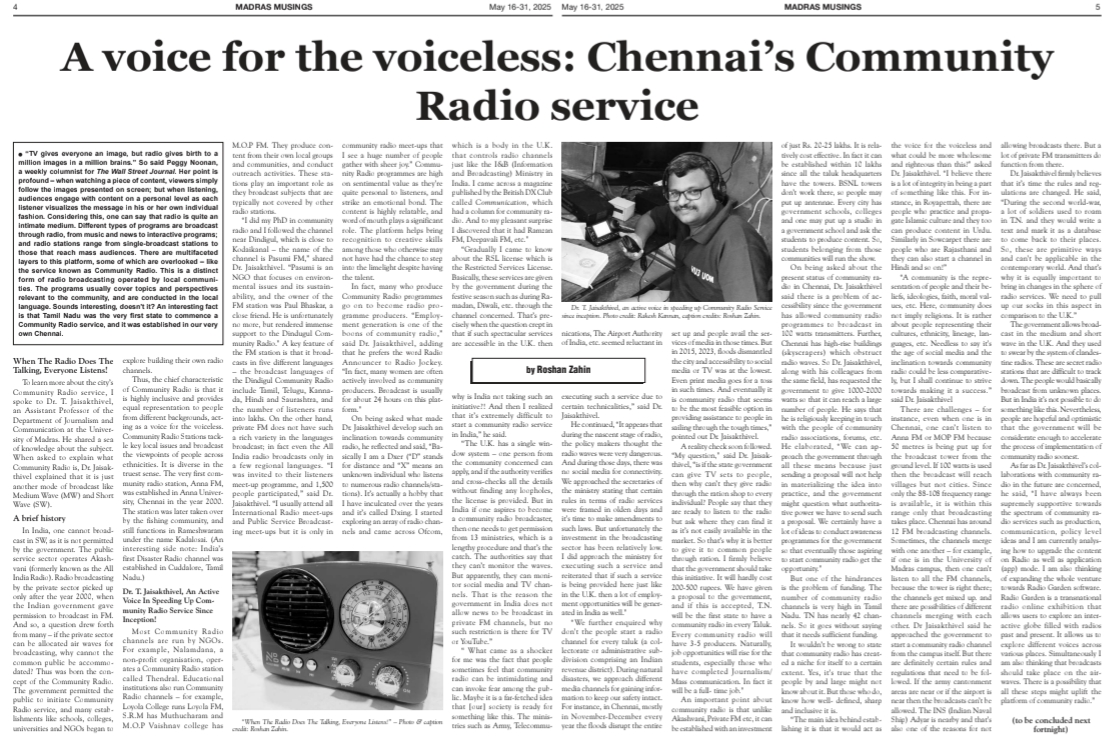
Article on Community Radio in Madras Musings


Just read a fascinating article on Community Radio, published by Madras Musings! 


A big thank you to Madras Musings and the author, Roshan Zahin, for shedding light on this important and engaging topic with me. 


It's wonderful to talk more about how community radio serves and connects people right here in our city.


If you'd like to read the full article,

you can find the link below! 👇


https://madrasmusings.com/vol-35-no-3/a-voice-for-the-voiceless-chennais-community-radio-service/


Or download this issue here


https://madrasmusings.com/wp-content/uploads/2025/05/MM-Vol.-XXXV-No.-3.pdf


Wednesday, March 30, 2016

NGO to launch community radio for Rameswaram fishermen

RAMESWARAM: An NGO will launch a community radio for the fisher folk in Rameswaram. The NGO, Nesakarangal Trust, plans to launch the community radio -- Kadalosai 90.4 FM -- on April 14.

Full story at :
http://timesofindia.indiatimes.com/city/chennai/NGO-to-launch-community-radio-for-Rameswaram-fishermen/articleshow/51600512.cms
Via Alokesh Gupta

Tuesday, January 13, 2015

TRAI MANAGED TO GIVE BROADCASTING AS MUCH IMPORTANCE AS TELECOM IN 2014

A decade after broadcasting was handed over to the Telecom Regulatory Authority of India (TRAI), it appears to have given equal if not more time to the broadcasting sector. It can be attributed largely to convergence of technology.
Thus, issues like spectrum, marketing and even FM radio have got equal space during the Regulator's work as telecom, apart from the digital addressable system introduced in 2011.
TRAI also mastered the art of marketing during the year 2014. It developed Radio Jingles in Hindi, English and 10 Regional languages on VAS/UCC which were aired on various FM channels in 84 cities across the country.
Admitting in its annual report that it had failed to carry out periodic reviews to make inflation- linked adjustments, TRAI said it had finally done so in concurrence of the Supreme Court. Thereafter, TRAI issued two tariff orders on 31 March and December as far as broadcasting was concerned.
As far as FM radio is concerned, TRAI on the request of MIB made recommendations on the amount of migration fee to be charged from existing FM operators on their migration from Phase-II to Phase-III of FM radio broadcasting. The permissions for operating FM Radio as per Phase-II policy were granted by MIB during the period 2005 to 2009 in 86 cities. As per the Phase-II policy, the permissions were granted for a period of 10 years to each FM Radio operator and there is no provision for extension of permission in the Phase-II policy. Therefore, Phase-II permissions will start expiring from 31 March 2015 onwards. There was no great incentive for an existing operator to pay a migration fee and operate as per the Phase-III policy only for the balance period of Phase-II permissions. Accordingly, the Authority in its Recommendations on ‘Migration of FM Radio Broadcasters from Phase-II to Phase-III’ dated 20 February 2014 recommended a period of permission of 15 years after migration from Phase-II to Phase-III.
The salient features of the recommendations are:
TRAI reiterated early implementation of its recommendations on minimum channel spacing of 400 KHz for FM Radio broadcast issued on 19 April 2012, which will in effect increase the number FM channels in each city for auction. The period of permission to operate the existing FM channels on migration from Phase-II to Phase-III will be fifteen years.
Regulatory restrictions on cross-media holdings seek to ensure external plurality in the media market, while restrictions in vertical holding by any entity of a broadcaster and a distribution entity are important to ensure that the distribution channels remain open to all desirous of presenting an opinion or view to the public. Finally, content regulation is critical in a time when news is increasingly seen as an asset belonging to a media entity’s owners to be monetised for political/ business/ or pecuniary gain.
Recommendations on ‘Issues related to Media Ownership' were issued on 12 August 2014. The key issues addressed and the concerned recommendations included defining who owns a media entity and controls it. In brief, an entity that possess not less than fifty per cent of voting rights in the media entity or can appoint more than fifty per cent of the members of its board of directors will be deemed to control it. The Recommendations also take into consideration control through debt, and has recommended the loan threshold that will deem the lender to be in control of a media entity.
The restrictions recommended on cross-media ownership apply on media entities that cover news and current affairs genres in the television and print segments only, as impact of radio and internet in India on opinion formation is marginal. In the print segment, only daily newspapers, including business and financial newspapers, should be considered.
Source: http://www.radioandmusic.com/

Thursday, June 10, 2010

Cellphone-based community radio

The Auroville Radio is testing since December 2009 broadcasting trough
cellphones connect with GPRS connections.
It's working fine but you need a cellphone supporting Flash technology
and for time being are expensive.
If you have a Flash enabled phone connected with Internet you can log
into http://www.aurovilleradio.org/mobile and listen the AurovilleRadio
from all over India.

cr-india Via Andrea Tazzari

Friday, May 15, 2009

5 new community radio stations in Tamil Nadu

TIRUCHY: Five more community radio centres would be set up in Tamil Nadu soon, said R Sridhar, director of Commonwealth Education Media Centre for Asia (CEMCA) here on Thursday.

Sridhar told reporters that 18 out of the 44 community radio centres across the nation were funded by the Department of Science and Te­chnology. Among the stations, 14 undertook science programmes for women and four broadcast programmes of ‘save earth’ concepts, he said. There are six such stations in TN, including two stations in Chennai
and Coimbatore, one in Tiruchy and Puducherry.

The Rural People Development Association would establish new stations in Madurai and another one would be established at Nagapattinam. Permission was granted to set up stations Namakkal, Tiruchencode and Kumarapalayam. More than 20 applications have been received from educational institutes and NGOs.

Indira Gandhi Open University has started a six-month certificate course on the operations of community radio stations and Holy Cross College has been identified as the study centre. Training would be given on the
organisation of the community radios, announcing and other radio-related activities, he added.

Sunday, May 10, 2009

Five New community radio stations in Tamil Nadu

Five more community radio centres would be set up in Tamil Nadu soon, said R Sridhar, director of Commonwealth Education Media Centre for Asia (CEMCA) here on Thursday.

Sridhar told reporters that 18 out of the 44 community radio centres across the nation were funded by the Department of Science and Te­chnology. Among the stations, 14 undertook science programmes for women and four broadcast programmes of ‘save earth’ concepts, he said. There are six such stations in TN, including two stations in Chennai and Coimbatore, one in Tiruchy and Puducherry.

The Rural People Development Association would establish new stations in Madurai and another one would be established at Nagapattinam. Permission was granted to set up stations Namakkal, Tiruchencode and Kumarapalayam. More than 20 applications have been received from educational institutes and NGOs.

Indira Gandhi Open University has started a six-month certificate course on the operations of community radio stations and Holy Cross College has been identified as the study centre. Training would be given on the organisation of the community radios, announcing and other radio-related activities, he added.
-http://www.expressbuzz.com

Thursday, February 12, 2009

COMMUNITY RADIO STATION MANAGERS WORKSHOP


SECOND CAPACITY BUILDING WORKSHOP FOR FUNCTIONAL COMMUNITY RADIO STATION MANAGERS
Held on February 10-11, 2009 EMMRC, ANNA UNIVERSITY, CHENNAI
Organised by
Ministry of Information & Broadcasting, Government of India
Jointly with
Commonwealth Educational Media Centre for Asia
In association with
EMMRC, ANNA UNIVERSITY CHENNAI

Thursday, February 05, 2009

Community Radio Station at Nagapattinam, Tamilnadu


The Ministry of Information and Broadcasting, Government of India has permitted the DHAN Foundation Madurai to establish, maintain and operate a Community Radio Station at Nagapattinam, Tamilnadu. The Community Radio Station is expected to be operational within three months as per the agreement.

DHAN Foundation, Madurai is a Non Governmental Organization. The Kalanjiam Community Radio Station will be established at Village-Vizhunthama vadi, Block-Keelaiyur, Distt-Nagapattinam, Tamilnadu.

It may be recalled that Nagapattinam is a tsunami affected area. The Community Radio Station is expected to serve particularly, the women, farmers, fishermen and empower them with information and communication critical for disaster preparedness and management. The community management committee has made linkages with the local government institutions like panchayats, health centers, schools and disaster management related Government institutions to establish a disaster management mechanism to face natural calamities.

The Ministry of Information and Broadcasting expects that the Community Radio initiative of the Ministry will provide an opportunity to the local communities to be better informed about the developmental initiatives of the Government and promote transparency in the implementation of the schemes.
(PIB, Govt of India Via Alokesh Guta)

For more details
DHAN Foundation
18, Pillaiyar Koil Street
S.S. Colony, Madurai - 625 016.
Tamil Nadu, INDIA
Tel: +91 - 452 - 2610794, 2610805
Fax: +91 - 452 - 2602247
Email: dhan@md3.vsnl.net.in
Web: http://www.dhan.org/media/index.php
Related News :
Tsunami-affected TN village to get community radio station
http://www.hindu. com/thehindu/ holnus/001200902 051922.htm

Sunday, February 01, 2009

150 scholarships announced - IGNOU's community radio programme to become more job oriented

IGNOU's community radio programme to become more job oriented Indopia - India To impart practical knowledge to its students of certificate programme in community radio, IGNOU has entered into an understanding with the
Commonwealth ...

To impart practical knowledge to its students of certificate programme in community radio, IGNOU has entered into an understanding with the Commonwealth Educational Media Centre for Asia (CEMCA) http://www.cemca. org/ and 10 broadcasters across the country.

The broadcasters are mostly based in the Southern states and in Jharkhand, West Bengal and Orissa. They will impart on-the-job-training to the enrolled students of the certificate programme at their centres and hands-on training to the pass-outs in the initial stage, said an IGNOU spokesperson.

" Half of the course component is thoroughly practical and will be learnt through apprenticeship, " he said.

The broadcasters would, in turn, be financially supported by IGNOU and CEMCA. CEMCA has also announced 150 scholarships for students willing to set up community radios, the spokesperson said.

Importantly, he said, IGNOU's School of Journalism and New Media Studies has also decided to utilise the Gyan Vani facility in selective charts of time-slots to run community radio broadcasting schedule. These efforts are
likely to generate jobs and boost extension services in agriculture, fisheries, floriculture, horticulture, among others. (George Lessard)