Thursday, January 18, 2007

Aahaa FM to hit Chennai airwaves


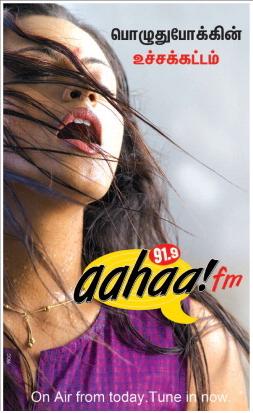
Chennai is all set to have another FM station hitting its airwaves soon – Aahaa FM, the radio venture of Kumudam Publications Pvt Ltd. Aahaa FM would be an out and out entertainment channel targeting young Chennai audience. The Tamil weekly major has appointed Chennai-based creative shop WOC as its creative partner for the new channel.

The content of the new FM channel would be predominantly in Tamil with minimal English and Hindi mix. 91.9 is the frequency number of the new station.

Commenting on the account win, WOC’s Managing Director, Amudhan, said, “This is the fastest account we have ever won. We were invited and in the presentation we said that we could contribute towards the content as well, which, I think, helped us win this account. It is a fairly big account. The client has given us an absolute free hand and the media campaign would break a week ahead of the launch. It will be a big impact campaign and we are looking at some pretty powerful creative.”

“The client wanted a creative partner who understood the Chennai market and at the same time could deliver cutting edge work, and our presentation fit the bill,” he added.

Commenting on the strategy, Amudhan said, “All the existing channels have the same clichéd format and there is hardly any distinction between the one programme and the other, except for replacement of RJs for every programme. We are taking some risks and gambles to be different from the all the existing players. Unlike other channels, Aahaa FM would not be an RJ dependent station but a content dependent one.”

Chennai currently listens to Suryan, Radio Mirchi, Radio City and the recently launched Hello FM and Big FM, while Muthoot Group and Radio Mid-Day West (India) Ltd, a Radio One-BBC World combine are waiting in the wings.

Kumudam Group publishes several magazines, including Tamil weekly ‘Kumudam’, ‘Kumudam Snegithi’, ‘Kumudam Bakthi Special’, ‘Telugu Bakthi Special’, ‘Kumudam Reporter’, ‘Kumudam Jothidam’, ‘Kumudam Health’, ‘Kumudam Theera Nadhi’ and ‘Kalkandu’.

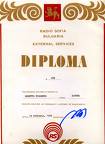
Become a member of Radio Bulgaria's

Dear listener of Radio Bulgaria,

The good news is that in order to become a member of Radio Bulgaria's
Monitoring Club and receive the 6 QSL cards in the series you have to
fulfill the following requirements:

For the FIRST QSL CARD you will have to submit THREE reception reports
for January and THREE for February.

For the SECOND QSL CARD you will have to submit THREE reception
reports for March and THREE for April.

For the THIRD QSL CARD you will have to submit THREE reception reports
for May and THREE for June.

For the FOURTH QSL CARD you will have to submit THREE reception
reports for July and THREE for August.

For the FIFTH QSL CARD you will have to submit THREE reception reports
for September and THREE for October.

For the SIXTH QSL CARD you will have to submit THREE reception reports
for November and THREE for December.

A valid reception report should cover at least 15 minutes of our
broadcasts on any frequency and at the time you prefer, and should
include details of the contents of the broadcast and SINPO rating.

Upon reception of the full set of 6 QSL cards, you will also get the
Monitoring Club Membership Certificate of Radio Bulgaria.

Letters and reception reports should be sent within the period
specified for each QSL card.

For more information contact us at the following address:

English Service, Radio Bulgaria 4 Dragan Tzankov Blvd.
1040 Sofia, Bulgaria
english@bnr. bg

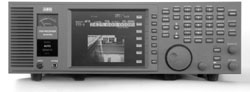
AOR AR-ALPHA MULTI-MODE COMMUNICATIONS RECEIVER


AOR is currently developing its flagship in communications receivers, a new kind of wideband software defined receiver based on ZERO-IF and DDS local generator, added to a 6” TFT screen displaying an amazing 1GHz bandwidth FFT spectrum! This high-end receiver targets communication professionals and authorities (surveillance, law enforcement…) as it also features a 1MHz wide high resolution digital I/Q output to PC.

Main specifications:

- Zero-IF and DDS local generator

- 10kHz-3.3GHz (with or without gaps, depending on country regulation)

- FFT Spectrum Display up to 1GHz bandwidth Wide Band I/Q digital output through continuous isochronous USB 2.0 Interface (1MHz BW, Mantissa 4-bit, Index 13-bit for wide dynamic range, 98.304M-bit/sec. transfer rate)

- Multi mode receive : WFM (in stereo, selectable de-emphasis), NFM, AM (Synchronous AM, diversity synchronous AM), ISB, RZSSB, USB, LSB, CW, P25, TV (FM, AM, NTSC/PAL/ SECAM/ PAL-M)

- Multiple IF filters: 200Hz, 500Hz, 3kHz, 6kHz, 15kHz, 30kHz, 100kHz, 200kHz, 300kHz

- Versatile digital processing: Digital noise filter, auto notch filter, noise blanker, IF shift, AFC, variable CW pitch, voice descrambler, voice squelch, CTCSS, DCS

- 6” color TFT display

- 19” rack mount

(all specifications subject to change without notice)

*Availability and price is still unknown*

AR-ALPHA Brochure Ad PDF 600 kB
AR-ALPHA Specifications PDF 500 kB


Jan 18, 2007
SM5YLO Lennart Deimert

Tuesday, January 09, 2007

BBC BENGALI SERVICE NEW TRANSMISSION

Dear listener
you may have heard from our programmes that we are going to launch a
NEW
dawn transmission from Thursday January 11, 2007. This will be a
half-hour programme, with news and current affairs, live contributions
from Dhaka, Delhi and Kolkata, press reviews, sports, culture etc.

The new dawn will be broadcast at 7am India time, on 31 metreband (9560
kHz) and 25 metreband (11995 kHz) on the shortwave.

Please let the listeners' clubs, your friends, neighbours in your
locality know of the new transmission.

Also, on Jan 8, 9 and 10, we will be testing the two frequencies . The
English news will be broadcast for half an hour on the above two
frequencies at 7am-7.30am, to see how effective they are. Would it be
possible for some listeners in West Bengal, Assam or Tripura to
monitor
these test tranmissions on those three days? Please request them, and
pass on the feedback to me immediately afterwards.

Regards
Amita Pal
BBC WS Marketing, Communications & Audience
New Delhi
+++++++++++++++++++++
Thanks to ,

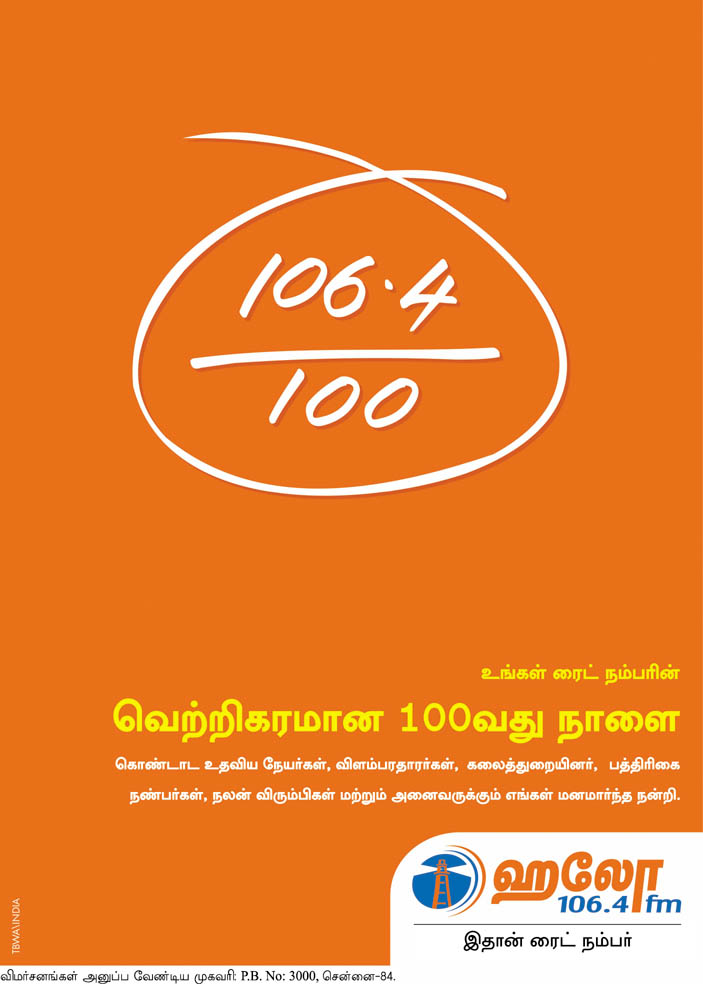
ஹலோ எப்.எம் 100 ஆவது நாள்


தினதந்தியில் 09-01-07 அன்று வெளிவந்த முதல் பக்க விளம்பரம்

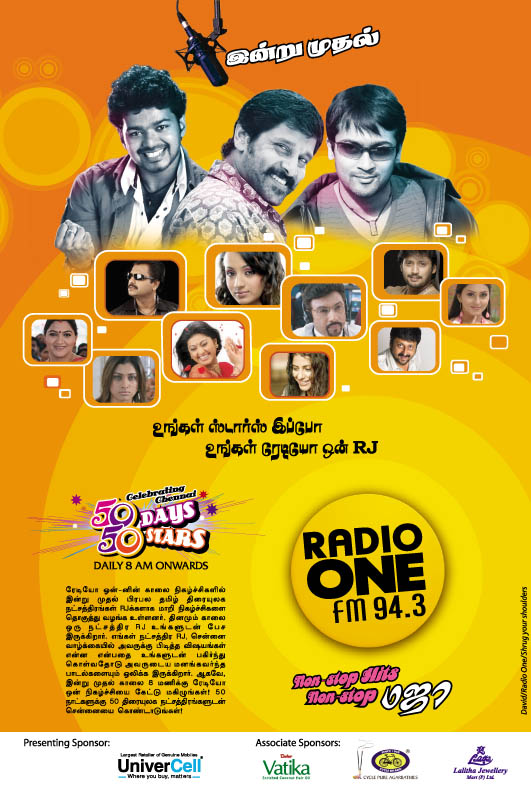
Radio One start in Chennai


This advt published on 10-01-2007 Daily Thanthi front page.

HCJB: New book to celebrate 75 years of ministry


vision
to reach the world
100-page, 9" x 11.75", hardcover book packed with scores of full-color photos, facts and history.
Pricing and Donation InformationFor a suggested donation of $50.00 or more (**) to HCJB Global, you will receive a copy of the book.

** The Internal Revenue Code permits you to deduct the amount you give in excess of the $24 fair market value of materials or services provided by HCJB Global. To assist you in determining the tax-deductible portion of your gift, a good faith estimate of the fair market value is shown with the total amount of your gift.

For more details:

http://www.hcjb.org/anniversary/site/75th_anniversary_celebration.html

World's First Missionary Broadcasting Ministry Changes Name; HCJB World Radio Becomes 'HCJB Global'

HCJB World Radio, the world’s first missionary broadcasting ministry, which also has developed an international medical outreach, has changed its name to “HCJB Global,” the organization announced recently.

The ministry also named its media ministries “HCJB Global Voice” and its healthcare ministries “HCJB Global Hands.”

“We feel as we move into the future and expand the incredible dynamic between media and healthcare, the HCJB World Radio name did not accurately portray this vision,” said HCJB Global President David Johnson. “We will work to develop leaders and mobilize missionaries as we serve the world through HCJB Global Voice, our media arm, and HCJB Global Hands, our healthcare ministry.”

At the same time, HCJB World Radio Engineering Center in Elkhart, Ind., has become the HCJB Global Technology Center, focusing on the provision of quality assistance through consulting, service and engineering development wherever technological solutions play a role in the advance of the gospel.

The new names, along with new logos, were launched at Urbana 06 in St. Louis, Mo., in late December. HCJB Global will formalize the name change in a dedication event at the ministry’s newly named Ministry Service Center in Colorado Springs later this month.

“This is a major change for our ministry, because it is far more than skin deep. Our new name reflects major changes in our vision and focus as we work to integrate media and healthcare ministry around the world,” said Communications Director Jon Hirst. “As we moved toward the name change, we found that our friends and supporters wanted us to retain the call letters of our first station radio station—HCJB—that we established 75 years ago in Quito, Ecuador. In maintaining the name, we are honoring our heritage and building upon it.”

For 75 years HCJB Global Voice has used shortwave radio, satellite, FM, AM, television and the Internet to deliver the gospel worldwide. For over 50 years HCJB Global Hands has been providing compassionate healthcare to those in the greatest need.

Since 1990 HCJB Global has enabled local partners to plant more than 300 radio ministries in 100 countries throughout Euro-Asia, North Africa/Middle East, Sub-Saharan Africa, Asia Pacific and the Americas.

HCJB Global’s missionaries, pastors, broadcasters and healthcare providers use media, healthcare and training to work with partners in more than 100 countries around the world to spread the gospel. Lives are transformed, so that people are engaged in the growing church, making an impact on their communities as they are empowered to use media and healthcare tools. The ministry is headquartered in Colorado Springs, Colorado. Its web site is www.hcjbglobal.org.

http://www.christiannewswire.com/news/310361893.html
++++++++++++++
Thanks to
ALOKESH GUPTA, PO BOX – 4914, SAFDARJUNG ENCLAVE, NEW DELHI – 110029, INDIA. TEL : +91-11-26177277, MOB : +91-9818449395, E-MAIL : alokesh@radiointel.com

Sunday, December 10, 2006

Suitcase Radio in Rs 5000

Shubhranshu Choudhary

Suitcase radio is what they call it. Weighing only about 12 kgs andmaking a hole of about only Rs 5000 in your pocket, this radio stationis being prepared by three students Kamal, Vikas and Dayal from Haryana.One can listen to the waves till 15 kms and none of the material used in its manufacturing is imported. All the material was procurred from the local markets of Ambala.This radio station was quite popular among the students in theuniversity hostel where they used to play it. They also used to getrequest from outside the university to play songs of choice.Interestingly the professors also knew about it but they never stoppedthem.In 1995, Indian Supreme Court passed a judgments that public has full and more rights on radio transmission rather than only government but unfortunately it is still illegal for a common man to run a radio station.Although this radio stations is analog but Kamal, Vikas and Dayal claim that they can make a digital FM radio station in about 20,000 rupees which will have a CD player, cassette player, mixer of four channels, two mikes and an antenna cables. It will be a complete radio station on its own which one can take anywhere.They emphasize an important fact that these techniques existed longbefore, only thing they want to prove is that technology can bedeveloped based on existing techniques without putting too much pressure on the financial front.These kinds of experiments and innovations are taking place in otherparts of the country as well. Few days back a volunteer organizationfrom down south organized a seminar for tribal communities from all over the country. The translation of the developments of the seminar in four different tribal languages kept playing on four FM radio stations. Because the people from different tribal were able to understand whatexactly was being said and done at the seminar, their participationinvolved was amazing to look at. This was all possible because of the FM radio station of mere Rs 50.Unfortunately, the women of tribal association near Vishakapattanam were not so very lucky. Police into custody labeling them as illegal took their sets.Vickram Crishna of the Radiophony.com organization who is providingtechnical help to such organizations says, "We are using the same radio technique which the foreign security agencies use in their walky talkies to maintain security systems of multinational companies in urban areas.But it is very much saddening and unfortunate that our government trusts them but its own tribal women."Recently, Government has given green signal to educational institutes to open radio stations. Frederick Noronha who is associated with themovment says that with such low-cost instruments, radio station and run in almost every village of India.Every citizen of this country can take part in information revolution.To democratise the media in a country like India there is no better option available than radio.
story on BBCHindi.com about radio in India (text in Hindi), at:http://www.bbc.co.uk/hindi/regionalnews/story/2005/
08/050823_radio_station.shtml

Thursday, December 07, 2006

Community Radio Manager’s Handbook

A Guide to Sustainable Radioby AMARC Africa This handbook, targeted at station managers and anyone involved in community radio, aims to be a guide on how to manage a community radio station in a sustainable manner. The handbook does not aim to be prescriptive, but aims to offer guidelines on issues that need to be considered when setting up and operating a community radio station and at what stage of the process they need to be considered. It offers information on the relationships that need to be built with stakeholders and gives ideas on how to make these relationship work better for the station. The handbook covers guidelines on the following issues:
How to get the Government to support you
How to identify what you want to do for the community, then doing that in your radio station
What is a volunteer
How to work with volunteer
How to get the community involved and how to keep them involved
How to market the station
What is an audience survey?
How to make money for your station
How to keep your station independent
How to manage conflict
How to manage change
How to help a community radio station to grow
How to make a training plan for the station
How to solve common problems you may face.
http://africa.amarc.org/files/AfricanCRHandbook.pdf for this resource in PDF format.

Publisher: AMARC Africa
Cost: Free downloadDate of publication: 2000
Number of pages: 185
Language(s): English
Contact:AMARC International
705 Bourget Street
Suite 100
Montreal
Quebec
Canada
H4C 2M6
Tel : +1-514-982-0351
Fax : +1-514 849-7129
amarc@amarc.orgAMARC website
Source: The African Community Radio Manager’s Handbook

Tuesday, November 28, 2006

Separate Lakshadweep Islands DXpeditions No Longer to Butt Heads

NEWINGTON, CT, Nov 28, 2006 -- The first of two planned DXpeditions to rare Lakshadweep Islands (VU7) is set to start December 1. A team sponsored by the Amateur Radio Society of India (ARSI) -- the International Amateur Radio Union (IARU) member-society for India -- plans to operate as VU7LD from Kavaratti Island. Meanwhile, a second announced foray to the second most-wanted DXCC entity has returned to its original plans to commence in mid-January instead of December, thus avoiding the potential for on-air chaos. ARSI says it has permission from India's telecommunication and military authorities to operate from December 1 until December 30.

"The plans for this expedition are well under way, and we are assembling together around 25 Indian radio operators who have a proven record of operating in 'pile up' conditions on all modes, so that the poor propagation conditions are utilized to the maximum," the DXpedition's Web site reports. ARSI says VU7LD -- the actual call sign could change -- will operate on all HF bands on CW, SSB and digital modes.

A DXpedition under the auspices of the National Institute for Amateur Radio (NIAR), will kick off with a three-day hamfest January 15, and the DXpedition will continue for approximately 10 days. The NIAR DXpedition plans to operate as VU7RG, in honor of the late Indian Prime Minister Rajiv Gandhi, VU2RG.

"We are pleased to inform that the Ministry of Communications and Information Technology, Department of Telecommunications, WPC wing has released the first list of special permission issued to foreign hams holding Indian Amateur Radio licenses to operate Amateur Radio stations from Bangaram, Kadmat and Agathi in Lakshadweep Islands," Rama Mohan, VU2MYH, said in a November 22 statement on the VU7RG Web site. "Until today a total of 33 DX hams have been officially approved for the VU7RG operation!" The NIAR operation could include as many as 50 radio amateurs from India and elsewhere.

NIAR says the "well-known, experienced operators" staffing all three operating sites will "work closely together to avoid multiple stations on the air using overlapping frequencies."

Concerns arose within the DX community in October after NIAR rescheduled its event from January to December, and it appeared the two DXpeditions would have multiple stations on the air simultaneously on various HF bands and modes at least during the first part of the month. NIAR organized and sponsored a DXpedition and hamfest-conference in the Andaman Islands (VU4) earlier this year.

Part of the Laccadive Islands, Lakshadweep -- the smallest union territory of India -- is located in the Arabian Sea some 200 to 300 km off the southwestern coast of India. The territory marks its 50th anniversary this year.
++++++++++++++
Source: http://www.arrl.org/news/stories/2006/11/28/103/?nc=1

Monday, November 20, 2006

AIR QSL's

Couple of qsl's from AIR :


AIR Gangtok QSL - 3390 kHz
http://www.geocities.com/alokeshgupta/air_gangtok_qsl.pdf

AIR Gangtok Prog Schd ( Times in IST)
http://www.geocities.com/alokeshgupta/air_gangtok_ps.pdf

AIR Bhopal QSL - 3315 kHz
http://www.geocities.com/alokeshgupta/airbhopal_qsl.pdf

These are also available at files section of this group :
http://groups.yahoo.com/group/dx_india/files/

-----------------------
Alokesh Gupta
New Delhi

குமுதம் தொடங்க உள்ள 'ஆஹா எப்.எம்': விளம்பரம்


குமுதம் 8/11/2006 இதழில் பக்கம் 15 இல் வெளிவந்த விளம்பரம்

Monday, November 06, 2006

'Listeners' lifestyles the key to radio sustainability'

Radio broadcasters should get involved in the lifestyles of their
listeners in order to guarantee the sustainability of their stations and
services, the ABU Programme Committee meeting heard in Beijing today.
Addressing delegates to the Programme Committee at the 43rd ABU General
Assembly, Capital Maharaja-Sri Lanka's Nedra Weerasinghe said radio
broadcasters should develop new services that complement the lifestyles
of their listeners.
"In an age of on-demand availability of information and entertainment,
radio needs to respond to keep up with the changes. The answer to this is to
develop new services that listeners want.
"A service that fits a lifestyle is often set for greater success than
a single emphasis on increasingly complex gadgetry," she said.
Ms Weerasinghe also cautioned broadcasters against upgrading to new and
better technology just to keep up with the times.
"We should use technology and not be driven by it. Upgrade only if it
enhances the listening experience and brings you closer to the
listeners, or if you have no choice," she said during the symposium on "Ten great
ways to make people listen longer".

Among the ways highlighted to attract and retain radio listeners were:
- having innovative programming;
- finding disc jockeys that can express themselves powerfully;
- rewarding listeners with competitions and prizes;
- connecting with listeners by inviting them to the studios;
- taking complex issues and presenting them in an easy-to-understand manner;
- maintaining good public relations and social responsibilities;
- motivating staff to interact directly with the public; promoting the station constantly and consistently.

"The key point is that radio needs to better understand what people
want. Radio stations that want to be in business 10 years from now will need
to better understand how consumers choose music to fit their lifestyles.
"It's a question of convenience and enriching people's lives, because
we can provide interaction, information and entertainment the way they want
it," said Ms Weerasinghe.

Friday 03 Nov 2006
http://www.abu.org.my/public/dsp_page.cfm?articleid=2417&urlsectionid=715&specialsection=ART_FULL&pageid=247&PSID=2807
----------------------------
Alokesh Gupta
New Delhi

DXERS UNLIMITED'S WEEKEND EDITION NOV 4 -5 2006

RADIO HAVANA CUBA
DXERS UNLIMITED
DXERS UNLIMITED'S WEEKEND EDITION NOV 4 -5 2006
BY ARNIE CORO
RADIO AMATEUR CO2KK

Hi amigos radio aficionados ! You are now listening to the weekend
edition of Dxers Unlimited, your favorite radio hobby program, covering
each and every aspect of our wonderful way of using our spare time.
YES,
there are more than 80 different ways that you can enjoy this hobby...
from listening to the AM broadcast band with a very inexpensive little
radio trying to pick up distant stations late in the evening, to taking
part in one of the big worldwide amateur radio contests... From
soldering the last electronic component to a printed circuit board that
will let you listen to the aircraft VHF band when connected to your
short wave radio, to installing a home brew antenna that will extend
the
range of your ham radio station... Si amigos, there are many different
and always challenging ways of enjoying the radio hobby... and that's
exactly what I want you all to think about every time that you have a
chance to start a new radio project... For example, listener Anil from
Mumbai , India, writes via e-mail to tell me that he has picked up
Radio
Havana Cuba's short wave broadcasts on 15230 kilo Hertz, something
surprising if you consider that 15230 kilo Hertz at the time that he
heard that transmitter was using our 160 degrees azimuth curtain array
of dipoles antenna... It seems like an odd radiation lobe of the big
curtain was making its way to India, across the Pacific Ocean, or as
one
of our engineers said , one never knows how a big antenna radiation
pattern may generate small lobes, that are the ones that produce such
unusual reception in far away places, even when the main lobe of the
antenna is pointing to a completely different azimuth..

More about reception reports received here , and what to expect during
the frequency management period BO6 that has just started a few days
ago.
Stay tuned for more radio hobby related items, coming to from Havana...
I am Arnie Coro..

.....

This is Radio Havana Cuba, the name of the show is Dxers Unlimited, and
yes, we do QSL , we do verify reception reports, and we do it the way
it
should be done... absolutely free of charge ... since the very first
day
that we tested a one Kilowatt Gates shortwave transmitter connected to
a
half wave dipole that was strung between two wooden poles provided by
the local electricity utility's storage yard near our Bauta
transmitting
station, we asked for signal reports, and as soon as they started to
come in, we began to answer them... and I remember from those days,
that
we went to the post office to buy stamps , and asked the girl at the
counter for the most beautiful Cuban stamps , so that when we sent out
the first Radio Havana Cuba QSL letters, listeners will also receive
Cuban stamps too...
You can send your signal reports and comments about this and other
Radio
Havana Cuba's programs via e-mail to arnie@rhc.cu, again arnie@rhc.cu,
and if you are not yet in cyberspace, send an AIR MAIL postcard to
Arnie
Coro, Radio Havana Cuba, Havana, Cuba...
Now more about B-06, and for those of you not familiar with that term,
now the international broadcast stations that use the so called HF or
more properly decametric bands, divide the year into two periods A and
B, each lasting six months. But the broadcast schedule periods don't
start on the first day of January, and end on the 31st of December...
The start up dates for the so called winter period, also known as the B
period, start at the end of October and lasts until some time in
March... This period that started a few days ago is known to broadcast
station frequency management engineers as B 06... And when B 06 ends in
March of 2007, then the A 07 period will start , covering all of the
summer season and a few weeks more until late October of 2007 when the
B
07 period will begin...
Selecting the best frequencies for broadcasting to the different target
areas of international short wave stations is a very complicated
process, that requires a lot of know how about antenna systems and
radio
wave propagation.
Managing the frequencies of a short wave station is quite a task, and
engineers make use of the most up to date computer programs, solar
activity forecasts and of course, that we do rely a lot on listener's
feedback, because short wave radio propagation is far from been an
exact
science...
In a few days time, our station Radio Havana Cuba will implement the
B-06 schedule, that this year is coming a bit late for us, due to the
need to finish working on several new antennas....
For our English language program listeners in North America, there are
a
few changes that are required due to the much lower solar activity
expected during the next several months... For example, our long time
frequency that has served so well listeners in the Central time zone of
North America, 9820 kilo Hertz , can not be used effectively during the
B-06 period, so we are changing it to a lower frequency band... YES
amigos, we are moving away from 9820 kilo Hertz from 23 hours UTC to 05
hours UTC , and will start using instead 6180 kilo Hertz with our new
low frequency band curtain array that is beaming to 340 degrees
azimuth.
This antenna has a gain of about 17 decibels over a dipole on 6 mega
Hertz, something that is achieved by using our new 105 meters high twin
towers that support the big antenna array, that engineers describe as
an
HR 4, 4, 0.8 Curtain Antenna, that meaning that it is a set of four
columns and four rows of dipoles, connected in phase, and that the
lower
row of dipoles is placed at 0 decimal 8 wavelengths above ground at the
center operating frequency of the antenna... I expect that this new
antenna will be delivering a very nice signal covering a large area of
North America from the Rocky Mountains to the East Coast... on 6180
kilo
Hertz... but of course, you, the listener will be the one that will be
telling us if reception is really good.By the way if you want to
practice Spanish, the 23 hours UTC to 00 Hours UTC segment on 6180 kilo
Hertz to Central North America is broadcast in Spanish, and we switch
to
our North America and the Caribbean English Language program at 00
hours
UTC... keeping 6180 kilo Hertz in operation until 05 UTC , that is
exactly twelve o'clock midnight Eastern Standard Time, and we may be
extending this broadcast until 07 hours UTC too...
Si amigos !!! the B 06 broadcast period is now in effect, and you will
need to take some time to find the new operating frequencies of many
international broadcast stations that have changed their schedules to
best adapt to the much lower solar activity expected...

......

ASK ARNIE, si amigos !!! ASK ARNIE is according to your e-mail,
postcards, letters, and Fax messages , THE most popular section of
Dxers
Unlimited... Today's ASK ARNIE, will be devoted to answering a question
sent by seventeen listeners from the USA, Canada, the UK, Jamaica,
Trinidad and Tobago , Nigeria and South Africa... They all want to know
more about what to expect during the end of the present solar cycle...
Well my friends, as you heard just a while ago, when I was explaining
why we have to drop our 31 meters band 9820 kilo Hertz frequency to
Central North America in favor of a frequency on the SIX megahertz or
49
meters band , the much lower solar activity has a devastating impact on
the higher frequency short wave bands...
When extended periods of very low solar activity happen, with the daily
solar flux staying around 70 units and the number of sunspots is zero
or
near zero for many days, the higher frequency short wave bands from 10
or 12 mega Hertz up simply go dead... The ionosphere is no longer
capable of sending back to Earth radio waves above 10 or 12 mega Hertz
during the local daytime hours... and as soon as the Sun sets, South to
North propagation paths take a nose dive, with the maximum usable
frequency dropping to frequencies as low as even 5.5 mega Hertz.. When
this happens, listeners monitoring the short wave bands will notice
that
there are almost absolutely no signals heard above 6 or 7 mega Hertz, a
very good indication of an extremely low period of solar activity. Of
the seventeen listeners that asked for the explanation that you have
just heard, six wanted also to know when HF propagation conditions
above
12 to 15 mega Hertz are going to improve... and the answer amigos is
that you should not expect any significant improvement until at least
the second half of the year 2008.... YES, you heard it right, until
solar cycle number 24 starts to generate more solar activity ,
something
expected by scientists to happen during the second half of 2008, short
wave propagation conditions on the higher frequencies are going to be
very poor or even non existent at all...
So, this is the right time to start thinking about installing antennas
for the lower frequency bands, and for those of you that don't have
space to install those long wires, there is an excellent option... home
brewing a large magnetic loop antenna , of at least 2 meters or about 6
feet diameter... that will provide the possibility of picking up low
frequency stations within the range between 1.5 and 10 mega Hertz..
In an upcoming edition of Dxers Unlimited, I will be describing such a
magnetic loop antenna, that can be installed in a much smaller space
than the area that you will require to install a long wire for low
frequencies reception...

......

Si amigos, we do QSL, send me your comments about the program,
reception
reports and radio hobby related questions to arnie@rhc.cu, or VIA AIR
MAIL, send a post card or letter to Arnie Coro, Radio Havana Cuba ,
Havana, Cuba...
Before going QRT here,let me tell you that many radio amateurs around
the world are enjoying very much using the PSK31 digital keyboard to
keyboard communications mode, that can be installed very easily using
readily available computer software for both LINUX and WINDOWS
operating
systems... PSK31 is a form of radio teletype that uses a very narrow
bandwidth and for that reason stations using low power and simple
antennas can make lots of DX contacts !!!
Thursday, November 02, 2006

BBC International Playwriting Competition 2007

Introduction

Welcome to our tenth biennial International Playwriting Competition, run in conjunction with the British Council. Write our actors their dream script Once again, we have two first prizes: for the best play by a writer with English as their first language, and for the best play by a writer with English as their second language. These two winners will each receive £2500 sterling and a trip to London to see their play being recorded for broadcast on BBC World Service in the World Drama slot. The playwriting competition is one of the most exciting events here at BBC World Service Drama, as it provides us with an opportunity to connect with our audience, drawing on a vast, untapped resource of writing talent from around the world. Previous winners have gone on to gain further commissions for BBC World Service Drama and other areas of BBC Radio Drama. So, if you are an experienced novelist or writer for theatre, film, television, but are new to Radio Drama; if you are a writer with no experience at all writing your first script; or if you're a writer somewhere in between - we want to hear from you. Your work is our future. Good luck.

Prizes

£2500 sterling for the overall winning playwright of the best play written with English as a first language and a trip to London to see the play being recorded and to attend a prize-giving evening.
£2500 sterling for the overall winning playwright of the best play written with English as a second language and a trip to London to see the play being recorded and to attend a prizegiving evening.
A prize of a digital or short wave radio for the best radio play to be written from each of the following geographical areas: The Americas; Europe; Africa and the Middle East; South Asia; Russia and the Caucasus; Asia and Pacific.
BBC goodie bags for all writers whose plays reach the judges' final shortlist.

Rules

You are asked to write a radio play of about sixty minutes on any subject of your choice. This means that your finished script should be a minimum of 50 pages of A4 paper (or equivalent) and a maximum of 75 pages (note, a rough guide is a minute per page; read and time your play if you can before you send it!). The play should have a maximum of six central characters.
The play must be the original, unpublished work of the person or persons submitting it. It must not have been professionally produced, in any medium.
Open to anyone not normally resident in the UK.
If you are under the age of 16 you must obtain permission from your parent/guardian before you enter this competition. Your parent/guardian must be prepared to travel with you to London to collect your prize. Your parent/guardian must be prepared to pay for their own travel costs.
Your play must be with us in London by April 30, 2007.

Help writing a radio play

Tell a good story. Radio Drama thrives on strong narratives. Whether you?re writing a tragedy, a comedy, a deeply personal piece of autobiography or a play to change the world, a great storyline will keep your audience listening.
However, don?t make the story too complicated, with too many themes, characters and plotlines, or the listener will get confused.
Get under the skin of your characters. Get to know them really well. Each will have their own individual speech mannerisms. Don?t have them all speaking in your tone of voice.
Don?t - in the interests of furthering the plot - have characters telling each other information they already know!
Radio Drama is not only about words. Use the four building blocks of radio drama - speech, sound effects, music and silence. Decide exactly what ?sound picture? - what mixture of these four elements - the listener needs to hear in each scene. Will a scene be enhanced by having music under it? Will a pause between a speech add to the dramatic effect?
But, if in doubt, keep it simple - the play stands or falls by the words you have written, not the amount of music or sound effects.
Vary the pace and length of your scenes, as well as their background acoustics and ?location?. A radio play which has six ten-minute scenes, each set in a dining-room, is likely to be less effective than a play which varies its scenes and settings. Keep the listener interested by thinking about how the play will sound. Using a variety of backgrounds, scene lengths and sound effects will usually serve to make a story more effective for the listener.
Presentation is important. Script readers (and play competition judges) are better disposed towards neatly-typed, professionallypresented manuscripts. Type all directions and sound effects in capital letters (e.g. HAMLET?S GARDEN. HAMLET IS DIGGING FOR POTATOES. IT IS RAINING) and dialogue in lower case. Leave a space each time a character speaks. Enjoy writing your play. If you enjoy it, the chances are that other people will too.
Feel free to ignore some of these tips. All the best playwrights break ?rules? from time to time. But have a good reason for breaking them.
Remember that good drama is not simply about one idea but about what happens when two ideas collide. Sixty minutes gives you a lot of time to develop your plot and your subplot.
Tune in to BBC World Drama on BBC World Service or listen via our website by going to www.bbcworldservice.com and selecting BBC World Drama from the Radio Programmes list.

And remember

Please read the rules and abide by them. If a play is either too short or much too long it may be disqualified.
Please do not send your only copy. Manuscripts are not returned under any circumstances.
Please do not send us amendments or further drafts once your play has been submitted.
Please do not send cassettes, CDs, videos or sheet music with your play - it is not necessary at the entry level and they cannot be returned to you.

Entry form

The entry form should be completed by all competitors and attached to your play.
Click here for the entry form (pdf version)
Click here for the entry form (word version)

Source: http://www.bbc.co.uk/worldservice/specials/1521_int_play_comp/index.shtml

Monday, October 30, 2006

BBC outsourcing to India

The BBC announced today that it has selected Xansa as the preferred supplier for the BBC's outsourced finance and accounting services. The new contract will run for a period of ten years.

It is the result of the re-tendering of services that were successfully outsourced to Medas, a wholly-owned subsidiary of EDS, in 1997.

Subject to contract signature:

Xansa will work closely with the BBC to deliver finance and accounting services across the BBC, including purchasing and sales transaction processing, artist and contributor payments, financial management and project accounting, payroll processing and expenses and customer support.

The ten-year contract will cost the BBC approximately £8.5m per annum, and will generate savings for the BBC in the region of £20m per annum.

This will be a major contribution to the BBC's target of releasing £355m of savings to invest in programmes and services.

The BBC is currently conducting a simplification of its business processes as part of its Future Finance programme, which is delivering further savings of £17m.

Xansa will provide their services from a blend of locations in the UK and India. All voice contact (Customer Support) with Xansa will remain in the UK; other services, including transaction processing, will be carried out at Xansa's location in Chennai, India.

In this way the BBC is taking advantage of the significant savings of globalisation while maintaining the benefits of more local customer support.

The original outsourcing of these services to Medas in 1997 was seen at the time as being a ground-breaking deal which included a successful implementation of a common systems platform (SAP) across the BBC.

Medas also successfully transformed the BBC's transaction processing operation, delivering a fit-for-purpose and efficient service to the BBC.

Xansa was selected from a shortlist of four companies (Capita, EDS, Infosys BPO and Xansa) after a rigorous evaluation process against a number of criteria which included value for money, cultural alignment with the BBC, service delivery capability; the ability to drive improvements to the BBC's business and financial processes, and transition and exit planning.

Xansa will act as prime contractor working with Siemens Business Services.

We are confident that this will bring advantages to the BBC in terms of simplicity and lower cost for making changes to the BBC's IT infrastructure.

Zarin Patel, BBC Group Finance Director, said: "I congratulate Xansa on winning this major contract. The BBC will benefit from Xansa's proven expertise in managing outsourced Finance and Accounting Services, and we look forward to developing a close relationship with them.

"I believe this is an excellent deal for the BBC, and I am confident that Xansa will help us further to transform our finance and business processes.

"By moving our transaction processing to India we are demonstrating that we are prepared to take bold and imaginative decisions that offer the licence-fee payer great value for money, while still maintaining the highest quality of service delivery.

"I would like to thank our colleagues in Medas for their valuable support over the last nine years: in that time they have helped us transform the BBC's finance and accounting processes, delivered a sound SAP implementation, managed our transaction processing, expenses and business systems and left us with a fit and stable operation to build on in the future."

Alistair Cox, Chief Executive of Xansa, said: "We are delighted that Xansa has been selected as preferred partner to deliver Finance and Accounting Services across the BBC.

"Our expert technology and back office services allows our clients to do more with their own business and we are confident that we will, as the UK leader in F&A services, enable the BBC to minimise its administrative costs and to free up funds to invest in its own core business of creative programming.

"We are particularly pleased to be the BBC's first offshore BPO partner, and this week's award win as offshore operator of the year is another terrific endorsement of our leading offshore position and capability."

Notes to Editors

BBC Finance

The BBC recently announced a significant number of changes to BBC Finance (BBC's finance division), as part of the corporation's drive to make significant cost reductions across its support divisions.

The Future Finance programme changes include:

The creation of a new specialist Finance Centre in Ty Oldfield (at the BBC's HQ in Cardiff), which came into existence in July 2006;

The introduction of new, simpler business procedures and a reduction in internal trading.

A reduction in the number of posts in BBC Finance from around 650 in 2005/6 to 310 in 2006/7, to 260 in 2007/8.

These measures will contribute to an anticipated saving within BBC Finance of £17m by 2008.

About Xansa

Xansa is the UK leader in the delivery of outsourced Finance and Accounting (F&A) services. With clients including BT, Lloyds TSB, MyTravel and the NHS, Xansa has many year experience of delivering F&A in both the private and public sector.

Xansa is an outsourcing and technology company with over 8,000 people in the UK and India.

Xansa has a 44-year history of delivering IT solutions to major clients across the private and public sector. Its portfolio of services includes: business and technology consulting, IT services, IT outsourcing, business process outsourcing, F&A outsourcing, and HR solutions.

Xansa is listed on the London Stock Exchange with revenues for 2006 of £357.3 million.

Medas and the BBC

Medas is a wholly owned subsidiary of EDS.

Medas was founded in 1997 to provide financial transactions processing for the BBC and also support the IT systems that facilitate that processing.

The company became fully operational in March 1998 following the transfer of nearly 400 finance staff from the BBC, in addition to the 80 IT staff who transferred in March 1997.

Medas operates from two sites: Ealing (West London) and Cardiff.

The services Medas provides to the BBC are in summary:
Accounts Payable
Accounts Receivable
Contributor Payments
Expenses and Advances
Financial Accounting
IT systems support and development
Payroll

Xansa have indicated that they will treat all existing Medas staff with fairness and sensitivity, and that normal TUPE regulations will apply.

BBC Press Office
++++++++++
http://www.bbc.co.uk/pressoffice/pressreleases/
stories/2006/10_october/20/finance.shtml

Chennai is awash with FM radio stations

The second coming
R. Ravikumar

Chennai is awash with FM radio stations, with more to come. Find out how they all plan to add ears to their lives.Your late mornings will never be the same again," avows an FM station. "We will rekindle the romance in you every day after you dispatch your children to school and husband to work," it goes on, addressing lonely housewives."The traffic at Anna Flyover is moving at a snail's pace, so please avoid that junction if you can," a friendly note of caution to those at the wheel, from another FM station.Of late, the FM radio space in Chennai has been bustling with activity following the implementation of Phase II of FM radio privatisation. The transition to a revenue-sharing regime from the earlier fixed-fee licensing model seems to have changed the business dynamics, and the space is now drawing more players. The Chennai FM story could well be replicating the cities across the country.As of now, apart from AIR's Rainbow FM, there are five FM stations - Suriyan FM (from the Sun group), Hello FM (from Malar Publications) , Big FM (Adlabs Films Ltd, a Reliance ADAG company), Radio Mirchi (Entertainment Network India Ltd) and Radio City (from Music Broadcast Pvt Ltd). In addition to these, Muthoot Finance Ltd, which has got a licence, and Radio Mid-Day West (India) Ltd, a Radio One-BBC World combine, are all set to venture into the space soon. All for a share of just a little over 2.4 per cent of the Rs 13,200-crore ad industry.Though ad avoidance by listeners in radio is almost nil in comparison with 68 per cent in newspaper and 44 per cent in TV, and local reach makes radio a very effective medium of advertisement, the share of 2.4 per cent is very small."Many media planners may not be considering radio as one of the primary media for communication. They have been primarily focusing on mass media such as print and TV. Especially after the recent flow of channels into markets beyond metros, it is high time radio is studied and looked at more seriously," says Siddhartha Mukherjee, Director - Communications, TAM Media Research.According to TAM Media Research, of the overall ad industry size of Rs 13,200 crore in the year 2005, radio could manage to rake in just Rs 317 crore, which is 20 per cent more than the Rs 220 crore registered in 2004.However, according to Tarun Katial, Chief Operating Officer - FM Initiative, Adlabs Films Ltd, the ad pie will certainly grow over a period. "Ad revenue is purely based on the reach of the medium. In 2005, there were less than 30 frequencies in just seven cities. It's now going to reach over 330 frequencies across the country," says Katial. He sees the medium getting 15 per cent of the ad spend by 2010. Prashant Panday, Deputy CEO, Radio Mirchi, also says the ad pie will grow to 14 per cent by then. "Even without any proper mechanism in place for audience research, it will grow to 7 per cent. Once a research mechanism falls into place, it will certainly reach 13-14 per cent," he says.According to Radio AdEx, a division of TAM Media Research, during January-December 2005, FM radio ad revenues were in the range of Rs 90 crore in Mumbai, Rs 87 crore in Delhi, Rs 30 crore in Kolkata and Rs 21 crore in Chennai.But, during the period there were only three FM channels in Chennai (Rainbow, Suriyan and Radio Mirchi). According to industry sources, during January-August 2006, the ad revenues in Chennai alone grew by 31 per cent in comparison with the same period in the previous year.K. Srinivasa Ragavan, Station Director - Chennai, All India Radio, says Rainbow FM earned Rs 1 crore during 2005, and is growing at 80 per cent. "The FMCG sector and Government service organisations contribute over 50 per cent of the total ad revenues," he says.In the previous fiscal, Radio Mirchi registered Rs 120-crore revenues and Rs 35.5 crore in the first quarter of this year, which, according to Panday, is a growth of 69 per cent over the same period last year. Of the total revenues, Chennai's contribution is 10-12 per cent, he says. "And the contributions mostly come from FMCG, auto, telecom, retail and the durables segments."L.V. Navaneeth, Station Head - Chennai, Radio One, sees revenues flowing in from retail, banking and finance and telecom. "Retail is one of the larger categories, followed by finance, banking, telecom, FMCG, consumer durables and even the media industry," he says.However, Mukherjee of TAM Media says, on the basis of January-September 2006 data, that it is quite clear conventional media such as press and TV too take much help from radio to reach out to their audience.While Big FM charges up to Rs 1,800 for a 10-second slot, Radio Mirchi charges, for an evenly distributed campaign (across prime time, afternoon, evening and late night), rates of Rs 1,100-1,200 per 10-second slot. For a campaign with a higher prime time component, the rate could go up to Rs 1,600-2,000.For a campaign that does not use prime time at all, the rate may be Rs 700-800. "Pricing is also a function of the size of the deal, time of the season and so on. The biggest determinant of pricing, however, is client returns - we gain only when the clients come back again and again," says Panday."We are doing missionary work in spreading research numbers to our advertising agency and media agency partners. We are pioneers of research in the country. We also offer clients brand solutions and suggest ways and means of using radio effectively. We develop radio commercials for clients who need this service at no cost. And lastly, all the marketing that we do goes towards building listenership, " he adds. Big FM too claims to provide advertising solutions.
http://www.thehindu businessline. com/catalyst/ 2006/10/19/ stories/20061019 00020100. htm
------------ --------- ----
Alokesh Gupta