Monday, August 09, 2010

Radio offers a lifeline to Pakistan as crisis worsens

Flood relief camp in Pakistan

In response to the devastating floods in northern Pakistan, lifeline radio programmes are to be broadcast in the most severely affected areas through the BBC Urdu service.

With much of the region's transport and communication links destroyed, the programmes will plug a critical gap in delivering information in the immediate aftermath of the disaster using one of the only media channels still available - radio.

Since heavy rain began falling two weeks ago, some 1,400 people have died and aid agencies say three million people have been affected by Pakistan's worst floods in 80 years, warning that thousands are still cut off and waiting for help. The new 'infoasaid' service, a collaborative project developed by BBC World Service Trust and Internews, will transmit lifesaving information to the hundreds of thousands of people.

It is the simplest information such as where to get food or how to avoid diseases that can save thousands of lives.

The United Nations has said around 98,000 people have already lost their homes or been forced to leave, and that figure is set to rise. With forecasters predicting further heavy rain fall and flash floods, and aid agencies warning of the threat of waterborne diseases, the service will provide vital information including how to stay safe, avoid disease and access aid.

BBC Urdu will transmit six ten-minute bulletins daily, three in Urdu and three in Pashto. As part of an increasingly nationwide response, the programmes will be broadcast on up to 34 BBC partner stations, reaching over 60 million people.

Director of the BBC World Service Trust, Caroline Nursey says:

"This humanitarian crisis is growing every day and is now on a huge scale. Very often it is the simplest information such as where to get food or how to avoid diseases that can save thousands of lives. This is what lifeline programming will deliver."

Infoasaid is funded by UKaid from the Department for International Development. Minister of State for International Development, Alan Duncan says:

"As flooding continues to cause destruction and suffering in Pakistan, many will find themselves cut off from family, friends and home. While of course not everyone will be able to access a radio, this is a proven way of reaching as many people as possible when no other means of communication are available.

"The lifeline radio programme is another great example of potentially lifesaving innovation from the BBC World Service Trust, providing essential emergency advice and information on staying healthy and accessing food and shelter, to help those affected cope with the immediate effects of this disaster."


Source: http://www.bbc.co.uk/worldservice/trust


Friday, July 30, 2010

Radio St. Helena QSL cards being shipped


Radio St. Helena Day 2009 QSL cards

According to Mr Kipp of Germany, who is the project Manager of Radio St. Helena Day revival project, the first batch of Radio St. Helena Day 2009 QSL was shipped on 15 July aboard the Royal Mail Ship RMS St. Helena. The ship would reach Ascension island about two days, then the cards would fly from there to England, then to worldwide. But the first batch is only 36 cards and remaining about three hundreds reports are still in process at St. Helena. The QSL cards and envelopes of Radio St. Helena Day 2009 were sponsored by JSWC.
(Japan SW Club via Dario Monferini, Italy/playdx2003 Via )

Thursday, July 29, 2010

More than 800 new FM stations planned in India

The rollout of the third-phase of private FM radio stations in India is set to go ahead following approval from the Committee of Secretaries. The rollout of FM-III has been delayed for nearly two years over various issues including objections from the Defence Ministry on the potential interference of FM radio signals with those of defence installations.

The Defence Ministry had suggested that all private radio operators would have to seek their permission before establishing any FM radio station under FM-III, especially when the radio towers were in the close vicinity of a defence installation. But a compromise agreementg has been reached, according to which the Information and Broadcasting (I&B) Ministry will share details of all sites where radio towers will be set up under FM-III. The Defence Ministry will get two months to communicate its views on sites. "In case of any objections from the Defence Ministry, the height of the proposed radio towers will be reduced to 25 metres from the mandated 30 metres," a top I&B official said.

FM-III will see the rollout of 806 new FM channels across 217 towns in the country. The private FM stations will cover all towns with a population of over 100,000.

(Source: The Financial Express)


Tuesday, July 20, 2010

2010 Pirate Radio Annual


By Andrew Yoder

Anyone who has dabbled in shortwave listening, knows there is an underground component that borders on the quirky, if not bizarre side of the hobby.

Andrew Yoder, a pirate radio afficionado, has recently released his new 2010 Pirate Radio Annual, a 126 page book focusing on the pirate side of the shortwave hobby. Whether you’re a newbie or the seasoned hardcore pirate listener, this excellent edition will no doubt grace the likes of many radio listening post (including mine).

So, what is the great mystery when it comes to tuning in pirates ? It may surprise the beginner that it involves just listening! Andrew takes you through the pirate mine field explaining that listeners are no longer limited to their receiver, but now have access to the bizarre via the Internet. Additional information includes pirate web sites, QSLing Pirates, mail drops and QSL tips to get you started.

Classifying the stations, includes an explanation of the various classifications of pirate stations and a 97 page section of stations active in 2009 with detailed station information, and their active status during the year. Email and postal maildrop addresses are included, plus QSL card reproductions for each station to keep you up to date on QSLing

A CD is included that features 75 different pirate stations from on-the-air program recordings, a monitoring plus to those new to pirate chasing.

If you’re a seasoned pirate fan or have considered delving into the sometimes bizarre, 2010 Pirate Radio Annual is an excellent guide to assist your listening. The 2010 PRA is available for $15.00 plus shipping ($ 3.00 to US, $ 4.00 to Canada, or $9.00 to the rest of the world) from Cabinet Communications, P.O. Box 109, Blue Ridge Summit, PA 17214.

Reviewed by Gayle Van Horn for Shortwave Central and Monitoring Times.

Thursday, July 08, 2010

AIR super-power station coming up near City

AIR super-power station coming up near City

Clipping (49kbs) - Deccan Herald, 31 / 08 / 1988. By Staff Reporter


Click to browse by keyword: All India Radio Broadcasting Doordarshan Television


By Our Staff Reporter

BANGALORE, Aug. 30. "Aralu Mallige", a remote village 10 km off Dodballapur, near Bangalore, is busy giving shape to All India Radio's long cherished dream of making its voice heard by people around the world.

Come January, the super-power shortwave radio transmitter being installed here will be in full bloom.

The idea of establishing this multiband transmitter for external services germinated as far back as 1979 when the Union Government realised that with the existing facilities it was impossible for it to disseminate to people in alien lands India's news and views. It was only in 1981, however, that the Public Investment Board gave the green signal to set up this super-power transmitter.

Designed and built by Asea Brown Boveri of Switzerland, the installation at present consists of two 500 KW shortwave transmitters along with associated antenna equipment. Under Phase-II of the project, four more 500 KW transmitters will be added on in the next two years.

Mr. R. K. Taneja, Deputy Director of Engineering, AIR, who is in charge of the project, says the progress of the project has been impressive.

LITIGATIONS: The project would have become operational by now but for the land acquisition litigations which delayed the execution by a year. In fact, AIR came into possession of the plot only in January 1986, Mr. Taneja said.

Installation work, which started roughly a year ago, is fast nearing completion. The AIR civil works wing put up the building providing for Phase-II installations. While the outlay for Phase-I is Rs. 15 crore, Phase-lI will cost Rs. 35 crore.

AIR external services are currently being broadcast by shortwave transmitters at Aligarh, Khampur-Delhi and Kingsway-Delhi, with support service by Bombay and Madras stations. The Aligarh station with a 250 KW transmitter is the strongest station (external services) in the country now. With most foreign countries (including Pakistan, China, Nepal, Bangladesh and Sri Lanka) installing 500 KW transmitters, the reception of AIR broadcasts in 'target areas" had deteriorated considerably. The Indian embassies abroad had also constantly complained about this. The "Aralu Mallige" complex will make India's voice more audible in the target areas hereafter.

BIGGEST IN ASIA: When commissioned fully with all the six transmitters in action, the Dodballapur complex will be the biggest of its kind in Asia. Said Mr. Adiran Bergamin, Commissioning Engineer of Asea Brown Boveri: "The latest technology has been incorporated in the manufacture of the main tube of the transmitters, the faraday cage and the modulator."

The computer-aided frequency control system helps control 100 frequencies at a time. Devoid of manual work, the system also has the facility to know the operational conditions of various sub-systems. The Phase-II transmitters are likely to involve the still more modern "pulse step modulation" technology resulting in very high efficiency.

The aerial system consisting of nine multiband aerial curtains are being installed by Marconi and Co of UK. Under Phase-II, 27 more aerial curtains will be installed. The 36 high gain curtains in eight beam directions will help AIR to simultaneously broadcast in various foreign languages to the benefit of listeners around the globe. The aerial system will have remote operation facility for changeover and slewing of certain aerials. The direction of the antennas and the aerials are changed depending on weather conditions, sunspots, target areas and the day and time of broadcast.


PROGRAMMES FROM DELHI:

The complex will be manned round the-clock by a band of 50 AIR technicians. The programmes to be broadcast will be readied in New Delhi and passed on to the complex either through microwave or the INSAT satellite (with one of them acting as a constant standby).

The Electronic Corporation of India of Hyderabad has been entrusted with the erection of the nine gigantic pylons (the tallest tower measuring 97 metres) and the aerials. The company has also supplied certain components, like connectors.

While the "European beam" (centred on Moscow) will cover Europe and parts of America, the "North African beam" will serve most part of Africa. In its reverse direction, the beam will land in Australia

CITY IN SHADOW AREA: With the Dodballapur complex's "skip area" being 100 kin, Bangaloreans will not be able to catch the waves on their sets.

Mr. MJ. Viswanathan, AIR South Zone Chief Engineer, who recently visited the project site, said work on the upgradation of the present 50 KW MW transmitter in Bangalore to two 100 KW MW transmitters (supplied by BEL) and the erection of the new 132-metre high ECIL mast was likely to be completed by November 1988.

Mr. Viswanathan also said that the work on the FM Radio stations at Hassan, Hospet and Chitradurga would be completed by March 1989.


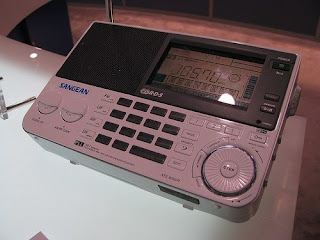
New Sangean ATS-909X Coming in November

The New Sangean ATS-909X Coming in November of This Year


Sangean ATS909X 

(Re-post)

Thanks to Tom for this great news. For radiophiles, the up and coming Sangean ATS-909X, featured on Universal Radio, is equivalent to a new version of the BMW M5. No price mentioned yet, but I'll be pre-ordering mine and hope it arrives around my birthday. Here are the specs from the Universal Radio site:

The ATS-909X is the new flagship of the Sangean line. It packs features and performance into a very compact and stylish package. Coverage includes all long wave (153-519 kHz), medium wave (520-1710 kHz) and all shortwave frequencies (1711-29999 kHz). FM and FM stereo to the headphone jack is also available (87.5-108 MHz). The new enlarged LCD features a bright white LED for excellent clarity.

Shortwave performance is enhanced with a wide-narrow bandwidth switch and excellent single side band performance (SSB tuning to 40 Hz steps via fine tuning). Five tuning methods are featured:  direct keypad entry, manual tuning, auto scan, manual up-down tuning, memory recall or manual knob tuning.

This new model is expected November 2010.

Source: http://sw77.blogspot.com


Monday, July 05, 2010

CRI launches radio channel in Sri Lanka

COLOMBO, July 2 (Xinhua) - China Radio International (CRI) held a ceremony here on Friday to celebrate the launch of a radio channel in the Sri Lankan capital of Colombo. Sri Lankan Prime Minister Dissanayake Jayaratne told the ceremony that China and Sri Lanka have been enjoying traditional friendship. Jayaratne said in the era of "Global Village", the launch of the radio channel will provide a new bridge for the two peoples to understand each other.

Wang Gengnian, director general of CRI, said Sri Lanka is among the countries where the CRI has the largest number of audience and receives most letters. "With the support of our friends in Sri Lanka and China, the Colombo FM channel will play an important role in promoting the bilateral relationship and the two countries' cooperation in broadcasting," said Wang.

Formally launched on April 23, the Colombo FM 102 channel broadcasts 19 hours of news and culture programmes in Sinhala, Tamil, English and Mandarin every day. The channel covers Western Province, the island's political, economic and business centre with an area of 3,700 sq km.

Founded in 1941, CRI aims at promoting understanding and friendship between the people of China and people throughout the world. CRI's programmes include news, current affairs, and features on politics, economy, culture, science and technology.

(Source: Xinhua news agency, Beijing, in English 1633 gmt 2 Jul 10 via BBC Monitoring)


Saturday, June 12, 2010

DX QUIZ 2009 Winners

AIR 70th anniversary special QSL (Front)

Answers for DX Quix 2009

1. a) Jerome S. Berg, 2. c) International Broadcasting Corporation 3. a). Kununurra 4. b)Jonathon Marks 5. b) DW 6. a) RN 7. c) RN 8. a) 1413 9. c) Digital Radio Mondiale 10. a)Best regards 11. b) FEBC 12. c) What is your position in latitude and longitude 13. b)Shortwave News 14. a) China 15. a) Dublin – Ireland 16. a) Bangladesh Betar 17. c) RadioNacional d'Andorra 18. a) RVA 19. c) RAI, Italy 20. a) Over to you 21. a) PoornamVishvanathan 22. a) 872 23. c) Radio Free Asia. 24. b) 70 25. c) Rhein-Main-. Radio-ClubSupported by ADDX.


AIR 70th anniversary special QSL (Back)

Winners of the quiz

1. P. Girish Chadaga, Bangalore – WRTH 2010

2. S. Muhammad Shamim, Chullimanoor, Kerala – PWBR (Collectors copy)

3. E. Selvaraj, Minnakal - “This is All India Radio” book given by Alokesh Gupta

4. M. Ganesan, Goa – WRTH (Collectors copy)

5. P.S. Sekar, Thalainayar – Shorwave Reception Booklet & DW cotton bag

6. N. Arun Kumar, Chennai – Shorwave Reception Booklet

7. S. Vetriveljar, Salem – Shorwave Reception Booklet

8. M. Muralidhar, Bangalore – DW Cap

9. S. Porunai Balu, Tirunelveli – DW Cap

10. Goutam Mandal, Bankura, West Bengal – DW Cap

11. Kavithuli Saktheeswaran, Namakiripettai – Radio Mirchi CD Case & DW cotton bag

12. K.C. Sivaraj, Salem – Radio Mirchi CD Case & DW Cotton bag

13. M. Asaithambi, Vedasandur – DW Pen & Cell phone tag

14. C. Manokaran, Theni – DW Pen & Cell phone tag

15. S. Santhosh Raj, Salem – DW Pen & Cell phone tag

16. T. Sivaraj, Coimbatore – Domestic broadcasting survey by DSWCI


AIR 70th anniversary special pennant


International winners

17. Jonathon Pukila, Canada – “This is All India Radio” book given by Alokesh Gupta

18. William Patalon, USA – European Medium Wave Guide in pdf

19. Bjorn Fransson, Sweden – European Medium Wave Guide in pdf

20. Patrick Robic, Austria – European Medium Wave Guide in pdf

21. Kenji Takeuchi, Japan – One year e-subscription of “Dxers Guide”

22. Sergej Rogov, United Kingdom – One year e-subscription of “Dxers Guide”

23. Ihor Karivets, Ukraine – One year e-subscription of “Dxers Guide”

24. Etienne Srtyn, Belgium – One year e-subscription of “Dxers Guide”

25. Jorge Luis Medina, Venezuela – One year e-subscription of “Dxers Guide”

Thursday, June 10, 2010

Cellphone-based community radio

The Auroville Radio is testing since December 2009 broadcasting trough
cellphones connect with GPRS connections.
It's working fine but you need a cellphone supporting Flash technology
and for time being are expensive.
If you have a Flash enabled phone connected with Internet you can log
into http://www.aurovilleradio.org/mobile and listen the AurovilleRadio
from all over India.

cr-india Via Andrea Tazzari

Tuesday, June 08, 2010

All India Radio wins international prizes in Iran

All India Radio Jalandhar & Bangalore stations have won four & threee international prizes respectively at the 11th International Radio Festival held in Iran.
Read the full story here :
http://in.news.yahoo.com/20/20100608/1416/tnl-all-india-radio-wins-international-p.html
Another report with Photo :
Jalandhar AIR programme bags international awards
http://www.indianexpress.com/news/Jalandhar-AIR-programme-bags-international-awards/630928

(by alokeshgupta@gmail.com Alokesh Gupta)

Monday, June 07, 2010

IBC Tamil to launch on London DAB

A new South Indian radio service is set to launch on DAB digital radio in London in the coming weeks.

IBC Tamil has previously broadcast on multicultural station, Spectrum Radio before it was removed off the platform. According to industry sources, IBC Tamil failed to make payments on time during its contractual period with Spectrum Radio. It will however run full-time on digital radio.

IBC Tamil has been on air for over 11 years and was started as a community radio station for the UK Tamil community.

IBC Tamil will replace Q Radio on London DAB multiplex 3. A launch date is yet to be confirmed.

(Alokesh Gupta Via http://media247.co.uk/bizasia/newsarchive/2010/06/ibc_tamil_to_la.php)

SLBC revises its External Service schedule

Victor Goonetilleke writes: As of today (4 June) the Sri Lanka Broadcasting Corporation (SLBC) has temporarily discontinued its service to Sri Lankan expats in South Korea on 15120 at 1030-1130 UTC via DW Trincomalee. Instead, SLBC has started another hour of Hindi to India on 11905 kHz via Trinco (azimuth 355 degrees) with 200kW at 1530-1630 UTC.

Reception reports will be welcome to:

Engineer AM Services
Sri Lanka Broadcasting Corporation
PO Box 574
Colombo

SLBC in association with the Union of Asian DXers (UADX) will QSL all reports on all its shortwave broadcasts during June. If the project is successful we will extend it. The full schedule is:

* 0055-0330 (Sun 0430) UTC on 6005, 9780, 15745 kHz (English to Asia)
* 0020-0500 and 0830-1230 UTC on 11905, 7185 kHz
* 1530-1630 on 11905 kHz
* 1615-1830 on 11750 kHz

SLBC is also progressing with the installation of a 50kW mediumwave transmitter in Puttalam on 1125 kHz to beam to South India where there are large numbers of Sri Lankans who fled the war over the last 30 years, and also to strengthen the coverage to the North of Sri Lanka.

(Source: Victor Goonetilleke, UADX by Andy Sennitt)

Monday, May 10, 2010

Video of Tom Meijer

Here is a video of Tom when he was acting in a TV series for RTL in 1991 and
1992.

The series was called Goede tijden, slechte tijden.

Tom shows up at 7:20 in the clip. The show is in Dutch with no translation,
but I thought you might find it interesting to watch.

http://www.youtube. com/watch? v=aXjAYjdvOi8

Andy Sennitt Via Keith

Monday, April 26, 2010

ITU Awards 2010

ITU Award goes to Prime Minister of Malaysia Dato' Tun Abdul Razak,
China Mobile CEO Wang Jianzhou and Internet pioneer Robert Kahn

World Telecommunication and Information Society Award will be presented at
World Expo 2010 in Shanghai, China on 17 May

Geneva, 23 April 2010 - ITU marks the 145th anniversary of its establishment on 17 May this year by recognizing three eminent personalities who have contributed to the ongoing digital revolution. Malaysian Premier Dato' Sri Mohd Najib bin Tun Abdul Razak; Chairman and CEO of China Mobile Mr Wang Jianzhou; and Mr Robert Kahn, one of the early pioneers of the Internet, were awarded the 2010 ITU World Telecommunication and Information Society Award in recognition of their dedication to promoting ICTs as a means of providing a better life for humanity.
The Awards were announced on the closing day of the annual session of ITU's Council.
Making the announcement, ITU Secretary-General Hamadoun Touré welcomed the three eminent laureates who have contributed to connecting the world through the Internet and the mobile phone and in making cyberspace a safer place for users everywhere. "ICTs have been instrumental in paving the way for a better future, increasingly dictating lifestyles and behaviour patterns, contributing to the growth of trade and commerce, improving governance and municipal services, and revolutionizing entertainment through the development of rapid communications," Dr Touré said. "On the 145th anniversary of ITU, it is my pleasure to honour those who have made this possible through their foresight and commitment to harness the potential of ICTs to make the world a better place."
World Telecommunication and Information Society Day (WTISD) marks the establishment of ITU on 17 May, 1865. It brings attention to the potential of information and communication technologies (ICT) in meeting the development and economic aspirations of societies and on the importance of the Internet as a global resource. This year's theme for WTISD, "Better City, Better Life with ICT", is in keeping with the overarching theme — Better City, Better Life — of the World Expo 2010 in Shanghai, China where the global ceremony commemorating the occasion will be held on 17 May.
ITU World Telecommunication and Information Society Awards

Prime Minister of Malaysia Dato' Sri Mohd Najib bin Tun Abdul Razak has made connectivity one of his priorities. As part of the New Economic Model for Malaysia, he has placed a high priority on strengthening ICT infrastructure. His administration has supported the work of ITU in strengthening global cybersecurity through the IMPACT Centre in Cyberjaya near Kuala Lumpur.
Mr Wang Jianzhou is Executive Director, Chairman and CEO of China Mobile, which operates the world's largest mobile network with over 500 million subscribers. The China Mobile network covers all major cities in China as well as outlying and remote rural areas.
Mr Robert Kahn, President and CEO of the Corporation for National Research Initiatives (CNRI), played a key pioneering role in the development of the Internet. He laid the foundations of the TCP/IP protocol architecture, which is a standard operating feature of the Internet. CNRI is a non-profit organization that focuses on the strategic development of network-based information technologies and Kahn has continued to nurture the evolution of the Internet, steering the development of new standards.
For more information, please see www.itu.int/wtisd/ or contact:
Sanjay Acharya, Chief, Media Relations and Public Information, ITU
(Jaisakthivel, Tirunelveli, India)

Thursday, April 22, 2010

Tuesday, April 20, 2010

Radio Prague Competition 2010

Radio Prague is announcing its 10th annual listeners' competition. This year the competition question is:

Which Czech writer or literary work do you like best and why?

The person who sends the best answer, which will be chosen by a specially appointed jury, will win a weeklong stay for two in Prague. There will also be prizes and souvenir items for runners-up. The best answers will be featured in our programme and published on our website www.radio.cz on the last weekend of June.

Entries should be sent no later than 15. June 2010 to the following address:

Radio Prague
Vinohradská 12, 120 99 Prague
Czech Republic
or via email to: cr@radio.cz

The main prize is being sponsored by PARKHOTEL Praha. Parkhotel Praha offers visitors a blend of comfort and history, quality and modern design, within easy reach of the city centre.(Via Radio Prague website)

Monday, April 19, 2010

GOVT TO SPEND AROUND RS 1,500 CRORE IN NEXT THREE YEARS for AIR & DD

In order to undertake effective use of spectrum and to shut down the broadcast transmission in the existing analogue mode, the government will spend around Rs 1,500 crore in next three years to turn Doordarshan and All India Radio (AIR) digital.

The infrastructure of Doordarshan and AIR in all major metros and important state capitals is expected to go digital in next three to four years. This will put India among the select group of countries to have turned their broadcasting digital.

This move will effectively reduce the number of terrestrial transmitters from 1,400 to less than 700 for Doordarshan while increasing the carrying capacity of channels per transmitter. For viewers, this will mean a substantial improvement in reception of picture and sound quality.

While the Union Cabinet has allocated Rs 620 crore towards the digitalisation plans of Doordarshan, AIR will get over Rs 840 crore. Both have to put in place the digital infrastructure in next three years.

According to Doordarshan officials, under the digitalisation drive, all the major Doordarshan Kendras will get digital equipment. Subsequently, all such Doordarshan stations will be digitally linked using the satellite. The digital archiving of content and video library is currently on. The transmission of Commonwealth Games in October will kick-off the digital transmission drive of Doordarshan terrestrially. Digital Terrestrial Transmission or DTT has been adopted by several developed and developing nations in order to unlock spectrum and provide better quality of broadcasting. India, according to a Planning Commission report, should be able to completely switch over to digital transmission before 2017.

n order to do so, the government is approaching the digitalisation drive in four steps. In the initial two steps, the digital infrastructure of Doordarshan in Delhi and other metros will be upgraded at an estimated cost of Rs 320 crore. Similarly, AIR's infrastructure will be overhauled by replacing the existing medium-wave transmitter by digital transmitters at an estimated cost of Rs 290 crore.

Source: www.financialexpress.com)

Send free SMS to your Friends on Mobile from your Yahoo! Messenger. Download Now! http://messenger.yahoo.com/download.php

Amateur Radio Day

Ms Bharathi Prasad, Chief Coordinator, National Institute of Amateur Radio (second from left), helps a young woman communicate via high frequency transceivers at the Amateur Radio Museum, which was inaugurated on the occasion of World Amateur Radio Day at the institute in Hyderabad on Sunday. The museum houses an impressive display of a wide range of HF/VHF/UHF Amateur (HAM) radio wireless communication equipment. Several home brewed devices and accessories, including HF transceivers, antennas, direction finding devices used for hunting and hidden transmitters are also on display. (www.thehindubusinessline.com 19/4)

Send free SMS to your Friends on Mobile from your Yahoo! Messenger. Download Now! http://messenger.yahoo.com/download.php

Friday, April 16, 2010

BBC on SLBC again

Sri Lankan national broadcaster SLBC has started relaying BBC World radio on FM band. The relaying starts the BBC English, Sinhala and Tamil programmes after a 14 month break. The BBC suspended its rebroadcast in February last year.

The BBC programmes were suspended in February last year "following deliberate interference in its broadcasts," BBC said in a statement.

During the suspension, the BBC's services in all three languages remained available in Sri Lanka via short wave; on bbc.com/news, bbcsinhala.com and bbctamil.com via the Internet; and news bulletins in English via the Sri Lankan commercial broadcaster MBC.

Director of BBC Global News Peter Horrocks said that the BBC wishes to rebuild its partnership with SLBC.

"We have been reassured by SLBC that our contractual agreement will be respected, which guarantees that our programmes in English, Sinhala, and Tamil are broadcast uninterrupted," he said. Mr. Horrocks added that the BBC audiences value the editorial intergrity of its programming.

"Our audiences understand that in order to cover news events in the most comprehensive and balanced way, the BBC adheres to specific editorial values that include impartiality, editorial independence and seeking a relevant range of views on any topic," he said. (Daily Mirror 15/04)


Send free SMS to your Friends on Mobile from your Yahoo! Messenger. Download Now! http://messenger.yahoo.com/download.php

Saturday, April 10, 2010

Friday, March 26, 2010

New DRM Steering Board leadership elected

The DRM Consortium has elected its new leadership for the next two years and agreed its broad strategy based on continuity, development and growth of the DRM standard worldwide during its General Assembly held at the headquarters of Radio Netherlands Worldwide (RNW) in Hilversum, Netherlands.

The Steering Board, which runs the DRM Consortium and sets its strategy and implementation, now includes five new companies: Digidia, Rfmondial, Nautel, Christian Vision and Voice of Russia. They join fifteen other companies that have existing representatives on the Steering Board and together strengthen the Consortium.

Ruxandra Obreja, Head of Digital Radio Development, BBC World Service was re-elected as the Chairperson of the DRM Consortium for the next two years. The Steering Board also elected two vice Chairs – Jochen Huber, Transradio and Ludo Maes, TDP. Lindsay Cornell, BBC and Michel Penneroux, TDF were re-elected Technical and Committee chairpersons respectively. Alexander Zink, Fraunhofer Institute, was confirmed as Treasurer of the Consortium for the next two years.

The two day conference (24th-25th March 2010) was attended by many DRM members and supporters from around the world who not only took part in the elections but discussed the progress of DRM technology and the challenges faced by the introduction of digital radio in general and DRM in particular. All members unanimously agreed that DRM has made great progress in the recent years including minimum receiver requirements, the extension of the DRM standard to include DRM+ and official adoption of the standard in Russia and India. The assembly urged receiver manufacturers not to overlook the growing demand for digital receivers and to bring appropriate products to the market.

The General Assembly is the largest decision-making body of the DRM Consortium which meets every two years for an extraordinary meeting to elect the governing bodies and representatives to oversee Consortium's activities in spreading the use and take-up of DRM digital radio technology.

> Click to read the full release.
http://www.drm.org/fileadmin/media/downloads/DRM_GA2010_releasev2.pdf


The INTERNET now has a personality. YOURS! See your Yahoo! Homepage. http://in.yahoo.com/

Thursday, March 25, 2010

Amazing collection of QSL

Amazing collection of QSL cards of Pradip Kundu, Tripura using his 2 band
analog receiver.

Thanks to Babul Gupta, Kolkata for scanning & uploading the images ...

http://picasaweb. google.com/ babulgupta/ QSLFromPradipKun du?feat=email#

(Alokesh)

Your Mail works best with the New Yahoo Optimized IE8. Get it NOW! http://downloads.yahoo.com/in/internetexplorer/

Passport 2009: Moving On

It's no secret — Passport 2009 is to be the last in an annual series that began in 1984. Now, the time is nigh to further phase down that operation by shuttering this website. Timing is inexact, but the wire should be snipped late this month.

Long, Strange Trip

In Deadspeak, this has been one long, strange trip. It started some 40 years back, when my first and wonderful wife was having increasingly serious personal problems. These led me to quit what I had been doing so I could watch over her fulltime.

Alas, this left me pretty much cooped up with little else to do. So, restless, I purchased a Drake R-4B receiver, which I still have, and became absorbed by digging through the boundless offerings of shortwave broadcasting.

It was fascinating, yet frustrating because of stations' technical and content shortcomings. Never one to keep my trap shut, I let blast with critiques and suggestions, and in due course wound up consulting professionally. (Cynics might conclude, in the spirit of Lyndon Johnson's explanation of why he retained J. Edgar Hoover, that they preferred to have me on the inside pissing out rather than the outside pissing in.)

It was fantastic work — especially victories against the KGB's vast jamming firewall — but the base of viable clients was thin. In 1980, after several unforgettable years, that client base all but vanished, thanks to shifting political winds. We scrambled into survival mode.

Our most useful assets for public consumption turned out to be within our frequency management activities. First, our team of monitors and experts from intelligence and other backgrounds was top-drawer. Second, we had what was generally recognized as the world's premiere database of shortwave spectrum occupancy.

Thus it was that the idea of publishing a world band database was born out of desperation.

But it wasn't to be a slam dunk. Until then, our "database" had been a internal pencil-and-ruler exercise like what Roger Legge had been preparing at the Voice of America. Obviously, this had to be computerized if a book were to be timely and attractive enough for public sale.

PCs Appear in Nick of Time

Since 1961, when I had had the good fortune to land a summer job at IBM-Paris, I'd been working on and off with mainframe computers and database development. However, in the early Eighties the attractiveness of renting mainframe time began to fade as the embryonic world of PCs with hard disks — "Winchesters" — came into being.

We first committed to a DEC Rainbo system with a 5 Mb disk and a hard-wired Pascal compiler, but it had development issues. So we wound up purchasing, instead, an IBM PC-XT with a then-astonishing 10 Mb "fixed disk" and RAM upgrade to the maximum-allowed 256k. This was the lone demonstration unit which had just arrived at a major Princeton outlet in advance of XTs being nationally introduced for sale. Thankfully, I was able to persuade a young lady there to part with it anyway, as we needed something fast.

Still, with nearly every dime we had going to lawyers, we nearly didn't make it. First, finding affordable programming talent to properly turn my specs into a working program was a huge hurdle. U.K. professor John Campbell, like Patton at Bastogne, ultimately came to the rescue. But only dogged persistence allowed us to overcome the main hurdle: a Federal lawsuit from an existing publisher.

Tarted Out for Survival

A small edition, dubbed Radio Database International, was ultimately released in early 1984, with the title eventually morphing into Passport to World Band Radio. But this was preceded by several near-death experiences, among them:

In late 1983 our legal counsel in New Jersey warned that we needed to produce something soon in print if we were to prevail in the lawsuit. Alas, we didn't have enough time to input the massive volumes of data into our lone PC, and there were no rentals or funds for a second machine.

So, one of our female co-conspirators dressed in her best approximation of a ditsy young thing married to some rich guy. Thus tarted out, she proceeded to a Philadelphia department store.

There, she cooed to an eager salesman that for Christmas she just might be amenable to getting a computer for her husband. She also pointed out that she couldn't be certain Daddy Warbucks would care for it.

Not wishing to miss out on a juicy sale, the salesman suggested she could take home a fully equipped PC and peripherals. If hubby wasn't pleased by his lavish surprise, she could return it weeks hence, in January — not incidentally allowing the salesman to collect his commission.

Thanks to this creative tomfoolery and the resulting round-the-clock keyboarding, we were able to successfully publish a first bare-bones edition within weeks.

Rise and Fall of World Band Radio

The rest, you may know. In the best of times sales were over 80,000 units a year, and for one snapped-fingers instant Passport was actually a national top-ten best seller.

But that was over 15 years ago. World band radio gained vigor during the buildup to WW II, and of course during the War. After that, the Cold War with its ideological bent kept the field thriving. But once the Berlin Wall came down, questions arose as to why these government broadcasts were taking place in the absence of any major conflict.

So, some reinvented themselves, while many phased down or terminated their shortwave operations. Add to that Sony's near-downfall, the growth of the Internet, and even the possible fading away of print publications — and it's sadly evident that the time has come to shutter Passport's declining operation.

Great Folks, Grand Times

It has been a fantastic quarter century creating and growing this book. I can but wish that everybody could experience what I have: the opportunity to do work that makes you excited about going to the office and getting cracking.

And what a pleasure to have had such exceptional folks as colleagues! Heading the roster has been the amiable Tony Jones, who was central to Passport's success from 1982 to the end. Without him, the book simply wouldn't be have been what it was.

One of life's eternal truths is that you don't know who your friends are until the chips are down. So it's worth recalling that early on, when we were threadbare, being sued and few gave us any chance of succeeding, we were fortunate enough to have had in our corner the likes of Don Jensen, Noel Green, David Meisel and Pennsylvania attorney Brian Price. During Passport's 25-year run there were a good hundred other angels, including Craig Tyson, Mike Wright, Jock Elliott, Rik Mayell, David Zantow and Rob Sherwood, who turned their exceptional skills into meaningful results. That's only some, and the names of certain others can never be made known. But you know who you are and how much your roles have meant.

The same holds for those who have read and supported Passport over the years. Especially, thank you, thank you and thank you for your many recent kind comments. We had precious little of this warmth when we started, and the difference cannot be overstated. It has thrown sunshine on otherwise difficult moments, even as we're gently pulling down the curtain.

–Lawrence Magne
(Source: Passband.com)


Your Mail works best with the New Yahoo Optimized IE8. Get it NOW! http://downloads.yahoo.com/in/internetexplorer/

Wednesday, March 17, 2010

Radio Free Asia releases fourth Radio Pioneer QSL Card


Radio Free Asia announces the release of the fourth QSL card in its Radio Pioneer series. The card honors Russian physicist, Alexander S. Popov. Popov demonstrated that a receiver could detect the electromagnetic waves produced by lightning discharges in the atmosphere many miles away. In 1895, Popov was able to receive and detect the radio waves produced by an oscillator circuit. In 1897 he successfully sent a ship-to- shore transmission over a distance of 3 miles and then persuaded Russian naval authorities to begin installing radio equipment in its vessels; just two years later he had increased the distance of ship-to-shore transmissions to 30 miles. Popov is credited with being the first to use an antenna in the transmission and reception of radio waves. The QSL card below will be issued for all valid RFA reception reports from April 1 - June 30, 2010.

Radio Free Asia (RFA) is a private, nonprofit corporation that broadcasts news and information to listeners in Asian countries where full, accurate, and timely news reports are unavailable. Created by Congress in 1994 and incorporated in 1996, RFA currently broadcasts in Burmese, Cantonese, Khmer, Korean to North Korea, Lao, Mandarin, the Wu dialect, Vietnamese, Tibetan
(Uke, Amdo, and Kham), and Uyghur. RFA strives for accuracy, balance, and fairness in its editorial content. As a 'surrogate' broadcaster, RFA provides news and commentary specific to each of its target countries, acting as the free press these countries lack. RFA broadcasts only in local languages and dialects, and most of its broadcasts comprise news of specific local interest. More information about Radio Free Asia, including our current broadcast frequency schedule, is available at http://www.rfa.org/.

RFA encourages listeners to submit reception reports. Reception reports are valuable to RFA as they help us evaluate the signal strength and quality of our transmissions. RFA confirms all accurate reception reports by mailing a QSL card to the listener. RFA welcomes all reception report submissions athttp://www.techweb.rfa.org/ (follow the QSL REPORTS link) not only from DX'ers, but also from its general listening audience. Reception reports are also accepted by email at qsl@rfa.org, and for anyone without Internet access, reception reports can be mailed to:

Reception Reports
Radio Free Asia
2025 M. Street NW, Suite 300
Washington DC 20036
United States of America.

(AJ Janitschek)