Monday, August 24, 2026

Celebrating a Century of Sound with Stamp

Slovakia’s Radio Broadcasting Milestone


This commemorative Slovakian postage stamp celebrating a monumental milestone: 100 Rokov Rozhlasového Vysielania na Slovensku (100 Years of Radio Broadcasting in Slovakia). Priced at €1.90, this finely detailed stamp honors a century of audio history. It highlights how deeply radio is woven into the cultural fabric of the nation. For generations, the airwaves have connected people across cities, mountains, and rural villages.


The focal point of the stamp is the iconic Slovenský Rozhlas (Slovak Radio) building located in Bratislava. Completed in 1983, this striking, upside-down pyramid is a masterpiece of late modernist architecture. The stamp brilliantly captures its geometric, steel-framed structure using bold red and blue outlines. This design choice highlights how the building itself stands as a symbol of technological innovation and artistic expression.

Radio in Slovakia has served as far more than just a source of daily background noise. Over the past one hundred years, it has acted as a vital pillar for culture, education, entertainment, and information. Through historic political shifts, social transformations, and wartime eras, the microphone remained a reliable voice of truth and community resilience for the Slovak people.


The stamp's backdrop features soft, undulating green and blue lines that represent invisible radio waves flowing across the landscape. This elegant visual metaphor illustrates how broadcasting bridges physical distances to unite the country. The inclusion of a small transmission tower at the peak of the pyramid emphasizes the literal and symbolic height of media's reach.
Issued in 2026, this commemorative stamp is a prized collector's item for both philatelists and history enthusiasts alike. It serves as a beautiful visual tribute to the pioneers, journalists, and artists who shaped Slovakia's sonic heritage. As technology continues to shift toward digital streaming, this stamp stands as a reminder that the spirit of radio remains timeless.
If you prefer to order via mail, use the addresses below:
  • Slovenská pošta Headquarters (For Mail Orders/Inquiries):
    Slovenská pošta, a. s.
    Partizánska cesta 9
    975 99 Banská Bystrica
    Slovakia
    Email Support: customerservice@slposta.sk

Friday, August 07, 2026

50 years of Italy radio


 Italy recently marked a significant milestone in its media history by issuing a commemorative postage stamp to celebrate 50 years of local radio and television broadcasting. On 29 July 2026, the Ministry of Enterprises and Made in Italy released this special stamp as part of the "Italy’s Cultural Heritage Excellence" series, following a proposal by the broadcasting association Aeranti-Corallo. Much like how India celebrates its rich history of All India Radio and Doordarshan through philately, Italy's postal service, Poste Italiane, released a full suite of collector items—including first-day covers, postcards, and special philatelic folders—to honor the country's local media pioneers.

The release commemorates a groundbreaking legal moment on 28 July 1976, when Italy’s Constitutional Court ruled (no. 202) to open up the airwaves for independent, local broadcasting. This pivotal decision allowed grassroots channels and community radio stations to flourish alongside national broadcasts. For an Indian audience familiar with the incredible diversity of regional television and FM radio stations across various states and languages, this Italian milestone reflects a similar democratic spirit—where regional voices get a platform to highlight hyper-local news, culture, and community life.

The stamp itself, printed by the Istituto Poligrafico e Zecca dello Stato on high-quality coated paper using rotogravure, stands as a tribute to an industry that transformed over five decades. What began as small-scale, pioneering broadcasting efforts has evolved into dynamic multimedia enterprises spanning digital, satellite, and online platforms. Beyond preserving local culture and fostering civic engagement, these media outlets have grown into crucial economic hubs that generate significant employment and offer career pathways for creative and technical talent.

Describing the release, Marco Rossignoli, coordinator of Aeranti-Corallo, noted that the stamp serves as a symbol of an industry that represents an essential pillar of democracy, public information, and job creation. For philatelists, media enthusiasts, and readers curious about global broadcasting history, complete technical details and images of the stamp are available in the official illustrated bulletin published by Poste Italiane.

Friday, July 31, 2026

Classic vinyl record spinning


 The Austrian Postal Service has officially launched a stunning new souvenir sheet featuring legendary singer-songwriter Georg Danzer. Released on June 27, 2026, this special edition proudly inaugurates the highly anticipated "Austropop" commemorative stamp series, designed to honor definitive musical figures who shaped the nation’s cultural landscape. The layout masterfully blends vintage audio nostalgia with modern postal artistry, celebrating what would have been the iconic musician's 80th birthday year.

The standout element of this beautiful release is its brilliant, multi-embossed golden background that emulates the radiating grooves of a classic vinyl record spinning on a vintage gramophone. These stylized parallel lines serve a double purpose, artfully doubling as symbolic radio broadcasting waves to honor the classic radio culture where the Austropop movement originally grew its massive, dedicated fanbase. This textured surface provides a tangible, physical depth to the piece, capturing the visceral connection between physical music formats and the golden age of over-the-air radio.
Centered within this golden soundwave design is the actual postage stamp, carrying a face value of 3.10 Euro cent which makes it ideal for domestic shipping. Designed by David Gruber, the stamp presents an intimate portrait of Georg Danzer smiling warmly with his acoustic guitar while donning his trademark fedora-style hat. This simple yet evocative imagery perfectly encapsulates his legacy as an authentic storyteller who shook up the music scene with timeless, dialect-driven hits like “Jö schau”.
With a limited worldwide print run of just 150,000 blocks, this offset-printed masterpiece is already a highly coveted item among philatelists and music history enthusiasts alike. It stands out as a beautiful collision of broadcast history, musical pride, and modern stamp collecting. For fans of classic radio and vinyl culture, this commemorative sheet offers a permanent, tangible tribute to the voice of an entire Austrian generation.

Tuesday, July 21, 2026

100 Years of Broadcasting Ireland

Photo: Thejus Raj Hari Haran

2RN was the first radio broadcasting station in the Irish Free State. Overseen by the Department of Posts and Telegraphs, 2RN began broadcasting on New Year's Day 1926. Teilifís Éireann (later called RTÉ Television) began broadcasting on New Year's Eve 1961.

From 2RN to the present day, RTE is at the heart of the story of broadcasting in Ireland. Today, as the national public service media, RTÉ's video and audio services, digital products and orchestra serve an increasingly diverse, local, regional, national and global Ireland. RTÉ's centenary milestone is the story of the evolution of a nation as much as it is the story of broadcasting on our island.


Technical Details

Design: Red&Grey Size: 30mm x 51mm Value and Quantity: N (74k)

Paper: TR 196gsm self-adhesive Make Up: Sheet of 4

Colour: CMYK and metallic silver (PMS 10101) plus phosphor tagging

Printer: Royal Joh. Enschedé Printing Process: Lithography

Monday, June 01, 2026

Radio Nepal's Diamond Jubilee: A Special Commemorative Stamp


To celebrate a significant milestone in the field of communication, the Postal Service Department of the Government of Nepal has released a special First Day Cover, a commemorative stamp, and a first day cancellation mark to honor the Diamond Jubilee of Radio Nepal. Launched on April 2, 1951, Radio Nepal has served for decades as the voice of the nation's people and a trusted medium of information. As part of this historic celebration, the First Day Cover—which is depicted here resting majestically beside an XHDATA D-808 radio receiver tuned to Radio Nepal's renowned MW frequency of 1143 kHz—seamlessly blends nostalgic memories of radio's past with the passion of philatelists.

The Stamp Designed by Purna Kala Limbu and printed by Nepal's Janak Education Materials Center, this commemorative stamp incorporates several unique technical features. With a face value of 10 rupees, this vertically oriented stamp is produced using security fibers that appear faintly visible under ultraviolet light. Furthermore, it is designed with a self-adhesive backing and features a six-color composition utilizing specialized inks, including fluorescent and thermochromic inks. Measuring 45 mm by 35 mm, these stamps were printed in a limited run of just 500,000 copies—issued in sheets of 40—and have already captured the attention of collectors worldwide.

The face of this First Day Cover features an elegant print of Radio Nepal's official emblem, set against a background displaying the iconic broadcasting phrase, "ON AIR." Affixed to the right side of this cover is a postage stamp bearing a special circular cancellation mark inscribed with "First Day Of Issue - 2025" and the Nepali Vikram Samvat date "2081 Baisakh 20." Featuring the official seal of the Department of Communication, Nepal, this envelope serves as a priceless treasure for anyone with a passion for the history of radio and the art of philately.


Wednesday, May 27, 2026

Radio Rangroot - Ek Awaaz, Ek Parivaar


In a significant move toward modernizing the training ecosystem for central armed forces, the Central Industrial Security Force (CISF) Rajaditya Cholan Recruit Training Centre (RTC) in Thakkolam, Tamil Nadu, has officially launched an innovative community radio initiative. Titled “Radio Rangroot - Ek Awaaz, Ek Parivaar,” this unique broadcasting platform is specifically engineered to enhance the holistic development of raw recruits during their grueling training period. Recognizing that rigorous physical preparation must be balanced with mental fortitude, the institution has introduced this audio network to serve as a vital support system. The initiative marks a paradigm shift in how paramilitary training centers approach the psychological conditioning and overall welfare of future guardians of the nation.

By focusing primarily on the intellectual and emotional well-being of the trainees, "Radio Rangroot" bridges the gap between intense operational training and personal mental health. The demanding schedule of a recruit often leaves little room for relaxation, making an internal communication network like this a crucial tool for stress management. Through carefully curated programming, the cable radio aims to soothe exhausted minds, reduce homesickness, and keep morale high among the young men and women undergoing preparation. This forward-thinking approach underscores the CISF’s commitment to nurturing resilient, empathetic, and mentally agile personnel who can handle the modern challenges of industrial and national security.

The acoustic landscape of the training center is set to transform with a diverse array of daily broadcasts meticulously tailored for the recruits. The station feature blocks dedicated to soothing classical ragas and relaxing Bollywood instrumental music designed to facilitate mental unwinding after exhausting field drills. Interspersed with the melodies are regular wellness tips, physical health advice, and essential training-related updates to keep everyone informed in real time. Moreover, the inclusion of daily motivational messages ensures that trainees receive constant encouragement, reinforcing their psychological endurance and reminding them of their higher calling in service to India.

What makes "Radio Rangroot" truly unique is its role as an interactive canvas for the trainees themselves, transforming passive listeners into active contributors. The platform offers a rare and welcoming space where recruits can showcase their hidden creative talents, including reciting self-written poems, singing songs, and sharing personal memes or memoirs. By allowing these young individuals to voice their unique life experiences and artistic expressions, the radio station acts as a therapeutic outlet for emotional release. This democratization of the airwaves ensures that the personal identities of the recruits are celebrated rather than suppressed during their transition into disciplined service members.

To maximize the impact of this internal network, advanced outdoor speakers have been strategically installed across key locations throughout the vast Thakkolam campus. These high-fidelity installations guarantee a wider outreach, seamlessly integrating the broadcasts into the daily routines of the trainees whether they are in dining halls, recreation zones, or residential quarters. This extensive infrastructure ensures maximum participation and collective listening, turning the act of tuning in into a shared community experience. No recruit is left isolated from the network, making the auditory warmth of the station accessible during virtually every pocket of free time available in their structured day.

The overarching design of "Radio Rangroot" is rooted in the philosophy of fostering deep positivity, unbreakable team spirit, and creative collaboration among the future workforce. In an environment where individuals from incredibly diverse regional, linguistic, and cultural backgrounds come together, this shared radio experience serves as a powerful unifying force. It builds collective bonding and camaraderie by creating a common cultural touchstone that every recruit can relate to regardless of their origin. Ultimately, the station strengthens the foundational spirit of its own tagline, weaving a tight-knit community out of diverse individuals who learn to move and breathe as one cohesive unit.

This trailblazing effort by CISF RTC Thakkolam beautifully aligns with the broader national vision of prioritizing comprehensive welfare within the paramilitary forces, earning commendations across administrative circles. Supported conceptually by the guidelines of the Ministry of Home Affairs and highlighted by regional information bureaus, the project stands as a model for modern training academies nationwide. By embodying the core ethos of "Nation First," the initiative proves that the path to a formidable security force begins with caring for the hearts and minds of its newest members. As "Radio Rangroot - Ek Awaaz, Ek Parivaar" continues to echo across the campus, it sets a new standard for training excellence where structural discipline and emotional well-being march hand in hand.


Tuesday, March 31, 2026

DX South Asia (A26)


 For those who ask, "Who is broadcasting on shortwave these days? Everywhere I tune, I only pick up Chinese broadcasts," here is the answer: numerous radio stations are broadcasting in a wide variety of languages ​​specifically for listeners in South Asia.

According to the 'DX South Asia' (A26) data updated by Jose Jacob (VU2JOS) on March 31, 2026, several international radio stations continue to provide extensive shortwave (SW) broadcasts for listeners across South Asia. These services, aimed at regional cultural exchange and global news delivery, utilize powerful transmitters with capacities ranging from 100 kW to 250 kW, and in some cases up to 500 kW. These broadcasts are meticulously scheduled across various frequencies (kHz) and coordinated from transmitter sites in countries such as China, Australia, Madagascar, and the UAE to ensure clear reception for audiences in India, Pakistan, Bangladesh, and Sri Lanka.

Tamil and Sinhala language services occupy a significant portion of the international shortwave spectrum. China Radio International (CGTN) provides extensive Tamil programming from its transmitters in China; morning broadcasts occur between 0200-0300 UTC on 9800 and 11870 kHz, followed by a session from 0300-0400 UTC on 13600 and 13730 kHz. Evening Tamil broadcasts by CRI are delivered from 1400-1500 UTC on 5965 and 9610 kHz, and from 1500-1600 UTC on 7360 and 9490 kHz. Additionally, Reach Beyond Australia broadcasts a daily Tamil program from its 100 kW Kununurra site between 1300-1315 UTC on 11900 kHz. For Sinhala listeners, CRI broadcasts from 1400-1457 UTC on 7265 and 9665 kHz, and again from 2330-0030 UTC on 6100 and 7260 kHz.

Hindi and Urdu broadcasts cater to one of the largest listener bases in the South Asian region. CRI serves Hindi listeners from 0300-0357 UTC using multiple frequencies including 9695, 11640, 11700, and 15350 kHz, and later from 1300-1357 UTC on 7265 and 9450 kHz. Radio Tehran in Iran provides a high-power 500 kW Hindi broadcast from 1420-1520 UTC on 11640/11710 kHz from its Sirjan site. For Urdu speakers, the Voice of Turkiye broadcasts from its Emirier site in Turkey at 1200-1300 UTC on 17580 kHz with 250 kW of power. CRI also provides Urdu services from 1400-1500 UTC on 6075 and 7285 kHz, and from 1500-1600 UTC on the same frequencies.

Broadcasting in Bengali and various regional languages is supported by organizations like Trans World Radio (TWR) and Adventist World Radio (AWR). CRI broadcasts in Bengali between 0200-0300 UTC on 9655 and 11640 kHz, while Radio Japan provides a 300 kW service from Yamata between 1500-1520 UTC on 11655 kHz. TWR, operating from a 250 kW site in Talata Volonondry, Madagascar, reaches India in languages such as Santhali (1400-1415 UTC, Fridays), Awadhi (1415-1430 UTC, Mondays), and Bundeli (1400-1415 UTC, Saturdays), all on 17700 kHz. AWR broadcasts in Assamese from its 100 kW KSDA Agat site in Guam between 1330-1400 UTC (Sundays and Wednesdays) on 15550 kHz.

English services and other South Indian languages such as Malayalam and Kannada are also well-represented. The BBC World Service broadcasts in English to South Asia from 0000-0200 UTC using 12095 kHz (Oman) and 9750 kHz (Uzbekistan), as well as from 1200-1400 UTC on 15295 kHz via Oman. Malayalam listeners are served by Vatican Radio from 1510-1530 UTC on 15490 and 17790 kHz from its 250 kW SMG transmitter. For Kannada speakers, Reach Beyond Australia operates from 1315-1330 UTC on 11900 kHz, while AWR provides services from 1500-1530 UTC and 1530-1600 UTC on 15215 and 15680 kHz respectively from Guam.

In conclusion, these shortwave services for South Asia are technically robust, utilizing global transmitter networks to overcome geographical barriers. Sites like Dhabbayya in the UAE facilitate FEBA Radio broadcasts in Urdu and Sindhi on 9540 kHz. Radio Taiwan International also reaches the region in English from 1600-1700 UTC on 9405 kHz from its Tamsui site with 300 kW power. Despite the rise of digital media, these 100 kW to 250 kW transmissions from diverse locations like Palau, Romania, and South Korea continue to serve as a vital link for information and culture, reaching the most remote corners of the South Asian subcontinent.

Take your shortwave radio receiver, scan through all the frequencies, and seize this opportunity to test the capabilities of both your radio and the transmitter.

Saturday, March 21, 2026

Ooty Conference Charts the Future of Community Radio

As the media landscape rapidly evolves through technological advancement, a two-focused conference titled “Community Radio in the Age of Artificial Intelligence” was held on March 14 and 15, 2026, at Vinayaga Inn by Poppys Hotel in Udhagamandalam. This gathering served as a vital platform for organizations, NGOs, and educational institutions to explore the growth of community broadcasting and the transformative power of AI in the sector. 


A major highlight of the event was the official release of the "Community Radio Handbook," authored by Dr. T. Jaisakthivel from the University of Madras and published by Airmedia Broadcast Solutions. This new publication offers a comprehensive guide for establishing and operating stations, including a detailed directory of existing community radio services across Tamil Nadu.


During the sessions, Dr. Jaisakthivel proposed a significant policy shift for the Indian broadcasting sector, advocating for a Restricted Service License (RSL) model similar to the system used in the United Kingdom. He explained that allowing short-term licenses for specific cultural events such as "Pongal FM" or "Ramadan FM" could boost employment and encourage localized radio growth. 


Complementing this vision for expansion, conference organizer Mr. P. Vijayakumar detailed the practical steps for accessing Central Government grants of up to ₹12.5 lakhs, providing essential guidance for schools and colleges looking to launch their own stations.


 The technical discussions delved into the practical applications of AI, specifically how automated 24-hour broadcasting and AI-driven content production can modernize local stations. Representatives from Rathinavani FM and Kalasalingam FM shared their operational experiences, while the second day shifted focus toward the future with preparations for an International Media Conference set for December. 

With contributions from academic experts like Dr. C. Praveenkumar and Dr. Pragathi, the conference reinforced the role of community radio as a bridge for social development, blending traditional grassroots outreach with cutting-edge technology.


Thursday, January 22, 2026

Docctoral research on the QSL Cards


 I am incredibly proud to congratulate Dr. Vijayakumar on receiving a prestigious award from the Hon'ble Governor of Tamil Nadu today. His doctoral research on the QSL Cards of International Radio Stations marks a monumental milestone as the first-ever PhD on this subject in India. While there have been occasional research articles published globally, a full-scale doctoral study on QSL cards is a rare feat even on the international stage, making his work truly pioneering.

This achievement is the result of Dr. Vijayakumar’s tireless effort and unwavering dedication to a unique field of study. By documenting the history and significance of these international radio confirmations, he has preserved a vital part of global communication history that few have explored in such depth. His passion for the subject has not only earned him this academic distinction but has also brought national recognition to this specialized field.

Please join me in celebrating this remarkable scholar! Dr. Vijayakumar’s success serves as an inspiration to all researchers to pursue their unique interests with courage and persistence. Congratulations once again on this well-deserved honor and for putting Indian radio research on the global map! 


Tuesday, January 06, 2026

Expansion of Community Radio Stations in India (2020–2024)


The expansion of Community Radio Stations (CRS) in India from 2020 to 2024 represents a significant period of decentralized media growth, with a total of 212 new stations established across 194 different districts. This study, formatted for scholarly review, examines the spatial and temporal trends of these installations using the data provided by the Ministry of Information and Broadcasting. While the global communication landscape shifted during these years, India’s community radio sector demonstrated a non-linear but robust upward trajectory, peaking significantly in 2023 before stabilizing in 2024. The methodology for this analysis involves a quantitative review of Annexure – I from (https://mib.gov.in/sites/default/files/2025-12/list-of-newly-established-community-radio-stations-crs-for-the-last-five-years-state-and-district-wise-1.pdf), which details the annual establishment of CRS and the number of districts covered across 36 States and Union Territories (UTs). It should be noted that while the statistical data is drawn directly from the sources, any discussion regarding the theoretical "last mile" communication or policy motivations is based on general academic knowledge and may require independent verification.

The national temporal pattern reveals that the period began with modest activity, seeing 20 new stations in 2020 and 24 in 2021. However, 2022 served as a turning point where expansion more than doubled to 59 new stations. This momentum culminated in a historic peak in 2023, during which 81 new stations were established across 75 districts. By 2024, the rate of establishment moderated to 28 stations, though it achieved a notable geographic precision by covering 28 unique districts. This trajectory suggests a strategic emphasis on expanding the reach of community radio rather than merely increasing station density in already served areas.

Regionally, Uttar Pradesh (UP) emerged as the dominant force in the community radio sector, establishing 35 stations in 33 different districts over the five-year period. UP’s growth was particularly concentrated in 2022 and 2023, where it added 11 and 15 stations respectively. Similarly, Odisha showcased a significant surge, starting with just 2 stations in 2020 but expanding rapidly to 12 new stations in 2023, totaling 26 establishments for the entire period. In contrast, Maharashtra’s growth was highly concentrated in a single year, 2022, when it established 15 stations—the highest for any state in a single year—yet it recorded zero new stations in 2023 before adding 7 more in 2024.

The geographic distribution also highlights significant activity in states like Chhattisgarh and Madhya Pradesh. Chhattisgarh maintained a steady pace, establishing 4 stations in 2020 and 4 again in 2023, reaching a total of 12 stations across 11 districts. Madhya Pradesh saw a sudden peak in 2023 with 6 new stations covering 5 districts, following several years of minimal activity. In the southern region, Tamil Nadu maintained a consistent presence, with its highest growth of 8 stations occurring in 2022. Meanwhile, Bihar showed a late-period acceleration, with 5 of its 7 new stations being established between 2023 and 2024. Other states like West Bengal followed a consistent growth curve, peaking in 2023 with 4 stations and covering a total of 9 districts over the period.

Despite these pockets of high activity, the data reveals a "digital divide" in community radio expansion across certain UTs and smaller states. Areas such as Goa, Lakshadweep, Puducherry, Sikkim, and Tripura recorded zero new CRS establishment during the entire five-year window. Furthermore, states like Haryana and Jharkhand, which showed early promise in 2020 with 5 and 1 stations respectively, saw long periods of stagnation before recording smaller numbers in 2023. This disparity highlights the uneven adoption of community radio infrastructure across the Indian subcontinent. It is also observed that regions like the Andaman & Nicobar Islands and Arunachal Pradesh only recorded their first station of this period in 2023.

A defining characteristic of the 2020–2024 expansion is the ratio of stations to districts. For the cumulative total, 212 stations were spread across 194 districts, maintaining a near 1:1 ratio. This ratio was most pronounced in 2024, where every one of the 28 new stations was situated in a distinct district. This pattern suggests a policy or institutional preference for diversifying coverage and ensuring that localized broadcasting reaches new administrative territories rather than duplicating services in existing ones. This trend is mirrored in states like Rajasthan, which established 14 stations across 11 districts, and Karnataka, which added 4 stations in 4 districts across the same period.

In conclusion, the data from 2020 to 2024 depicts a community radio landscape in India that is maturing and seeking universal district coverage. The 2023 peak suggests a high-water mark for administrative or community-led initiatives, while the 2024 data indicates a more targeted approach to geographic expansion. While large states like Uttar Pradesh and Odisha drive the national numbers, the lack of growth in smaller regions remains a point for further investigation. It is clear that community radio remains a vital, albeit regionally varied, component of the Indian media ecosystem.

Expanding a community radio network is like planting a forest across a diverse landscape. Initially, only a few saplings take root (2020-2021), but as the environment becomes more favorable, there is a massive growth spurt where trees begin appearing in almost every corner (2022-2023). By the final stage (2024), the focus shifts from rapid planting to carefully selecting the remaining open spots to ensure every part of the land has its own shade.

References

  1. Pavarala, V., & Malik, K. K. (2007). Other Voices: The Struggle for Community Radio in India. Sage Publications.
  2. Belavadi, V. (2014). Community Radio in India. Oxford University Press.
  3. Manyozo, L. (2012). Media, Communication and Development: Three Approaches. Sage Publications.
  4. Tabassum, R. (2015). Community Radio: A Tool for Community Empowerment. New Delhi Publishers.
  5. Fraser, C., & Estrada, S. R. (2001). Community Radio Handbook. UNESCO.
  6. Milan, S. (2013). Social Movements and Their Technologies: Wiring Social Change. Palgrave Macmillan.
  7. Narayan, S. (2014). Community Radio in India: The Struggle for Participation. Routledge.
  8. Banjaree, I., & Logan, S. (2008). Asian Communication Handbook. AMIC.
  9. Jallov, B. (2012). Empowerment Radio: Voices for a Civilized Society. Empowerment Radio.
  10. Malik, K. K. (2012). Our Media, Not Theirs: The Community Radio Movement in India. Sage India.


Wednesday, December 03, 2025

Sona FM: A companion of the hill people


What can a community radio do? Can you believe that it is providing road facilities, medical assistance and essential needs to the people living in the hills? Salem Sona FM is the only community media for the people of 36 villages located on the Yercaud hills. This radio station broadcasts for 16 hours a day and has a huge audience all over Salem district. I recently got the opportunity to attend the third anniversary of the radio station. 


The program was beautifully presented by Ilakkiya. Project Director Mr. Subramaniam coordinated the program very well. In his speech, the chairman of the Valliyappa Foundation, Mr. C. Valliyappa, directly listened to the needs of the audience and asked them to take notes from the program producers. In addition, he directly introduced all the announcers and program producers to the audience


 I am very happy that the Chairman is in close contact with Gyanpeeth award winner Akhilan, a former employee of Akashvani. It is noteworthy that this is one of the few community radio stations that is successfully operating in Tamil Nadu. 


.


Saturday, October 18, 2025

Special talk on Community Radio: International Scenario

 Grateful for the opportunity to deliver a  at BRIDGE 2025 — the National Seminar on Building Radio Initiatives for Development, Governance, and Empowerment.


The seminar, organized by Muthucharam Community Radio Station (90.4 MHz), SRMIST-KTR, served as a vibrant platform for dialogue and collaboration among policymakers, media professionals, and academics. The event highlighted critical issues like governance frameworks, content creation, licensing, and capacity building, underscoring community radio’s pivotal role in promoting transparency, inclusivity, and grassroots development.


Sharing insights on the international landscape of community radio, I emphasized how global practices and collaborative models can strengthen local empowerment and media diversity.

(Pictured: Moment from the seminar session.)


Sunday, September 07, 2025

Seminar Unveils the Power of Radio Journalism


Dwaraka Doss Goverdhan Doss Vaishnav College’s PG Department of Journalism & Communication is proud to announce a seminar titled “The Voice Profession: Unlocking Radio Journalism Career” on 8th September 2025 at 2:30 PM, AV Room, Ganga Block.


The upcoming seminar aims to explore the dynamic world of radio journalism, offering students and aspiring professionals valuable insights into this vital media field. Attendees will learn from broadcasting professionals and gain expert guidance on building a successful career in radio journalism.


Key Highlights

- Understand radio journalism insights from an industry expert.

- Learn best practices in broadcast media.

- Receive personalized professional career guidance.

The seminar features Dr. T. Jaisakthivel, a renowned figure in journalism and mass communication, who will share his expertise and experience with the attendees. The event is intended for students of BA & MA Journalism and is open to all who wish to explore career opportunities in radio broadcasting.


Organized By

The event is coordinated by faculty members including Mr. P. Rajesh Kumar (Faculty Coordinator), Dr. A. Pragathi (Asst. Prof. & Head i/c), Dr. S. Santosh Baboo (President), and Dr. Ashok Kumar Mundhra (Secretary), with Dwaraka Doss Goverdhan Doss Vaishnav College committed to academic excellence and professional development in the field of journalism.


For further information, please visit the college website or contact the Journalism & Communication Department.


Dxers Guide - September 2025


Listening to shortwave radio stations during a lunar eclipse is important because eclipses cause significant changes in the Earth's ionosphere, which affects radio wave propagation. During an eclipse, the sudden reduction or blocking of sunlight temporarily alters ionization levels in the ionosphere, especially in the D and E layers. This change can improve the reflection and travel distance of shortwave radio waves, allowing signals that are usually weak or undetectable during the day to be received more clearly and over longer distances at that time.


Eclipses create a natural experiment for observing how the ionosphere responds to rapid changes in solar radiation. By listening to shortwave radio stations during an eclipse, researchers and radio enthusiasts can study how ionospheric properties affect radio signal strength, propagation, and fading. This helps improve understanding of radio communications critical for emergency responders, aviation, maritime navigation, and global communication. Specifically, the eclipse-induced "night-like" conditions temporarily reduce the ionospheric absorption of radio waves, enhancing the reception of distant shortwave broadcasts that are otherwise masked during daylight [1][2][3][4].

In summary, listening to shortwave radio during a moon or solar eclipse provides an opportunity to observe and study atmospheric and ionospheric changes that impact radio wave behavior and communication capabilities.


Citations:

[1] Audio eclipse may fill the sky - EurekAlert! https://www.eurekalert.org/news-releases/1021230

[2] “Observe” August's Eclipse with Your AM Radio - Sky & Telescope https://skyandtelescope.org/2017-total-solar-eclipse/how-to-hear-the-solar-eclipse/

[3] How Ham Radio Operators Do Eclipse Science https://www.sciencefriday.com/articles/ham-radio-eclipse-citizen-science/

[4] The Solar Eclipse and Ham Radio https://www.nutsvolts.com/magazine/article/the-solar-eclipse-and-ham-radio

[5] The odd way eclipses affect radio - BBC https://www.bbc.com/future/article/20231005-eclipses-do-odd-things-to-radio-waves-to-learn-more-an-army-of-american-amateurs-will-broadcast-during-the-next-ones

[6] Beyond DXing: Analyzing Medium Wave Propagation During the ... https://swling.com/blog/2025/02/beyond-dxing-analyzing-medium-wave-propagation-during-the-2023-annular-eclipse/

[7] Ride the Wave of Radio Astronomy During the Solar Eclipse https://science.nasa.gov/solar-system/skywatching/ride-the-wave-of-radio-astronomy-during-the-solar-eclipse/

[8] How is it like to use radio during an eclipse? : r/HamRadio - Reddit https://www.reddit.com/r/HamRadio/comments/1k15jvc/how_is_it_like_to_use_radio_during_an_eclipse/

[9] Ham Radios Crowdsourced Ionospheric Science During Eclipse - Eos https://eos.org/articles/ham-radios-crowdsourced-ionospheric-science-during-eclipse

[10] Eclipse Radio: Several NASA-Funded Science Projects https://swling.com/blog/2024/02/eclipse-radio-several-nasa-funded-science-projects/

[11] Ham Radio Operators, We Need Your Help During Solar Eclipses! https://science.nasa.gov/get-involved/citizen-science/ham-radio-operators-we-need-your-help-during-solar-eclipses/

[12] NASA-Funded Science Projects Tuning In to 'Eclipse Radio' https://science.nasa.gov/solar-system/skywatching/nasa-funded-science-projects-tuning-in-to-eclipse-radio/

[13] Sky and Telescope: “Observe” August's Eclipse with Your AM Radio https://swling.com/blog/2017/06/sky-and-telescope-observe-augusts-eclipse-with-your-am-radio/

[14] HamSCI Reminder: Contribute to ionospheric research during the ... https://swling.com/blog/2023/10/hamsci-reminder-contribute-to-ionospheric-research-during-the-october-14-2023-solar-eclipse/

[15] Eclipses do odd things to radio waves. An army of amateur ... https://www.reddit.com/r/amateurradio/comments/1716y1c/eclipses_do_odd_things_to_radio_waves_an_army_of/

[16] Monitoring radio reception during the eclipse https://www.ukssdc.ac.uk/ionosondes/eclipse/outline.html

[17] Effect of total lunar eclipse of 27th July 2018 on the D- ... https://www.sciencedirect.com/science/article/abs/pii/S0273117721007201

[18] Shortwave radio proves simple, powerful — and necessary - RedTech https://www.redtech.pro/shortwave-radio-proves-simple-powerful-and-necessary/

[19] Ham Radio Operators' Ionospheric Science During The ... https://hackaday.com/2023/10/31/ham-radio-operators-ionospheric-science-during-the-solar-eclipse/

Sunday, June 01, 2025

A Radio Postcard Journey - 71


A Postcrossers Naren, recently sent a postcard featuring a unique image: the International AM/FM/LW Stereo Dual Cassette Recorder AK-21. The postcard, depicting a classic boombox with its dual cassette decks, sparked a wave of nostalgia online.


Adding to the retro charm, the cassette slots on the recorder are labeled with "Ilayaraja" - a likely reference to the popular music of the renowned Tamil  film composer.


The postcard, sent from Sholingur, a town in the Ranipet district of Tamil Nadu, India, has generated interest among vintage audio enthusiasts and fans of Ilayaraja's music alike. The image serves as a reminder of the era of cassette tapes and portable stereos, a time before digital music streaming.


#

Friday, May 30, 2025

Article on Community Radio in Madras Musings


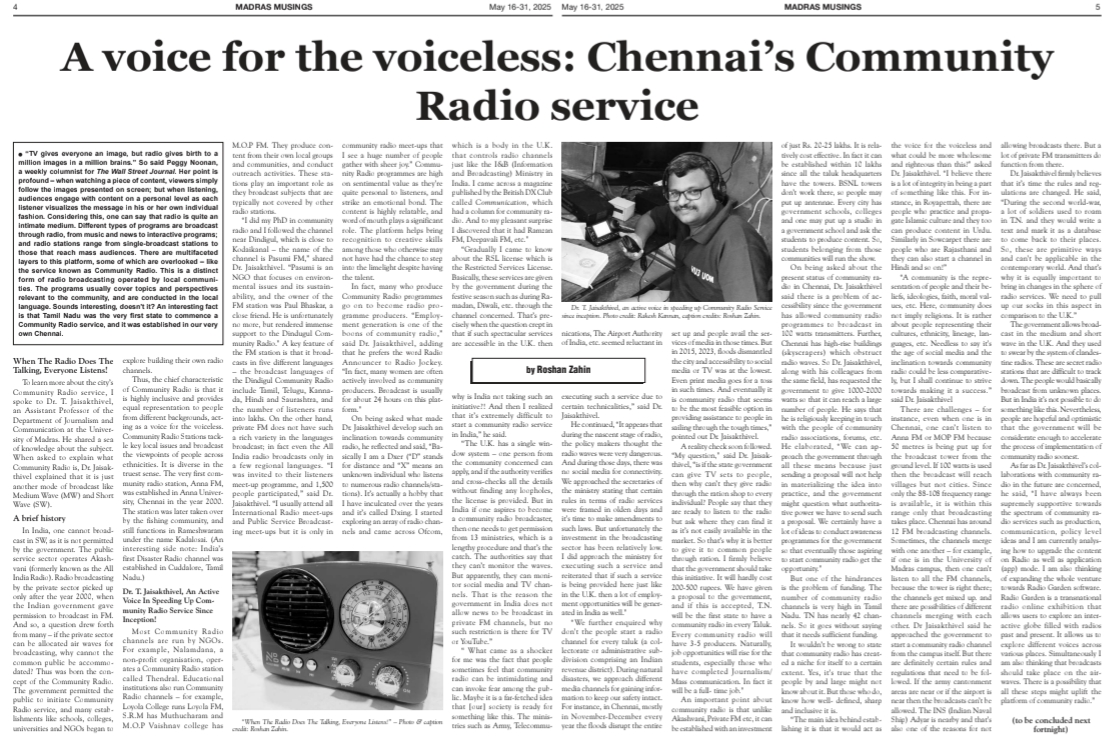
Just read a fascinating article on Community Radio, published by Madras Musings! 


A big thank you to Madras Musings and the author, Roshan Zahin, for shedding light on this important and engaging topic with me. 


It's wonderful to talk more about how community radio serves and connects people right here in our city.


If you'd like to read the full article,

you can find the link below! 👇


https://madrasmusings.com/vol-35-no-3/a-voice-for-the-voiceless-chennais-community-radio-service/


Or download this issue here


https://madrasmusings.com/wp-content/uploads/2025/05/MM-Vol.-XXXV-No.-3.pdf


Saturday, April 05, 2025

Celebrate the Legacy of Wireless Communication Pioneer with Limited Edition Postcards


Postally Postcards Launches Special Set of 7 Cards for Guglielmo Marconi's Birth Anniversary


April 5, 2025 — In celebration of the birth anniversary of Guglielmo Marconi, the inventor of wireless telegraphy and a pioneer of modern radio communication, Postally Postcards proudly unveils a special edition set of 7 uniquely designed postcards. Marconi, born on April 25, 1874, is commemorated globally on his birthday, with the Saturday closest to it observed as International Marconi Day.


Each postcard in this collector’s set features distinctive artwork and historical imagery capturing Marconi’s groundbreaking contributions to wireless communication. Designed to inspire radio enthusiasts, collectors, and history buffs alike, the postcards are both a tribute and a visual journey through Marconi’s revolutionary work.


Set Details:

7 exclusive postcard designs

Price: ₹70 (excluding postage)

Printed by: Postally Postcards


Celebrate the legacy of a true innovator and share the story of Marconi with these beautifully crafted cards — perfect for collectors or as gifts to fellow wireless enthusiasts.


For more details or to place an order, WhatsApp the number mentioned in the poster.


BUY NOW and mark this International Marconi Day with a touch of history.

Stay connected. Celebrate innovation. Postally Postcards